 Ghatkopar (East), Mumbai)

Home > Neonatology > Phototherapy (Neonatal Jaundice)
Phototherapy for Neonatal Jaundice In Mumbai
Safe and Effective Light Therapy for Newborn Jaundice
Neonatal jaundice is one of the most common conditions affecting newborns and requires prompt assessment and treatment when bilirubin levels rise to potentially harmful levels. At Shree Hospitals, our neonatology team provides expert phototherapy using advanced LED light therapy units to safely and effectively reduce hyperbilirubinaemia in newborns, protecting neurological development.
Worried About Your Baby's Jaundice? Get Expert Care Today
Quick facts
Condition Treated: Neonatal Hyperbilirubinaemia (Jaundice)
Treatment Type: LED Phototherapy (Blue Spectrum Light)
Duration: Typically 24 to 72 hours depending on bilirubin levels
Monitoring: Regular bilirubin blood tests during treatment
Hospital Stay: 1 to 5 days (may be managed alongside mother)
Specialist Team: Neonatologists, NICU nurses, paediatric haematology
Key Benefit: Prevents severe jaundice complications including brain damage
What is Phototherapy for Neonatal Jaundice?
Neonatal jaundice (also called neonatal hyperbilirubinaemia) occurs when bilirubin - a yellow pigment produced by the normal breakdown of red blood cells - accumulates in the newborn's blood faster than the immature liver can process and eliminate it. The result is yellowing of the skin and whites of the eyes. While mild jaundice is common and self-limiting, severe or rapidly rising jaundice requires prompt treatment to prevent bilirubin toxicity (kernicterus) which can cause permanent brain damage.
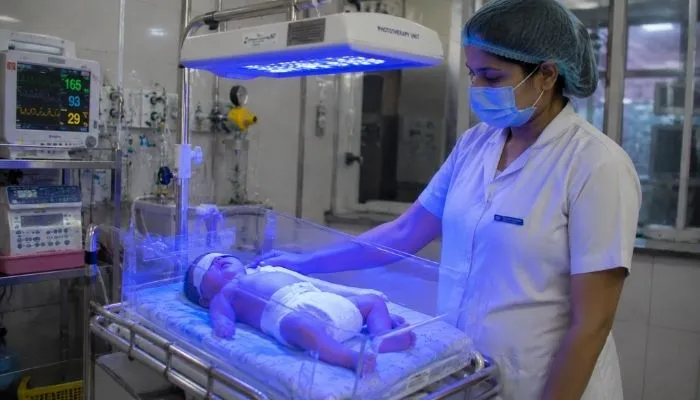
Phototherapy is the first-line treatment for neonatal jaundice requiring intervention. It uses blue-spectrum LED or fluorescent light to convert unconjugated bilirubin in the skin into water-soluble forms that can be excreted by the body without requiring liver conjugation. The baby is placed under a phototherapy lamp (or on a bili-blanket) with eyes protected, and bilirubin levels are monitored through regular blood tests until they fall to a safe level.
At Shree Hospitals, phototherapy is provided in our NICU using modern LED phototherapy units with optimal blue-spectrum output for maximum effectiveness. Our neonatologists follow national guidelines for treatment thresholds based on the baby's age in hours, gestation, and clinical risk factors. Babies are continuously monitored throughout therapy to ensure safe and complete resolution of jaundice.
When Should You Seek Medical Assessment for Jaundice?
When Should You Seek Medical Assessment for Jaundice?
You should seek immediate medical assessment if your newborn has:
- Yellow skin or eyes appearing within 24 hours of birth
- Jaundice spreading below the navel or to the palms and soles
- A high-pitched cry, poor feeding, or unusual drowsiness
- Dark urine or pale chalky stools
- Any risk factors for severe jaundice including prematurity, blood group incompatibility, or bruising
Early assessment prevents dangerous bilirubin accumulation and protects your baby's brain.
Does Your Baby Need Phototherapy?
Phototherapy is recommended when:
- Serum bilirubin levels rise above the treatment threshold for the baby's age and gestation
- Jaundice develops within the first 24 hours of life (always abnormal and requiring investigation)
- The rate of bilirubin rise is rapid regardless of absolute level
- The baby has haemolytic jaundice (due to blood group incompatibility or enzyme deficiency)
- Bilirubin does not fall sufficiently with feeding optimisation alone
Your neonatologist will plot bilirubin on a treatment chart to determine when phototherapy is needed.
Why Prompt Treatment of Jaundice Matters?
Untreated severe neonatal jaundice carries serious risks:
- Kernicterus - bilirubin deposits in the brain causing permanent neurological damage
- Hearing loss from bilirubin toxicity to the auditory pathways
- Cerebral palsy and intellectual disability in severe untreated cases
- Exchange transfusion (a more invasive procedure) may be required if phototherapy is delayed
- Prompt phototherapy at the right threshold prevents all of these complications in the vast majority of cases
Phototherapy is effective in resolving neonatal jaundice in over 95% of cases when started at the appropriate threshold.
At Shree Hospitals, every newborn with jaundice is assessed by our neonatology team using validated bilirubin nomograms to ensure phototherapy is started at the right time, delivering the right light dose to bring bilirubin to a safe level as quickly as possible.
24×7 Emergency Care
Our Approach to Phototherapy and Jaundice Management
At Shree Hospitals, we take a careful, guideline-led approach to neonatal jaundice assessment and treatment. Every baby with jaundice is evaluated by our neonatology team who assess bilirubin levels in the context of the baby's age, gestation, and individual risk factors before making a treatment decision. Our goal is to treat effectively while minimising unnecessary separation of mother and baby.
24×7 Emergency Care
Accurate Jaundice Assessment
All newborns are assessed clinically for jaundice before discharge. Transcutaneous bilirubin (TcB) screening is used as a non-invasive first-line tool. Where levels approach or exceed the threshold, a serum bilirubin blood test is performed and plotted on an age-specific nomogram to determine whether and when to start phototherapy.
High-Intensity LED Phototherapy
We use modern LED phototherapy units delivering high-intensity blue-spectrum light (wavelength 430-490nm) at the skin surface for maximum bilirubin conversion efficiency. Babies receive intensive phototherapy where the clinical situation demands, with regular repositioning to maximise skin surface area exposure and treatment response.
Continuous Monitoring
During phototherapy, bilirubin levels are checked every 6 to 12 hours initially to confirm a satisfactory treatment response. Temperature, hydration, feeding, and nappy output are monitored by our nursing team. The baby's eyes are protected at all times during light therapy with phototherapy eye masks.
Investigation of Underlying Cause
While treating jaundice with phototherapy, our team investigates the cause of jaundice where indicated. Blood group and Coombs testing, G6PD enzyme testing, haematological investigations, and thyroid function may be checked depending on the clinical picture to ensure the underlying cause is identified and managed appropriately.
Top Neonatologists in Mumbai
Every specialist at Shree Hospitals is board-certified and has an average of 15+ years of clinical experience in neonatal intensive care, preterm infant management, and neonatal resuscitation.
24×7 Emergency Care

Dr. Raghav Arora
Consultant Fetal Medicine Specialist
Neonatal and Newborn Care Services at Shree Hospitals
We offer a full range of specialist neonatal services including phototherapy, NICU care, exchange transfusion, surfactant therapy, mechanical ventilation, and total parenteral nutrition, all delivered by expert neonatologists in a dedicated Level III NICU facility.
Step by Step Process of Phototherapy
Step 1 - Jaundice Detection and Bilirubin Assessment
Clinical jaundice is assessed by our nursing and medical team using validated Kramer scoring and transcutaneous bilirubinometry (TcB). If the TcB reading approaches the phototherapy threshold, a serum bilirubin (SBR) blood test is performed and the result plotted on an age-specific treatment nomogram.
Step 2 - Phototherapy Decision and Parent Counselling
When serum bilirubin meets or exceeds the treatment threshold, the neonatologist makes the decision to start phototherapy. Parents are counselled about the reason for treatment, what it involves, the expected duration, and how bilirubin levels will be monitored. Written information is provided.
Step 3 - Setting Up Phototherapy
The baby is placed in a cot or incubator under the LED phototherapy unit with as much skin exposed as possible. Phototherapy eye shields are applied to protect the eyes. The baby's temperature and hydration are checked. The start time and initial bilirubin level are documented.
Step 4 - Treatment Monitoring
Bilirubin levels are checked via blood test every 6 to 12 hours initially, then less frequently as levels fall. Temperature, weight, urine output, and feeding volumes are monitored closely. Parents are encouraged to continue breastfeeding during phototherapy with breaks from the light lamp for feeding and kangaroo care.
Step 5 - Treatment Response and Stopping Phototherapy
Phototherapy is stopped when bilirubin levels fall sufficiently below the treatment threshold. Most babies respond within 24 to 48 hours. A rebound bilirubin check is performed 6 to 12 hours after stopping phototherapy to confirm levels remain stable and are not re-rising.
Step 6 - Discharge and Follow-Up
Once bilirubin levels are satisfactory and the baby is feeding well, discharge is arranged. Parents are given clear instructions on signs of recurrent jaundice to watch for at home. A follow-up appointment is arranged within 48 hours of discharge to recheck bilirubin if clinically indicated.
Parent Questions About Phototherapy and Neonatal Jaundice
Is phototherapy safe for my newborn?
The length of a NICU stay depends entirely on the baby's gestation, birth weight, and clinical condition. Premature babies typically remain in the NICU until close to their original expected due date, often requiring 4 to 16 weeks of care. Babies admitted for shorter-term conditions such as jaundice or mild respiratory difficulties may be discharged within days to a week. Your neonatologist will give you a more specific estimate based on your baby's individual progress.
Can I breastfeed during phototherapy?
Yes. Breastfeeding is actively encouraged and supported during phototherapy. Adequate feeding is important because it helps the bowel excrete bilirubin and prevents dehydration. Your baby will have brief, planned breaks from the phototherapy light for each feeding session. Our lactation team will support you with positioning and technique to ensure effective feeding during this time.
Will my baby need an exchange transfusion?
Exchange transfusion is only required when bilirubin levels are extremely high and have not responded adequately to intensive phototherapy, or when they reach a level where the risk of brain damage (kernicterus) is imminent. This occurs in a small minority of cases. Our team monitors bilirubin levels closely throughout phototherapy to detect any situation where exchange transfusion may be needed and acts promptly to prevent further bilirubin rise.
What causes jaundice in newborns?
Neonatal jaundice has many causes. The most common is physiological jaundice - a normal transitional process as the newborn's liver matures and adjusts to breaking down bilirubin from red cell turnover. Other causes include breast milk jaundice, blood group incompatibility (ABO or Rh), G6PD enzyme deficiency, infection, hypothyroidism, and liver conditions. Our team investigates the underlying cause in all babies requiring phototherapy to ensure the most appropriate management.

Evidence-Based Case Studies by Our Specialists
Would Recommend Us
"My baby turned yellow within hours of birth and I was very scared. The neonatology team at Shree Hospitals started phototherapy immediately and monitored her bilirubin every few hours. Within two days she was clear and we were home. Thank you for catching it so quickly."
Mother of Baby Priya M. (ABO Incompatibility Jaundice)
“When our baby did not breathe at birth, the team acted instantly. The NICU specialists explained everything and kept us informed throughout. She is now a healthy, happy child and we are so thankful for the care she received.”
Parents of Master Rohan T. (Late Preterm Prolonged Jaundice)
“Having twins in the NICU was overwhelming, but the nurses and doctors at Shree Hospitals supported us every single day. Both our boys came home five weeks later and are now thriving. The NICU team are extraordinary.”
Parents of Master Advait K. (G6PD Deficiency Jaundice)
Patient
Resources

Schedule consultation

Billing & Payments

Health Packages

Hospital Facilities
24×7 Emergency Care

1800-268-4000

News & Updates
Shree Hospitals is the first to perform robotic endo surgery.
Shree Hospitals Introduces Advanced Robotic Surgery for Better Patient Care
Shree Hospitals Expands Advanced Surgical Care With Latest Medical Technology
Health Center
Exploring the Future of Telemedicine: What’s Next for Healthcare?
The Rise of Renewable Energy: Innovations in Sustainability
Follow Us

Shree
Hospitals

Shree
Hospitals
