 Ghatkopar (East), Mumbai)


Table Of Content
Patient Resources
Billing, Insurances & Estimates
Admission & Discharge
Visitors’ Rules
International Patients
Hospital Facilities
Health Packges

For Appointment/Query
1800-268-4000

Search or
Find Specialist
Whipple vs Distal Pancreatectomy: Differences, Recovery
- Whipple: for tumours in the head or neck of the pancreas. More complex, with several reconnections.
- Distal pancreatectomy: for tumours in the body or tail. Generally less complex, often with the spleen removed.
- Both are major surgery and need weeks of recovery.
Key takeaways
- Tumour location decides the operation.
- Diabetes can follow either surgery. Enzymes are more often needed after a Whipple.
- Without a spleen, you need a vaccine plan.
- Survival can't be compared between the two operations. It depends on tumour type and stage.

Reviewed By
Shree Hospitals Multi-Speciality Care
Treatment:
Breast Cancer Surgery
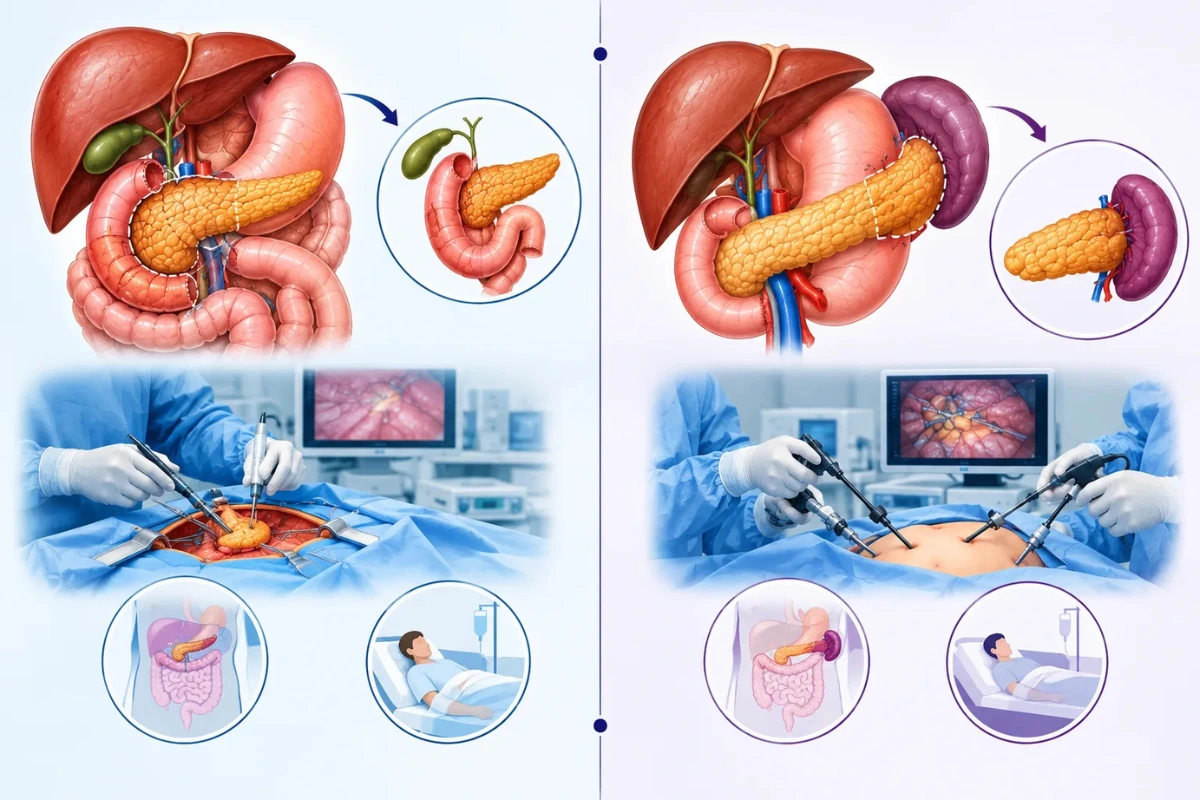
What is the difference between a Whipple and a distal pancreatectomy?
According to OncoLink, a standard Whipple removes the head of the pancreas, gallbladder, bile duct, part of the stomach (pylorus), duodenum and nearby lymph nodes. A distal pancreatectomy removes the left side of the pancreas, the body and tail, and leaves the head, duodenum, gallbladder and bile duct in place.
| Whipple | Distal pancreatectomy | |
|---|---|---|
| Tumour location | Head / neck | Body / tail |
| Spleen | Kept | Often removed |
| Complexity | Higher | Generally lower |
| Typical hospital stay* | About a week | 3 to 5 days (keyhole) |
| Diabetes | Possible, any time | More likely |
| Enzymes | More often needed | Less often needed |
| Main risks | Pancreatic leak, slow stomach emptying | Pancreatic leak, infection risk without spleen |
*Ranges from hospital sources. Your stay depends on the approach, your health and any complications.
Why would I need a Whipple instead of a distal pancreatectomy?
Because of the tumour's position. A Whipple is used for cancers in the head or neck of the pancreas, and it is the most common surgery for pancreatic cancer. A distal pancreatectomy is used more often for tumours in the middle and tail.
Neither operation is only for cancer. A Whipple is also used for pancreatic neuroendocrine tumours. Not every pancreatic cyst needs surgery, and some are watched with scans. Your surgeon will weigh cyst type, size and growth.
Is a distal pancreatectomy easier than a Whipple?
Usually, yes. A distal pancreatectomy is less complicated than a Whipple but is still major surgery. It involves fewer organs and fewer reconnections. "Easier" doesn't mean small, and which one is riskier for you depends on your health, tumour and surgical team.
Why is the spleen removed, and can it be saved?
The spleen sits against the pancreatic tail and shares blood vessels, so surgeons most often remove it too. Removing it also clears nearby lymph nodes in cancer surgery. For benign or precancerous tumours, a spleen-preserving operation may be possible, according to Let's Win Pancreatic Cancer. Ask your surgeon which fits your case.
Open, keyhole or robotic: which approach is used?
Whether surgery is keyhole or robotic depends on the extent of the operation and your surgeon's experience, as noted in this hospital encyclopaedia entry. A keyhole distal pancreatectomy takes about three to four hours, per MedStar Health. A Whipple often takes longer because of the reconnections.
How long is recovery after each surgery?
- Whipple: a stay of about a week, then recovery over several weeks to months, with fatigue often outlasting pain.
- Distal pancreatectomy: a keyhole stay of three to five days.
How long off work? There is no fixed answer. Plan for weeks to months, depending on your job, the operation and any complications. Ask your surgeon for a realistic plan.
What do patients say? In a Mayo Clinic Connect thread, one patient felt laid up for about a week, and lying flat was the hardest part. Another had an 11-day stay and still struggled to lie flat a year and a half later. These are individual stories, not predictions
What are the risks and complications?
- Pancreatic fistula: leakage of pancreatic juice from where the pancreas joins the intestine. It can mean a longer stay or a drain that stays in for weeks, as CION Cancer Clinics explains.
- Delayed gastric emptying: food leaves the stomach slowly, causing nausea and early fullness.
- Bleeding, infection and clots can follow any major abdominal surgery.
When to worry: get urgent help for fever, worsening belly pain, repeated vomiting, wound redness or discharge, yellow skin or eyes, black stools, calf swelling, chest pain or breathlessness.
Will I get diabetes or need enzymes?
Pancreatic Cancer UK says diabetes is more likely after a distal pancreatectomy and digestion problems are less likely than after a Whipple. After a Whipple, diabetes can appear at any time.
After a Whipple, enzyme pills may be prescribed to prevent diarrhoea and help digestion. Signs you may need them include loose, oily stools and weight loss. Ask for a dietitian and a diabetes and endocrinology review.
Can I live a normal life with part of my pancreas removed?
Many people do. After a Whipple, the remaining pancreas keeps making digestive juices and insulin. Expect diet changes, possible enzymes and blood sugar checks. Eat small, frequent meals at first. See our nutrition and dietetics team for a plan.
What vaccines do I need without a spleen?
Extra vaccines are recommended after splenectomy because the spleen supports the immune system. Your doctor will set a schedule based on your age and health. Keep a record, tell any new doctor you have no spleen, and seek care promptly for fever.
Which has the better survival rate?
They can't be compared fairly. The two operations treat different sites and often different stages. Outcomes depend mostly on tumour type, stage and spread. Ask your oncologist about your own situation, not averages. Beware of pages that rank one surgery above the other.
Will I need chemotherapy?
Possibly. Some people have chemotherapy before surgery to shrink a tumour or see how it behaves. Others have it afterwards. Your surgical oncology team will explain the timing based on your tumour.
How much does it cost?
I can't give a reliable figure. Cost depends on the operation, keyhole or robotic approach, room type, length of stay, complications and implants or devices used. Ask for a written estimate that lists inclusions, and check what your insurance covers and whether cashless admission is available.
What should I ask my surgeon?
- Why this operation and not the other?
- Can the spleen be saved, and can it be done keyhole?
- How often does your team do this operation?
- Will I need chemotherapy before or after?
- How likely are enzymes or insulin?
- What vaccines will I need?
- What is the plan if there is a leak?
Pancreatic surgery consultation in Mumbai
Pancreatic surgery is complex, so team experience and support services matter. A surgical gastroenterology or hepatobiliary surgeon can review your scans and explain options. At shree Hospitals , Ghatkopar East , Bring your scans, biopsy results and questions, then book a consultation.
Frequently Asked Question
Is pancreas surgery always for cancer?
No. Cysts and some non-cancer tumours also need surgery sometimes.
Is a Whipple more dangerous?
It is more complex, with a higher chance of digestive problems. Individual risk depends on your health and your team.
Can I exercise after surgery?
Yes, gradually. Start walking early and ask your surgeon when to resume stronger activity.
Do I need blood sugar checks?
Often yes, especially after a distal pancreatectomy.
Can I drive after surgery?
Not until you are off strong pain medicines and can move safely. Ask your surgeon.
Medical disclaimer: This article is for general education. It does not replace diagnosis, advice or treatment from a qualified doctor. Please consult a qualified specialist about your own condition.