 Ghatkopar (East), Mumbai)

Home >Dermatology >Acne Vulgaris
Acne Vulgaris
Acne is the most common skin condition seen by dermatologists worldwide - and the most trivialised. "You'll grow out of it" has delayed appropriate treatment for millions of adolescents who instead developed permanent scarring that no amount of growing out reverses. Acne is a disease of the pilosebaceous unit involving sebum overproduction, follicular plugging, Cutibacterium acnes proliferation, and inflammatory cascade - and it requires a treatment matched to its severity and type.
At Shree Hospitals, our acne treatment in Mumbai is structured around preventing two things: active disease progression and acne scar prevention because scars are the outcome of undertreated or inadequately treated inflammatory acne, not an inevitable consequence of having it.
(24×7 Emergency Care)
Our Approach
(24×7 Emergency Care)
Our Approach in Acne Vulgaris
The two most common acne management failures in India are under-treatment of moderate inflammatory acne with topicals alone, and over-prescription of oral antibiotics without a systemic plan. Our acne specialist dermatologist team in Mumbai, India grades severity formally at every visit, selects treatment matched to that grade, and limits antibiotic duration to the evidence-supported window - because antibiotic resistance in Cutibacterium acnes is a growing clinical problem driven directly by prolonged, inappropriate antibiotic prescribing.
1.Acne Grading & Lesion Classification
Treatment is determined by lesion type and severity - not patient frustration level.
-
- Comedonal acne (Grade I) - open comedones (blackheads), closed comedones (whiteheads); no inflammatory lesions
- Mild inflammatory acne (Grade II) - papules and pustules on a background of comedones; limited to one anatomical area
- Moderate inflammatory acne (Grade III) - multiple papules, pustules, and early nodules; extending across face, chest, or back
- Severe nodulocystic acne (Grade IV) - deep nodules, cysts, confluent lesions; significant scarring risk; isotretinoin for severe acne is the appropriate treatment
- Global Acne Grading System (GAGS) - formal scoring for clinical consistency and response monitoring.
- Topical Therapy - The Backbone of Mild to Moderate Acne
- Retinoids - Tretinoin (0.025–0.05%), Adapalene (0.1–0.3%), Tazarotene; normalise follicular keratinisation; reduce comedone and inflammatory acne; first-line for comedonal and mild inflammatory acne; night use only; photosensitivity counselling
- Benzoyl peroxide - bactericidal; reduces antibiotic resistance when combined with topical antibiotics; 2.5–10% gel or wash; bleaches fabric
- Topical antibiotics - Clindamycin, Erythromycin; never as monotherapy - always combined with BPO to prevent resistance
- Azelaic acid 15–20% - anti-inflammatory, antibacterial, and comedolytic; well-tolerated; safe in pregnancy; reduces post-acne pigmentation
- Adapalene/BPO combination - the most evidence-based topical combination for mild-moderate acne; once-daily fixed-dose formulation
- Topical Ivermectin - emerging for inflammatory acne; particularly useful where Demodex infestation contributes .
3. Oral Antibiotics - Time-Limited & Targeted
Oral antibiotics are indicated for moderate inflammatory acne and as adjunct to topical therapy in severe disease before isotretinoin.
- Doxycycline 100mg daily - first-line; 12-week course maximum; GI side effects reduced by taking with food; photosensitivity counselling
- Lymecycline - less photosensitivity than Doxycycline; alternative in photosensitive patients
- Azithromycin pulse therapy - 3 days per week for 12 weeks; useful where daily Doxycycline is poorly tolerated
- Always combine with BPO or topical retinoid - prevents resistance development
- Never prescribe antibiotics beyond 12 weeks without reassessment - escalate to isotretinoin if inadequate response
4.Hormonal Therapy for Women
- Combined oral contraceptives (COC) - Ethinylestradiol/Cyproterone acetate (Diane-35); Ethinylestradiol/Drospirenone (Yasmin) - reduce androgen-driven sebum production; effective for moderate acne in women
- Spironolactone 50–200mg daily - anti-androgen; particularly effective for jawline and lower face acne in women; potassium monitoring; not in pregnancy
- Indication: women with premenstrual acne flares, late-onset adult acne, and clinical or biochemical evidence of androgen excess
5. Isotretinoin - The Disease-Modifying Treatment
Isotretinoin for severe acne is the only treatment that produces long-term remission - targeting all four pathogenic factors simultaneously.
- Indications: severe nodulocystic acne, moderate acne unresponsive to two courses of oral antibiotics + topicals, acne causing psychological distress or scarring despite moderate treatment
- Dose: 0.5–1mg/kg/day; cumulative dose target 120–150mg/kg for sustained remission
- Duration: typically 6–9 months at standard dosing
- Monitoring: LFTs and lipids at baseline and monthly; CBC; avoid concurrent tetracyclines (pseudotumour cerebri risk)
- Teratogenicity - absolutely contraindicated in pregnancy; two forms of contraception mandatory in women of childbearing age throughout and for 1 month post-treatment
- Mucocutaneous side effects - dry lips (cheilitis), dry eyes, dry skin, epistaxis - managed with emollients, eye drops, and lip balm; almost universal
- Mood monitoring - depression and suicidality reported; baseline mental health assessment and monitoring throughout; not a contraindication in most cases but requires awareness
6. Acne Scar Prevention & Treatment
- Monthly trichoscopy in active disease - tracks yellow dot count (stable follicle reserve), regrowth pattern, and activity markers
- Thyroid function annually - the most common autoimmune comorbidity
- Relapse planning - patients with prior extensive AA are counselled on early re-treatment triggers; JAK inhibitors may need to be continued rather than stopped on achieving response
Happy Patients & Their Case Stories
She had been managing moderate inflammatory acne with three successive courses of antibiotics over 18 months - temporary improvement followed by relapse each time. Scarring was beginning to appear on her cheeks. At Shree Hospitals, acne was graded at GAGS 26 - moderate to severe. Isotretinoin for severe acne was initiated at 0.5mg/kg/day. Cheilitis was managed with heavy emollient lip balm. By month 4, she was clear. At 7 months cumulative dose achieved, she was stopped. At 12-month follow-up, her skin remained clear without any topical or systemic therapy.
Mr. Kavya R.
Presented with persistent melasma unresponsive to hydroquinone — malar and centrofacial mixed pattern on Wood's lamp. Tranexamic acid 250mg twice daily was added to her topical regimen alongside Q-switched Nd:YAG laser toning at monthly intervals. Strict tinted sunscreen use was reinforced. At 9 months, MASI had reduced from 18 to 5. Maintenance tranexamic acid and azelaic acid were continued.
Mr. Kavitha S.
How to Identify Acne Vulgaris ?
Acne is clinically recognisable but the type of lesions present determines the appropriate treatment entirely.
Features identifying acne vulgaris and its severity:
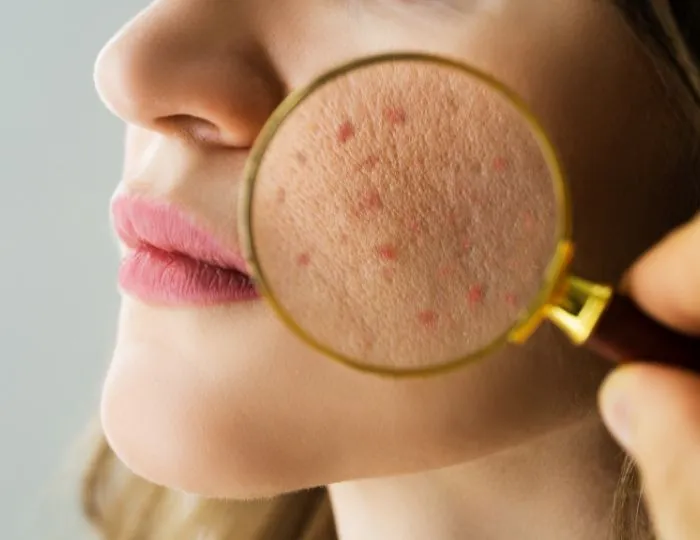
- Comedones - the primary lesion; blackheads (open comedones with oxidised melanin visible) and whiteheads (closed comedones beneath the skin surface) - the starting point of all acne pathology
-
- Papules : small, raised, red inflammatory lesions; comedone and inflammatory acne co-existing indicates progression beyond purely comedonal disease
- Pustules - papules with a visible pus-filled centre; moderate inflammatory acne
- Nodules : deep, painful, solid lesions larger than 5mm; scarring risk significantly elevated at this stage
- Cysts : fluctuant, pus-containing lesions; the highest scarring risk; require urgent isotretinoin evaluation
- Distribution face (especially central face and jawline in adult acne), chest, upper back, and shoulders - the sebaceous gland-rich anatomical sites
- Post-acne marks : erythematous or hyperpigmented flat marks at resolved lesion sites; not scars, but precursors if new lesions continue forming
Important FAQs: Acne Vulgaris
At what point should isotretinoin be started?
Severe nodulocystic acne warrants isotretinoin at first presentation. Moderate acne failing two adequate courses of oral antibiotics combined with topical therapy warrants escalation to isotretinoin - without a third antibiotic course.
Does diet cause acne?
High-glycaemic-index diets and dairy consumption - particularly skim milk have evidence supporting acne aggravation. Eliminating these is a useful adjunct to treatment but not a substitute for pharmacological therapy in moderate to severe acne.
Is isotretinoin safe?
When monitored appropriately, isotretinoin is one of the most effective and safe medications in dermatology. The teratogenicity concern is absolute - but with reliable contraception, it is fully manageable. Long-term safety data over decades are reassuring.
Can adults get acne?
Yes, adult acne is increasingly common, particularly in women. Hormonal fluctuations, stress, diet, and cosmetic use all contribute. Adult acne often requires a different treatment approach including hormonal therapy.
Does sunscreen worsen acne?
Comedogenic sunscreens worsen acne. Non-comedogenic, lightweight, gel or fluid formulations are well-tolerated. SPF is mandatory during retinoid and antibiotic therapy the risk of avoiding sun protection far exceeds the risk of a correctly formulated sunscreen.
Treatments For Acne Vulgaris At Shree Hospitals
Comprehensive acne vulgaris diagnosis and management in Mumbai from topical retinoids to isotretinoin and scar treatment.
Top Acne & Dermatology Specialists in Mumbai

Dr. Snehal Thank
Pioneer Pediatric Physiotherapist & Neuro-Developmental
Dr. Yogesh Kalyanpad
Dermatology, Cosmetology and Hair Transplant
Every doctor and specialist at Shree Hospitals is board-certified and brings an average of 15 or more years of clinical experience in their area of subspecialty.

For Appointment/Query
1800-268-4000

Tele consultation/2nd Opinion
Schedule Consultation

News & Updates
Shree Hospitals is the first to perform robotic endo surgery.
Shree Hospitals Introduces Advanced Robotic Surgery for Better Patient Care
Shree Hospitals Expands Advanced Surgical Care With Latest Medical Technology


