 Ghatkopar (East), Mumbai)

Home >Dermatology > Psoriasis
Psoriasis Treatment in Mumbai
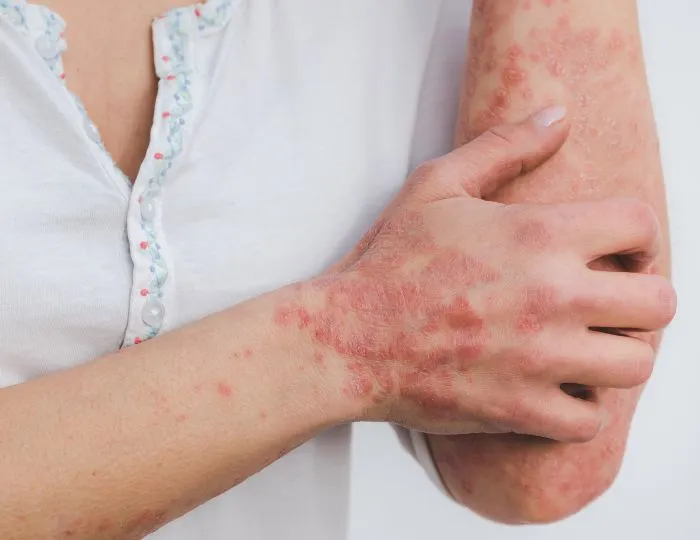
Psoriasis is not a skin allergy, and it is not contagious. That needs to be said clearly because in India, the social stigma attached to visible psoriatic plaques causes as much damage as the disease itself. Psoriasis is a chronic immune-mediated condition where the skin cell cycle is accelerated dramatically cells that normally renew over 28 days are replaced in 3 to 4 days, building up into the thick, scaly, inflamed plaques that define the condition. It affects joints, nails, and psychological wellbeing not just skin.
At Shree Hospitals, our psoriasis treatment in Mumbai is structured around the full picture: disease severity, body surface area involvement, joint assessment, quality of life impact, and the patient's own treatment goals. A person living with psoriasis deserves more than a topical steroid and a follow-up in three months.
(24×7 Emergency Care)
Our Approach
(24×7 Emergency Care)
Our Approach in Managing Psoriasis
Shree Hospitals — Life-saving care
Psoriasis management has more treatment options available today than at any point in its history and choosing the right one requires knowing precisely what type of psoriasis the patient has, how severe it is, where it is located, what has been tried before, and what comorbidities coexist. Our psoriasis specialist dermatologist team in Mumbai, India builds this picture at the first visit and builds a treatment plan that matches it not a generic step-therapy ladder applied without context.
- Clinical Assessment & Disease Severity Scoring
- PASI (Psoriasis Area and Severity Index) quantifies erythema, induration, scaling, and body surface area involvement; PASI >10 = moderate to severe
- BSA (Body Surface Area) percentage of skin involved; >10% = significant disease burden
- DLQI (Dermatology Life Quality Index) quantifies the impact on daily function, relationships, and psychological health; often the most important number
- Clinical typing: plaque psoriasis (most common, 85–90%), guttate, inverse, erythrodermic, pustular
- Nail psoriasis assessment pitting, onycholysis, oil-drop sign; present in 50% of patients; associated with psoriatic arthritis
- Joint examination psoriatic arthritis affects up to 30% of psoriasis patients; early detection prevents joint destruction
- Topical Therapy — First Line for Mild Disease
- High-potency corticosteroids (Clobetasol, Betamethasone) first-line for localised plaques; potency matched to body site; face and flexures require lower potency
- Vitamin D analogues (Calcipotriol, Calcitriol) anti-proliferative; combined with corticosteroids in fixed-dose formulations (Calcipotriol/Betamethasone gel) for superior efficacy
- Coal tar anti-inflammatory and anti-proliferative; effective for scalp and chronic thick plaques; cosmetically limiting
- Calcineurin inhibitors (Tacrolimus, Pimecrolimus) for facial and intertriginous psoriasis where steroids carry atrophy risk
- Keratolytics (Salicylic acid) reduces skin cell buildup in thick hyperkeratotic plaques; facilitates penetration of other topicals
- Tazarotene retinoid; effective for plaque thinning; teratogenic contraception counselling mandatory
- Phototherapy
- Narrowband UVB (NB-UVB) the most widely used phototherapy modality; effective in plaque and guttate psoriasis; 2–3 sessions per week for 6–12 weeks; clearance rates 70–80%
- PUVA (Psoralen + UVA) for thick resistant plaques; oral or topical psoralen sensitiser + UVA exposure; higher cumulative dose limitations due to carcinogenicity concerns
- Targeted phototherapy (Excimer laser) for localised resistant plaques; high-intensity 308nm UVB to small areas; avoids radiation to uninvolved skin
- Systemic Therapy for Moderate to Severe Disease
- Methotrexate first line systemic agent; weekly oral or SC injection; monitoring: LFTs, CBC, renal function; hepatotoxicity risk with cumulative dose; contraindicated in conception (both sexes washout required)
- Cyclosporine rapid onset; useful for acute severe psoriasis flares and erythrodermic psoriasis; BP and renal monitoring; limited to 1–2 years continuous use
- Acitretin oral retinoid; most effective for pustular and erythrodermic psoriasis; teratogenic for 2 years post-treatment limited use in women of childbearing age
- Apremilast oral PDE4 inhibitor; modest efficacy; useful when biologics are not accessible; good safety profile; GI side effects initially
5. Biologic Therapy — The Paradigm Shift
Biologic therapy for psoriasis has transformed outcomes for moderate to severe disease producing PASI 90 and PASI 100 (near-complete and complete clearance) in most patients.
- IL-17A inhibitors (Secukinumab, Ixekizumab) fastest onset of action; highest clearance rates at week 16; superior for nail and scalp psoriasis
- IL-23 inhibitors (Guselkumab, Risankizumab, Tildrakizumab) quarterly dosing after induction; durable remission; highest long-term PASI 90/100 rates
- IL-12/23 inhibitor (Ustekinumab) 12-weekly dosing; well-established safety profile; effective in psoriatic arthritis also
- TNF-alpha inhibitors (Adalimumab, Etanercept, Infliximab) older biologics; effective; particularly useful in psoriatic arthritis
- Selection based on: disease pattern, concomitant arthritis, prior biologic exposure, comorbidities (inflammatory bowel disease, recurrent infections), and dosing interval preference
Happy Patients & Their Case Stories
He had lived with plaque psoriasis for 11 years — managed intermittently with topical steroids that provided temporary relief but never sustained clearance. PASI was 18 at first assessment, DLQI was 21. He was started on Methotrexate for 6 months with inadequate response. Biologic therapy for psoriasis was initiated with Secukinumab. At week 16, his PASI had reduced to 1.2 — PASI 90 response.
Mr. Ramesh S.
A teacher who came to us with guttate psoriasis appearing after a streptococcal throat infection. Multiple small drop-shaped plaques covered her trunk and limbs. Throat culture confirmed Group A Streptococcus. She received antibiotics for the throat infection, a course of narrowband UVB phototherapy twice weekly for 10 weeks, and topical calcipotriol. Complete clearance was achieved.
Mrs.Sunita P.,
How to Identify Psoriasis ?
Psoriasis has a clinical appearance distinct enough that an experienced dermatologist can diagnose it on examination alone in most cases.
Features that point clearly to psoriasis:
- Well-defined, raised, red plaques covered with thick silvery-white scales most commonly on elbows, knees, scalp, and lower back
- Auspitz sign pinpoint bleeding when scales are scraped off a plaque
- Nail changes pitting, thickening, separation from the nail bed (onycholysis), or salmon-patch discolouration
- Skin cell buildup at sites of friction or trauma the Koebner phenomenon; lesions appearing at scratch lines, scars, or sun-exposed skin
- Itching that is variable some patients have intense itch, others have none; absence of itch does not rule out psoriasis
- Family history psoriasis has a strong genetic component; 30% of patients have a first-degree relative with the condition
- Joint involvement asymmetric, small joint pain with skin disease; dactylitis (sausage digit); enthesitis
The key distinction from eczema which psoriasis is most commonly confused with is the nature of the scale (thick, silvery, and adherent in psoriasis versus thin, excoriated, and weeping in eczema) and the lesion border (sharply defined in psoriasis, poorly defined in eczema). A skin biopsy settles the question when clinical assessment is uncertain. Seek psoriasis treatment in Mumbai from a dermatologist who assesses severity formally, checks for joint disease, and offers the full range of therapeutic options not just topicals.
Important FAQs: Psoriasis
Is psoriasis contagious?
Absolutely not. Psoriasis is an immune-mediated condition — not an infection. It cannot spread through touch, shared clothing, water, or any form of contact
Can psoriasis be permanently cured?
There is currently no permanent cure. However, biologic therapy produces sustained near-complete clearance in most patients, and remission periods of years are achievable with maintenance therapy.
Does diet affect psoriasis?
Obesity worsens psoriasis and reduces biologic response rates — weight management is clinically meaningful. A Mediterranean diet pattern has the most consistent evidence for modestly reducing psoriasis severity.
Is psoriasis linked to other health conditions?
Yes — psoriasis is associated with psoriatic arthritis, metabolic syndrome, cardiovascular disease, inflammatory bowel disease, and depression. Screening for these comorbidities is part of comprehensive psoriasis care.
How long does it take for biologic therapy to work?
Most IL-17 and IL-23 inhibitors produce visible improvement within 4 weeks and near-complete clearance (PASI 90) by week 16. Some patients achieve PASI 100 — completely clear skin by week 12.
Can children develop psoriasis?
Yes — approximately one-third of psoriasis cases begin before age 20. Guttate psoriasis is particularly common in children following streptococcal infections. Treatment options are adapted to paediatric dosing and safety profiles.
Treatments For Psoriasis
Treatments for Psoriasis at Shree Hospitals. Comprehensive plaque psoriasis diagnosis and management in Mumbai from topical therapy to biologic infusion.
Biologic Therapy — IL-17 & IL-23 Inhibitors Biologic therapy for psoriasis
Secukinumab, Ixekizumab, Guselkumab, Risankizumab — producing PASI 90 and PASI 100 clearance in the majority of moderate to severe patients. Individually selected based on disease pattern, arthritis status, and comorbidities.
Treatments for Psoriasis Specialists in Mumbai

Dr. Snehal Thank
Pioneer Pediatric Physiotherapist & Neuro-Developmental
Dr. Yogesh Kalyanpad
Dermatology, Cosmetology and Hair Transplant
Every doctor and specialist at Shree Hospitals is board-certified and brings an average of 15 or more years of clinical experience in their area of subspecialty.

For Appointment/Query
1800-268-4000

Tele consultation/2nd Opinion
Schedule Consultation

News & Updates
Shree Hospitals is the first to perform robotic endo surgery.
Shree Hospitals Introduces Advanced Robotic Surgery for Better Patient Care
Shree Hospitals Expands Advanced Surgical Care With Latest Medical Technology


