 Ghatkopar (East), Mumbai)

Home > ENT (Otorhinolaryngology) > Myringotomy (Grommets)
Myringotomy (Grommets) In Mumbai
Safe and Effective Ventilation Tube Insertion for Glue Ear and Recurrent Ear Infections
Myringotomy is a small surgical procedure in which a tiny incision is made in the eardrum (tympanic membrane) to drain fluid from the middle ear and insert a ventilation tube (grommet). At Shree Hospitals, our specialist ENT surgeons perform myringotomy and grommet insertion for children and adults suffering from glue ear (otitis media with effusion), recurrent acute otitis media, and eustachian tube dysfunction, restoring hearing, reducing ear infections, and improving quality of life.
Glue Ear or Recurrent Ear Infections? Consult Our ENT Specialist Today
Quick facts
Procedure Type: Myringotomy with Ventilation Tube (Grommet) Insertion
Hospital Stay: Day case (same day discharge in most cases)
Duration: 10 to 15 minutes
Type of Anesthesia: General Anaesthesia
Tube Duration: Grommets stay in for 6 to 18 months then fall out naturally
Support Team: ENT surgeons, audiologists, paediatric anaesthetists
Key Benefit: Restores hearing, prevents recurrent ear infections, relieves middle ear fluid
What is Myringotomy and Grommet Insertion?
Myringotomy is the surgical creation of a small incision in the eardrum (tympanic membrane) to access the middle ear space. When the eustachian tube (the channel connecting the middle ear to the back of the throat) fails to function normally, fluid accumulates in the middle ear causing hearing loss, ear discomfort, and susceptibility to recurrent infection. Grommet insertion (ventilation tube) at the time of myringotomy provides a bypass channel that aerates the middle ear and allows fluid to drain.
Grommets (also called ventilation tubes or tympanostomy tubes) are tiny hollow tubes approximately 1 to 2mm in diameter that sit in the eardrum and keep the myringotomy incision open. They allow air to pass into the middle ear, equalising pressure and preventing fluid accumulation. In children, grommets are the most commonly performed surgical procedure and are used primarily for glue ear (otitis media with effusion, OME) causing conductive hearing loss and recurrent acute otitis media that has not responded to conservative management.
At Shree Hospitals, myringotomy and grommet insertion is performed by our specialist ENT surgeons under the operating microscope using short-acting general anaesthesia in children (typically taking 10 to 15 minutes) and under local anaesthesia in cooperative adults. Short-term Shah grommets remain in the eardrum for 6 to 12 months before naturally extruding. Long-term T-tubes are used in cases requiring prolonged middle ear ventilation such as those associated with cleft palate or chronic eustachian tube dysfunction.
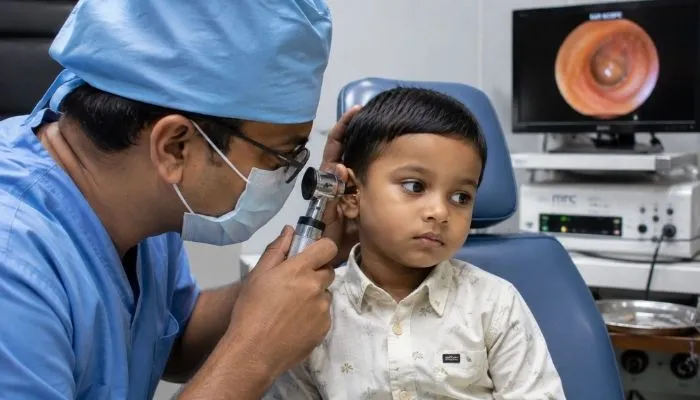
When Should You Consult an ENT Surgeon About Ear Fluid or Infections?
You should seek specialist evaluation if your child or you experience:
- Hearing loss or muffled hearing, particularly if fluctuating
- Your child has speech or language delay that may be related to hearing loss from glue ear
- 3 or more episodes of acute otitis media (middle ear infections) in 6 months
- Persistent ear fluid (glue ear) for more than 3 months confirmed on audiometry or tympanometry
- Ear discomfort, popping, or fullness related to eustachian tube dysfunction
Is Myringotomy and Grommet Insertion Right for Your Child or You?
Myringotomy with grommets is recommended if:
- Persistent bilateral glue ear with associated conductive hearing loss of 25dB or more on audiometry has been present for more than 3 months
- Recurrent acute otitis media is causing frequent antibiotic courses, missed school, or disrupted family life
- Hearing loss from glue ear is impacting speech development, learning, or behaviour in a child
- Eustachian tube dysfunction is causing significant ear pressure, pain, or difficulty equalising during flying
- Adenoid hypertrophy contributing to recurrent ear disease is to be addressed simultaneously
Why Treating Glue Ear Matters for Your Child's Development?
Untreated glue ear and recurrent ear infections can have significant consequences:
- Conductive hearing loss during the critical period of speech and language development can cause lasting delays
- Learning difficulties and poor school performance attributable to persistent hearing loss
- Behavioural problems in children from the frustration of not hearing clearly
- Recurrent acute ear infections causing pain, fever, and missed schooling
- Grommets provide rapid hearing improvement and break the cycle of recurrent infection
Grommet insertion restores normal hearing in children with glue ear in over 90% of cases immediately after the procedure.
At Shree Hospitals, our ENT surgical team performs myringotomy and grommet insertion as a safe, quick day-case procedure that provides immediate relief from the hearing loss and ear discomfort of chronic middle ear fluid, with most children experiencing dramatic improvement in hearing on the same day as surgery.
24×7 Emergency Care
Our Approach to Myringotomy and Grommet Insertion at Shree Hospitals
At Shree Hospitals, myringotomy is recommended only after thorough audiological assessment and clinical evaluation confirming the indications. Our ENT team ensures each family receives a clear explanation of the procedure, what to expect, and how to care for the ear post-operatively, including water precautions and signs of grommet blockage or early extrusion.
24×7 Emergency Care
Full Audiological and Tympanometric Assessment
Every patient undergoes pure tone audiometry (or visual reinforcement audiometry for young children) and tympanometry before surgery is recommended. Type B tympanograms confirm the presence of middle ear fluid. The degree of conductive hearing loss and its impact on speech, learning, and quality of life are assessed to confirm the surgical indication.
Adenoid Assessment and Combined Procedures
In children with recurrent ear disease, our ENT surgeon assesses whether enlarged adenoids are contributing to eustachian tube obstruction and recurrent middle ear infection. Where adenoid hypertrophy is confirmed, adenoidectomy at the same sitting as grommet insertion significantly reduces the risk of recurrent glue ear and further grommet requirement compared to grommets alone.
Precise Myringotomy and Grommet Insertion
Myringotomy is performed under operating microscope magnification through the ear canal. A precise radial incision is made in the anteroinferior quadrant of the eardrum (the safest anatomical position). Fluid is suctioned from the middle ear. The grommet is positioned in the incision with micro-forceps and confirmed to be seated correctly. The procedure takes only 10 to 15 minutes per ear.
Post-Operative Guidance and Follow-Up
After grommet insertion, families receive clear written instructions on water precautions (whether to use ear plugs during bathing depends on individual surgeon preference - we provide tailored guidance). Post-operative audiometry at 6 to 8 weeks confirms the expected improvement in hearing. Grommets are monitored at regular clinic visits until they naturally extrude (typically at 6 to 18 months for short-term grommets).
Top ENT Surgeons in Mumbai
Every specialist at Shree Hospitals is board-certified and has an average of 15+ years of clinical experience in rhinology, endoscopic sinus surgery, and nasal reconstruction.
24×7 Emergency Care

Dr. Kaustubh Sarvade
ENT / Otorhinolaryngology, Head & Neck
Dr. Sunil Tanvar
ENT & Rhinoplasty Surgery, Head & Neck Surgery
Dr. Kaushal G. Sheth
Consultant ENT & Head Neck Surgeon

Dr. Ritu K. Sheth
ENT and Head-Neck Oncosurgeon
ENT Surgical & Medical Services at Shree Hospitals
We offer a full range of ENT surgical and medical services including tonsillectomy, adenoidectomy, FESS for sinusitis, septoplasty, tympanoplasty, cochlear implant, microlaryngoscopy, and myringotomy, all delivered by expert ENT surgeons.
FESS (Functional Endoscopic Sinus Surgery)
Minimally invasive endoscopic surgery for chronic sinusitis, nasal polyps, and sinus blockages. Our ENT surgeons use advanced high-definition endoscopes to restore normal sinus drainage and improve nasal breathing without external incisions.
Step by Step Process of Myringotomy and Grommet Insertion at Shree Hospitals
ENT Consultation and Ear Assessment
1.) Your ENT specialist performs a full history and examination of the ear including otoscopy or otomicroscopy to assess the eardrum and detect the characteristic amber or dull appearance of fluid behind the eardrum. The child's hearing, speech development, infection frequency, and quality of life impact are all assessed to confirm the indication for grommet insertion.
2.) Audiological Testing- Pure tone audiometry
(or visual reinforcement audiometry for children under 4 years) and tympanometry are performed to objectively document the degree of conductive hearing loss and confirm the presence of middle ear fluid (Type B tympanogram). The results are used both to confirm the surgical indication and to provide a baseline for post-operative improvement.
3.) Anaesthetic Consultation and Pre-Operative Preparation
The anaesthetic team assesses the child's fitness for general anaesthesia. Parents receive clear information about what to expect on the day of surgery including fasting requirements, the procedure itself, and the expected recovery. Any questions about water precautions or post-operative care are addressed. Consent is obtained from parents or guardians.
4.) General Anaesthesia (or Local Anaesthesia in Adults)
In children, general anaesthesia is induced quickly and maintained with inhalational agents for the brief duration of the procedure. Children typically wake within minutes of the procedure being completed. In cooperative adults, local anaesthetic ear drops or infiltration can be used to perform myringotomy as a clinic or day-case procedure under local anaesthesia.
5.) Myringotomy and Grommet Insertion
Under operating microscope magnification, the ear canal is cleaned and the eardrum is inspected. A precise radial incision is made in the anteroinferior quadrant of the eardrum using a myringotomy knife. Thick mucoid fluid ("glue") is suctioned from the middle ear. The grommet is grasped with alligator forceps and placed into the myringotomy incision, which holds it in position without sutures. Correct positioning is confirmed. The procedure takes 10 to 15 minutes per ear.
6.) Recovery and Post-Operative Care
Children wake quickly from general anaesthesia and are usually ready to go home within 1 to 2 hours of the procedure. Parents are given written instructions on water precautions, recognition of grommet blockage (muffled hearing or return of symptoms), and management of any ear discharge (which can occur in the first days after insertion and is usually treated with antibiotic ear drops). A follow-up appointment is booked at 6 to 8 weeks for post-operative audiometry to confirm hearing improvement.
Patient Questions About Myringotomy and Grommets
Can my child swim with grommets?
The evidence on water precautions with grommets has evolved significantly. Current guidelines from major ENT bodies including ENT UK indicate that swimming in clean water (pools, sea) is generally safe for children with grommets without ear plugs, and that routine bathing and hair washing do not require plugging. However, diving, underwater swimming, and exposure to soapy or dirty water should be avoided. Individual surgeons may have specific preferences, and our team will provide you with tailored guidance at the time of your child's procedure.
How long do grommets stay in?
Standard short-term Shah grommets naturally extrude from the eardrum after 6 to 18 months in most children. The eardrum heals over as the grommet works its way out and is usually found in the ear canal on examination or may simply fall out unnoticed. Long-term T-tubes (used when prolonged ventilation is needed) can stay in for several years before requiring surgical removal. Your ENT surgeon will tell you which type of grommet was inserted and what the expected duration is.
What happens if glue ear comes back after grommets fall out?
If glue ear returns after the initial grommets extrude, a second set of grommets may be recommended, particularly in children who still have significant hearing impact or recurrent infections. In this situation, adenoidectomy (if not already performed) is strongly considered at the same time as a second grommet insertion, as evidence shows it significantly reduces the likelihood of further recurrence. Some children will have naturally improved eustachian tube function by the time their first grommets extrude and will not need further intervention.
Is grommet insertion painful?
Myringotomy and grommet insertion is not painful. In children, it is performed under general anaesthesia and takes only 10 to 15 minutes. Most children are surprised at how quick and straightforward the recovery is. Some children experience mild ear discomfort or irritability for a day or two after surgery, managed with standard paracetamol. Many parents report that their child's hearing improvement is immediately noticeable when they wake from anaesthesia, which is a very rewarding outcome.

Evidence-Based Case Studies by Our Specialists
Would Recommend Us
"Our daughter's hearing was so muffled she was falling behind in her speech. After grommets and adenoid removal at Shree Hospitals, she could hear clearly the same day she woke up. Her speech has caught up completely in just a few months. We wished we had done it sooner."
Miss Priya R.
"Our son was on antibiotics almost every month and missing school constantly with ear infections. After grommets at Shree Hospitals, he has not had a single ear infection in a year. The difference has been life-changing for the whole family."
Mr. Arjun K.
"I had constant pressure in my ears and could not fly without severe pain. My ENT at Shree Hospitals inserted grommets under local anaesthetic and the relief was immediate. I can now fly without any problem and the ear pressure has completely resolved."
Mr. Sandeep V.
Patient
Resources

Schedule consultation

Billing & Payments

Health Packages

Hospital Facilities
24×7 Emergency Care

1800-268-4000

News & Updates
Shree Hospitals is the first to perform robotic endo surgery.
Shree Hospitals Introduces Advanced Robotic Surgery for Better Patient Care
Shree Hospitals Expands Advanced Surgical Care With Latest Medical Technology
Health Center
Exploring the Future of Telemedicine: What’s Next for Healthcare?
The Rise of Renewable Energy: Innovations in Sustainability
Follow Us

Shree
Hospitals

Shree
Hospitals
