 Ghatkopar (East), Mumbai)

Home > ENT (Otorhinolaryngology) > Tonsillectomy and Adenoidectomy
Tonsillectomy and Adenoidectomy In Mumbai
Expert Surgical Removal of Tonsils and Adenoids for Children and Adults
Tonsillectomy (surgical removal of the tonsils) and adenoidectomy (surgical removal of the adenoids) are among the most commonly performed ENT procedures in both children and adults. At Shree Hospitals, our experienced ENT surgeons perform these procedures safely and effectively for patients suffering from recurrent tonsillitis, obstructive sleep apnoea, snoring, and chronic adenoid hypertrophy affecting breathing and quality of life.
Recurrent Throat Infections? Consult Our ENT Specialists Today
Quick facts
Procedure Type: Surgical Removal of Tonsils and/or Adenoids
Hospital Stay: Typically 1 to 2 days
Recovery Time: 7 to 14 days
Type of Anesthesia: General Anaesthesia
Incisions: None (all surgery performed through the nostrils)
Support Team: ENT surgeons, anaesthetists, endoscopy nurses
Key Benefit: Eliminates recurrent tonsillitis, improves breathing and sleep quality.
What is Tonsillectomy and Adenoidectomy?
The tonsils are two oval-shaped pads of lymphatic tissue at the back of the throat and the adenoids are a patch of lymphatic tissue at the back of the nasal passage. Both are part of the immune system and help fight infections in childhood. However, when they become chronically enlarged or repeatedly infected, they can cause more harm than benefit and surgical removal is recommended.
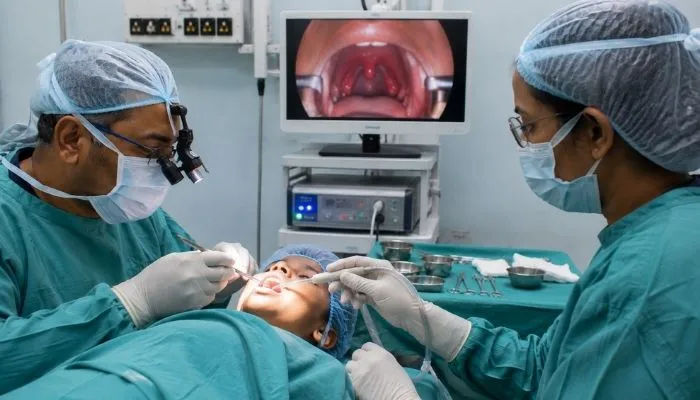
A tonsillectomy involves the complete surgical removal of both tonsils through the mouth, under general anaesthesia. An adenoidectomy involves the removal of the adenoid tissue at the back of the nasal cavity, also performed under general anaesthesia through the mouth without any external incisions. The two procedures are frequently performed together as a combined tonsillectomy and adenoidectomy (T and A) when both structures are causing problems.
At Shree Hospitals, tonsillectomy and adenoidectomy are performed by our experienced ENT surgical team using modern surgical techniques including cold steel dissection, bipolar diathermy, and coblation (radiofrequency ablation) to minimise blood loss and post-operative pain. Our dedicated paediatric ENT capability ensures children receive age-appropriate care in a reassuring and supportive environment.
When Should You Consult an ENT Surgeon About Tonsils?
You should seek specialist evaluation if you have:
- 7 or more episodes of tonsillitis in one year, or 5 or more episodes per year for 2 consecutive years
- Tonsils causing difficulty swallowing or significantly affecting eating
- Snoring and breathing pauses during sleep suggesting obstructive sleep apnoea
- A peritonsillar abscess (quinsy) which may recur
- Enlarged adenoids causing persistent nasal obstruction, mouth breathing, or glue ear
Is Tonsillectomy the Right Choice for You or Your Child?
Surgery is typically recommended when:
- Recurrent tonsillitis meets the clinical frequency threshold despite medical management
- Obstructive sleep apnoea is confirmed on clinical assessment or sleep study
- Tonsillar hypertrophy is causing significant obstruction to swallowing or breathing
- A unilateral enlarged tonsil requires removal for histological assessment
- Adenoid hypertrophy is causing nasal obstruction, snoring, or contributing to recurrent otitis media with effusion (glue ear)
Why Tonsillectomy Transforms Quality of Life?
For patients with recurrent tonsillitis or significant tonsil obstruction:
- Eliminates recurrent throat infections and reduces antibiotic use
- Resolves obstructive sleep apnoea and snoring, dramatically improving sleep quality
- Improves energy levels, concentration, and school or work performance
- Allows normal eating and swallowing when tonsils were previously obstructive
- For children, early surgery can dramatically improve growth, behaviour, and development
Tonsillectomy reduces the frequency of throat infections by over 85% in patients with recurrent tonsillitis.
At Shree Hospitals, our ENT surgical team performs tonsillectomy and adenoidectomy using modern techniques that minimise blood loss and post-operative pain, allowing most patients to return to normal diet and activities within 10 to 14 days.
24×7 Emergency Care
Our Approach to Our Approach to Tonsillectomy and Adenoidectomy at Shree Hospitals
At Shree Hospitals, we take a careful, patient-centred approach to tonsillectomy and adenoidectomy. Our ENT surgeons assess each patient individually and recommend surgery only when the clinical indications are clearly met. We use modern surgical techniques that prioritise safety, minimal blood loss, and the most comfortable possible recovery.
24×7 Emergency Care
Thorough Pre-Operative Assessment
Every patient undergoes a full ENT examination including assessment of tonsil size, adenoid assessment (via nasal endoscopy or X-ray in children), and review of the frequency and severity of infections. For patients with snoring or breathing pauses, overnight oximetry or formal sleep study is performed to document obstructive sleep apnoea.
Modern Surgical Technique
We use bipolar diathermy and coblation (radiofrequency tonsillectomy) techniques that significantly reduce intra-operative bleeding and are associated with less post-operative pain and faster recovery compared to traditional cold steel dissection. Technique selection is tailored to the individual patient.
Safe Paediatric Anaesthesia
Children undergoing tonsillectomy and adenoidectomy at Shree Hospitals receive care from experienced paediatric anaesthetists using age-appropriate anaesthetic protocols. Our theatre and nursing team create a calm, child-friendly environment to reduce pre-operative anxiety.
Comprehensive Post-Operative Care
After surgery, patients are monitored for bleeding - the most important post-operative complication - and given clear written instructions on pain management, diet progression, and warning signs requiring immediate return to hospital. A follow-up clinic appointment is arranged at 2 to 4 weeks to confirm full recovery.
Top ENT Surgeons in Mumbai
Every specialist at Shree Hospitals is board-certified and has an average of 15+ years of clinical experience in rhinology, endoscopic sinus surgery, and nasal reconstruction.
24×7 Emergency Care

Dr. Kaustubh Sarvade
ENT / Otorhinolaryngology, Head & Neck
Dr. Sunil Tanvar
ENT & Rhinoplasty Surgery, Head & Neck Surgery
Dr. Kaushal G. Sheth
Consultant ENT & Head Neck Surgeon

Dr. Ritu K. Sheth
ENT and Head-Neck Oncosurgeon
ENT Surgical & Medical Services at Shree Hospitals
We offer a full range of ENT surgical and medical services including tonsillectomy, adenoidectomy, FESS for sinusitis, septoplasty, tympanoplasty, cochlear implant, microlaryngoscopy, and myringotomy, all delivered by expert ENT surgeons.
Step by Step Process of Tonsillectomy and Adenoidectomy at Shree Hospitals
ENT Consultation and Clinical Assessment
Your ENT specialist takes a full history of throat infection frequency, severity, and impact on quality of life. Tonsil size is graded (1 to 4) and adenoid tissue is assessed. The indications for surgery are confirmed against clinical guidelines and the procedure is explained in detail to the patient and family.
Pre-Operative Investigations
Standard blood tests including full blood count and clotting screen are performed to confirm fitness for surgery. Anaesthetic assessment is completed. Any blood-thinning medications are stopped in advance as advised. Nasal steroid spray may be prescribed if adenoid hypertrophy is significant.
Anaesthesia and Theatre Preparation
Tonsillectomy and adenoidectomy is performed under general anaesthesia. The patient is positioned supine with the neck extended and a mouth gag is inserted to expose the tonsils and back of the throat. The surgical field is carefully prepared with gauze packs.
Tonsillectomy
The tonsils are dissected from their peritonsillar capsule using the selected surgical technique (coblation, bipolar diathermy, or cold steel dissection). Careful haemostasis is achieved throughout. Both tonsils are removed completely, including the entire tonsil capsule to minimise the risk of regrowth and recurrence of symptoms.
Adenoidectomy (if combined) Where adenoidectomy is also performed, the adenoid tissue at the back of the nasopharynx is removed using a curette, suction diathermy, or coblation wand under direct vision with a mirror or endoscope. The nasopharynx is inspected to confirm complete removal and secure haemostasis.
Recovery and Discharge
After surgery, the patient is monitored in recovery for haemostasis and then transferred to the ward. Analgesia, anti-nausea medications, and fluids are given. Diet is progressed from cool fluids to soft food during the hospital stay. Most patients are discharged on day 1 or 2 with written instructions on pain relief, diet, activity restrictions, and emergency contact details.
Patient Questions About Tonsillectomy and Adenoidectomy
At what age can a child have a tonsillectomy?
Tonsillectomy can be performed at any age but is most commonly performed in children aged 3 to 15 years. In very young children (under 3), the decision requires careful consideration of the risks of general anaesthesia versus the severity of the indication. There is no upper age limit - adults with appropriate indications benefit equally from tonsillectomy. Our ENT surgeons and paediatric anaesthetists are experienced in managing children of all ages safely.
What is the risk of bleeding after tonsillectomy?
Post-tonsillectomy haemorrhage is the most significant risk of the procedure, occurring in approximately 2 to 3% of cases. Bleeding can occur in the first 24 hours (primary haemorrhage) or between days 5 and 10 when the healing scabs separate (secondary haemorrhage). Parents are given clear written instructions to return to hospital immediately if significant bleeding is observed. Our team monitors all patients in hospital for the first night after surgery specifically to detect early bleeding.
How much pain will there be after tonsillectomy?
Post-tonsillectomy pain is common and typically peaks around days 3 to 5 after surgery as the scabs develop. Pain is managed with regular paracetamol and ibuprofen (where appropriate). A soft, cool diet is recommended in the first week. Most children and adults find the pain manageable with regular analgesia and it improves significantly by day 10 to 14. Our team provides clear analgesia instructions to take home.
Will my child get more infections without tonsils?
No. Removing the tonsils does not significantly impair the immune system. The tonsils are just one small part of the body's extensive lymphatic and immune system, and the immune function they provide is replicated by many other tissues throughout the body. Studies consistently show that children who have tonsillectomy have significantly fewer throat infections and better overall health outcomes after surgery compared to before.

Evidence-Based Case Studies by Our Specialists
Would Recommend Us
"Our son was getting tonsillitis every few weeks and snoring so badly he was exhausted at school. After his tonsillectomy at Shree Hospitals he has not had a throat infection in 18 months and sleeps perfectly. His whole personality has changed - he is so much happier and more energetic."
Mr. Rohan M.
"I had a quinsy twice in six months and the ENT surgeon at Shree Hospitals recommended removing my tonsils. That was two years ago and I have had no infections since. I wish I had done it years earlier."
Mr. Amit P.
"Our daughter had her mouth open constantly, was snoring loudly, and her hearing was affected. After adenoidectomy and grommets at Shree Hospitals, she breathes normally, sleeps quietly, and her hearing has come back completely. The difference is remarkable."
Miss Anika S.
Patient
Resources

Schedule consultation

Billing & Payments

Health Packages

Hospital Facilities
24×7 Emergency Care

1800-268-4000

News & Updates
Shree Hospitals is the first to perform robotic endo surgery.
Shree Hospitals Introduces Advanced Robotic Surgery for Better Patient Care
Shree Hospitals Expands Advanced Surgical Care With Latest Medical Technology
Health Center
Exploring the Future of Telemedicine: What’s Next for Healthcare?
The Rise of Renewable Energy: Innovations in Sustainability
Follow Us

Shree
Hospitals

Shree
Hospitals
