 Ghatkopar (East), Mumbai)


Home > Gastroenterology > Liver Biopsy
Liver Biopsy
Accurate Liver Tissue Diagnosis for Definitive Liver Disease Assessment
A liver biopsy is the definitive diagnostic procedure for assessing liver disease severity, fibrosis staging, and identifying the cause of unexplained liver abnormalities.
At Shree Hospitals, our specialist hepatologists and gastroenterologists perform safe, ultrasound-guided liver biopsies to deliver the most reliable liver tissue diagnosis for accurate treatment planning.
Need a Liver Biopsy? Consult Our Hepatology Specialists Today
Quick facts
Procedure Type: Minimally Invasive Diagnostic Procedure
Duration: 20 to 30 minutes
Hospital Stay: 4 to 6 hours observation (same day)
Type of Anaesthesia: Local Anaesthesia
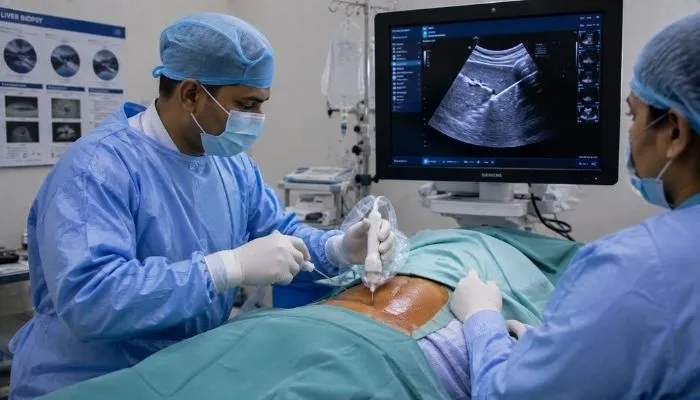
Guidance: Real-Time Ultrasound-Guided
Support Team: Hepatologists, radiologists, specialist nurses
Key Benefit: Definitive tissue diagnosis for accurate liver disease staging and treatment planning
What is a Liver Biopsy?
A liver biopsy is a diagnostic procedure in which a small sample of liver tissue is obtained using a thin needle inserted through the skin into the liver. The tissue sample is then analysed under a microscope by a specialist pathologist to assess the degree of liver inflammation, scarring (fibrosis), and architectural changes that indicate the presence and severity of liver disease.
Liver biopsy is considered the gold standard for diagnosing and staging a range of liver conditions including chronic hepatitis B and C, non-alcoholic fatty liver disease (NAFLD) and non-alcoholic steatohepatitis (NASH), autoimmune hepatitis, primary biliary cholangitis (PBC), primary sclerosing cholangitis (PSC), and unexplained elevated liver enzymes that have not been clarified by non-invasive tests.
At Shree Hospitals, all liver biopsies are performed under real-time ultrasound guidance by experienced hepatologists to maximise accuracy and minimise procedural risk. Biopsy samples are processed in our accredited pathology laboratory and all results are reviewed and discussed with every patient at a dedicated follow-up consultation.
When Should You Consider a Liver Biopsy?
A liver biopsy may be recommended if you have:
- Persistently elevated liver enzymes (ALT, AST, ALP) with unknown cause
- Diagnosed chronic hepatitis B or C requiring fibrosis staging
- Suspected autoimmune liver disease (autoimmune hepatitis, PBC, PSC)
- Unexplained abnormal liver appearances on ultrasound or MRI
- Fibroscan (non-invasive fibrosis test) showing significant fibrosis requiring confirmation
Your hepatologist will assess whether a biopsy is the most appropriate next step.
Is a Liver Biopsy Right for You?
A liver biopsy is appropriate if:
- Non-invasive tests have been inconclusive and a definitive liver diagnosis is required
- You have chronic liver disease and fibrosis staging is needed to guide treatment decisions
- Your hepatologist recommends biopsy to assess treatment response
- You have suspected autoimmune hepatitis or primary biliary cholangitis requiring confirmation
- A biopsy is required to evaluate a liver lesion or tumour
Our specialists will assess the risks and benefits and recommend biopsy only when it is clinically necessary.
Why Accurate Liver Diagnosis Matters?
The degree of liver fibrosis is the most important factor in determining treatment urgency and type. Accurate diagnosis:
- Determines whether urgent antiviral treatment is required
- Guides the choice of antiviral, immunosuppressive, or other therapy
- Identifies cirrhosis early so liver cancer surveillance can begin
- Confirms rare or complex liver conditions that cannot be diagnosed otherwise
- Prevents both over-treatment and under-treatment of liver disease
Liver biopsy provides definitive tissue diagnosis in over 95% of cases where non-invasive tests are inconclusive.
24×7 Emergency Care
Our Approach to Liver Biopsy
At Shree Hospitals, liver biopsy is performed with meticulous care by experienced hepatologists using real-time ultrasound guidance to ensure both diagnostic accuracy and patient safety.
Every patient receives a thorough pre-biopsy assessment, full procedural support, post-biopsy observation, and a detailed results consultation.
24×7 Emergency Care
Thorough Pre-Biopsy Clinical Assessment
Before performing a biopsy, our hepatologists review your blood tests (including clotting profile and platelet count), liver imaging, and medical history to ensure you are a safe candidate. Medications that increase bleeding risk (aspirin, anticoagulants) are reviewed and adjusted where required.
Ultrasound-Guided Needle Technique
All liver biopsies at Shree Hospitals are performed under real-time ultrasound imaging to precisely target the liver and avoid blood vessels, bile ducts, and surrounding organs. This significantly reduces the risk of complications and improves the quality of the tissue sample obtained.
Accredited Histopathology Analysis
Liver biopsy samples are processed in our accredited pathology laboratory and stained with multiple histochemical techniques to assess fibrosis grade (Ishak or Metavir scoring), inflammation activity, fat content, iron deposition, and other diagnostic features. Results are reviewed by experienced hepatopathologists.
Results Consultation and Treatment Planning
Every patient attends a dedicated results consultation where the hepatologist explains the biopsy findings clearly, answers questions, and outlines the recommended treatment plan based on the histological diagnosis. No patient receives biopsy results without full specialist explanation and support.
Top Gastroenterologists in Mumbai at Shree Hospitals
Every specialist at Shree Hospitals is board-certified and has an average of 15+ years of clinical experience in diagnostic and therapeutic endoscopy, colonoscopy, and gastrointestinal disease management.
24×7 Emergency Care

Dr. Keyur A. Sheth
Gastroenterologist, Hepatologist & Advanced GI

Dr. Sandeep Kirit Davavala
Gastroenterology, Therapeutic Endoscopy
Gastroenterology and Hepatology Services at Shree Hospitals
We offer a comprehensive range of liver and gastroenterology services including liver biopsy, fibroscan, antiviral therapy for hepatitis, cirrhosis management, ERCP, endoscopy, colonoscopy, and IBD treatment, all delivered by experienced hepatologists and gastroenterologists in a dedicated liver disease facility.
Antiviral Therapy (Hepatitis)
Evidence-based antiviral treatment for chronic hepatitis B and C. Modern direct-acting antiviral therapy cures hepatitis C in over 95% of patients within 8 to 12 weeks, preventing cirrhosis and liver cancer.
ERCP (Bile Duct Procedure)
Specialised endoscopic procedure for diagnosis and treatment of bile duct stones, strictures, and biliary obstruction. ERCP achieves non-surgical stone removal and biliary stenting in over 90% of cases.
Endoscopy and Colonoscopy
High-definition upper GI endoscopy and colonoscopy for accurate diagnosis and treatment of digestive conditions. Biopsies, polyp removal, and therapeutic procedures are performed at the same session without the need for further intervention.
Immunosuppressive Therapy (IBD)
Expert medical management of Crohn's disease and ulcerative colitis using immunosuppressive and advanced biologic therapy. Our IBD team achieves sustained remission and mucosal healing in the majority of patients.
Step by Step Process of Liver Biopsy at Shree Hospitals
Hundreds of successful liver biopsies performed by our specialist team over 20+ years
Step 1 - Clinical Assessment and Pre-Biopsy Investigations Your hepatologist reviews your symptoms, blood tests (LFTs, clotting screen, FBC, platelet count), and liver imaging to confirm the indication for biopsy. Contraindications (very low platelets, abnormal clotting, uncontrolled ascites) are excluded. Your medications are reviewed and blood thinners adjusted if necessary.
Step 2 - Patient Preparation and Consent You are asked to fast for 6 hours before the procedure. An IV cannula is placed and your blood pressure and pulse are recorded. You receive full written and verbal information about the procedure and provide informed consent. A mild sedative may be offered if required.
Step 3 - Ultrasound-Guided Needle Positioning You lie flat on your back with your right arm raised. The hepatologist uses real-time ultrasound to identify the safest biopsy site on the liver. The skin is cleaned with antiseptic and local anaesthetic is injected to numb the area before the biopsy needle is inserted.
Step 4 - Liver Tissue Sampling A thin biopsy needle is passed quickly through the skin into the liver under ultrasound guidance. You will be asked to hold your breath for a few seconds during needle insertion. The biopsy takes only a few seconds and typically yields a small core of liver tissue 1 to 2 cm in length. The procedure is usually repeated 2 to 3 times for adequate sampling.
Step 5 - Post-Biopsy Observation You are observed for 4 to 6 hours after the biopsy with regular vital sign monitoring (pulse, blood pressure, oxygen saturation) to detect any signs of bleeding or other complications. Mild right-sided discomfort is normal and managed with simple pain relief. You must arrange for someone to take you home as you should not drive or travel alone.
Step 6 - Pathology Results and Treatment Planning Biopsy results are typically available within 7 to 14 working days. You attend a results consultation with your hepatologist to discuss the findings, fibrosis staging, and diagnosis in detail. A personalised treatment plan is developed based on the histological results and your overall clinical picture.
Patient Questions About Liver Biopsy
Is a liver biopsy painful?
The procedure is performed under local anaesthesia so the skin and surrounding area are fully numbed before the biopsy needle is inserted. Most patients feel pressure rather than pain during the biopsy itself. After the procedure, mild right-sided abdominal or shoulder discomfort is common for a few hours and is managed with simple pain relief. Significant pain after biopsy should be reported immediately to your care team. The majority of patients find the procedure tolerable and far less uncomfortable than they expected.
What are the risks of a liver biopsy?
Liver biopsy is a safe procedure when performed by experienced hepatologists with ultrasound guidance. The most common complication is minor bruising at the biopsy site. Significant bleeding requiring intervention occurs in approximately 1 in 300 to 500 cases. Very rare complications include bile leak and inadvertent puncture of adjacent structures. Your hepatologist will discuss the specific risks relevant to your case, including any factors that increase your individual risk, before the procedure.
Can I eat and drink before a liver biopsy?
You must fast for 6 hours before the procedure. This means no food or milk. You may drink plain water up to 2 hours before the procedure. Take your regular medications with a small sip of water unless specifically advised to withhold them. Blood thinning medications (warfarin, aspirin, clopidogrel, novel anticoagulants) must be discussed with your doctor well in advance as these may need to be stopped for several days before the biopsy.
How long do liver biopsy results take?
Liver biopsy histology results typically take 7 to 14 working days as the tissue samples require specialised processing and staining before being reviewed by a hepatopathologist. Your hepatologist will contact you to arrange a dedicated results appointment where findings are explained in full and a treatment plan is discussed. You will not receive results by phone or letter without the opportunity to discuss them with your specialist.

Evidence-Based Case Studies by Our Specialists
Would Recommend Us
"My liver enzymes were very high and no blood test could explain why. The liver biopsy at Shree Hospitals diagnosed autoimmune hepatitis. Starting the right treatment immediately has prevented serious liver damage. I am deeply grateful."
Mrs. Kavitha R.
"I had fatty liver on ultrasound but normal blood tests. The biopsy showed significant scarring that needed urgent attention. The team at Shree Hospitals gave me a clear treatment and lifestyle plan. My follow-up fibroscan has shown real improvement."
Mr. Suhas M.
"My hepatitis C needed staging before treatment could begin. The biopsy showed I had significant fibrosis and needed to start antiviral therapy immediately. After 12 weeks of treatment, my virus is gone. The team at Shree Hospitals was outstanding throughout."
Mr. Raju N.
Patient
Resources

Schedule
consultation

Billing &
Payments

Hospital
Facilities
24×7 Emergency Care

1800-268-4000

Follow Us

Shree
Hospitals

Shree
Hospitals
