 Ghatkopar (East), Mumbai)


Home > Interventional Radiology > Uterine Artery Embolization (UAE)
Uterine Artery Embolization (UAE) In Mumbai
Non-Surgical Fibroid Treatment That Preserves Your Uterus
Uterine Artery Embolization (UAE) is a minimally invasive interventional radiology procedure that treats uterine fibroids by blocking the blood vessels that supply them, causing them to shrink and die. At Shree Hospitals, our specialist interventional radiologists perform UAE as a highly effective, non-surgical alternative to hysterectomy or myomectomy, preserving the uterus while achieving lasting relief from heavy menstrual bleeding, pelvic pain, pressure symptoms, and urinary frequency caused by fibroids.
Suffering from Fibroids? Ask About UAE at Shree Hospitals Today
Quick facts
Procedure Type : Minimally Invasive Uterine Fibroid Embolization
Anaesthesia : Conscious Sedation (no general anaesthesia)
Duration : 45 to 90 minutes
Hospital Stay : 1 - 2 days
Recovery Time : 1 to 2 weeks (vs 4 to 6 weeks for surgery)
Support Team : Interventional radiologists, gynaecologists, nursing team
Key Benefit : Treats all fibroids simultaneously, preserves uterus, avoids surgery
What is Uterine Artery Embolization (UAE)?
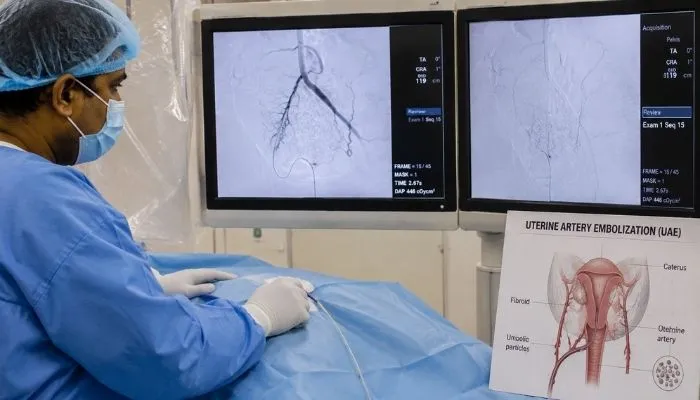
Uterine Artery Embolization (UAE) is an interventional radiology procedure in which a thin flexible tube (catheter) is inserted through a small puncture in the wrist or groin and guided under X-ray imaging (fluoroscopy) into the uterine arteries - the blood vessels that supply the uterus and its fibroids. Tiny particles (embolic agents) are then injected through the catheter to block these arteries, cutting off the blood supply to the fibroids. Without blood flow, the fibroids shrink and die over the following weeks and months.
Uterine fibroids (also called leiomyomas or myomas) are non-cancerous growths of the uterine muscle that affect up to 70% of women by age 50. While many fibroids are asymptomatic, those causing heavy or prolonged menstrual bleeding, severe pelvic pain or pressure, bloating, urinary frequency, constipation, or difficulty conceiving require treatment. UAE treats all fibroids present in the uterus simultaneously in a single procedure, unlike myomectomy which removes individual fibroids surgically and may miss smaller ones.
At Shree Hospitals, UAE is performed by our experienced interventional radiology team in a dedicated angiography suite using advanced digital subtraction angiography (DSA) and fluoroscopic guidance. The procedure is performed under conscious sedation (the patient is awake but comfortable and pain-free) with overnight admission. Our gynaecology team works in close collaboration with the interventional radiology team to ensure comprehensive care from pre-procedure planning through to post-procedure recovery and follow-up.
When Should You Consider UAE for Uterine Fibroids?
You may be a candidate for UAE if you experience:
- Heavy menstrual bleeding (soaking through pads or tampons, passing clots) causing anaemia or affecting quality of life
- Pelvic pressure or pain from enlarged fibroids pressing on surrounding organs
- Urinary frequency or urgency from fibroids pressing on the bladder
- Abdominal bloating or visible uterine enlargement from large fibroids
- Fibroids confirmed on ultrasound or MRI that are causing significant symptoms
Is UAE the Right Treatment for Your Fibroids?
UAE is particularly suitable if:
- You have symptomatic uterine fibroids confirmed on imaging
- You wish to avoid major surgery (hysterectomy or myomectomy) and general anaesthesia
- You want to preserve your uterus (UAE is uterus-preserving)
- You have multiple fibroids making surgical myomectomy complex
- You have completed your family or are not planning pregnancy in the near future (fertility after UAE requires specialist counselling)
- You are not a surgical candidate due to medical co-morbidities
Why UAE Is a Life-Changing Alternative to Surgery?
UAE offers significant advantages over traditional surgical approaches:
- Treats all fibroids simultaneously regardless of number, size, or location
- No surgical incision, no general anaesthesia, no surgical scar
- Shorter recovery (1 to 2 weeks vs 4 to 6 weeks for surgery)
- 85 to 90% of patients report significant improvement in bleeding and pressure symptoms
- Uterus is preserved - not removed as in hysterectomy
- Associated with lower risk of surgical complications compared to hysterectomy
85 to 90% of women treated with UAE report significant relief from fibroid symptoms within 3 months.
At Shree Hospitals, our interventional radiology team performs UAE using advanced imaging guidance and premium embolic agents to achieve consistent, durable fibroid shrinkage and lasting symptom relief, avoiding the need for major surgery and preserving the uterus.
24×7 Emergency Care
Our Approach to UAE
At Shree Hospitals, UAE is delivered through a structured, multi-disciplinary pathway. Our interventional radiologists and gynaecologists jointly assess every patient to confirm UAE is the most appropriate treatment for their fibroid type, size, and symptom profile before proceeding.
24×7 Emergency Care
Pre-Procedure MRI and Multi-Disciplinary Assessment
Every UAE candidate undergoes dedicated pelvic MRI before the procedure to map the number, size, location, and blood supply of all fibroids. This is reviewed jointly by the interventional radiologist and gynaecologist. Fibroid subtypes (submucosal, intramural, subserosal, pedunculated) are assessed as they influence both the UAE technique and expected outcomes. Blood tests confirm haemoglobin and exclude other causes of abnormal bleeding.
Precision Fluoroscopy - Guided Embolization
UAE is performed in our dedicated angiography suite under digital subtraction fluoroscopy. A radial or femoral arterial access is used. A microcatheter is advanced selectively into each uterine artery in turn. Embolic microspheres of precisely calibrated size are injected until complete devascularisation of the fibroid blood supply is confirmed. The normal uterine blood supply is preserved.
Comprehensive Pain Management
Post-embolization pelvic cramping is the most common and expected side effect of UAE as the fibroids lose their blood supply. Our team provides a structured post-procedure pain management protocol including intravenous analgesia, anti-inflammatory medications, and anti-nausea agents during the overnight stay, ensuring patient comfort throughout the post-procedure period.
Follow-Up Imaging and Gynaecology
Review MRI follow-up at 3 to 6 months after UAE confirms the degree of fibroid shrinkage and uterine response. A clinical review with our gynaecology team assesses symptom improvement and menstrual pattern recovery. Most patients notice improvement in menstrual bleeding within the first 2 to 3 cycles after UAE.
Interventional Radiologists and Gynaecologists in Mumbai
Book Expert Consultation

10+ years of experience
Dr. Swati Narurkar
Interventional Radiology
Interventional Radiology Services at Shree Hospitals
We offer a comprehensive range of minimally invasive interventional radiology procedures including UAE, TACE, peripheral angioplasty, radiofrequency ablation, percutaneous drainage, biliary drainage, vertebroplasty, and IVC filter placement, all delivered by specialist interventional radiologists using advanced imaging guidance.
Percutaneous Drainage (Abscess)
Ultrasound or CT-guided needle drainage of abscesses, fluid collections, and cysts without open surgery. Safe and effective treatment avoiding surgical risks with rapid symptom relief.
Radiofrequency Ablation (RFA)
Image-guided thermal ablation using radiofrequency energy to destroy tumour tissue in the liver, kidney, lung, or thyroid. A minimally invasive alternative to surgery for selected solid tumours.
Step by Step Process of UAE
Step 1 - Consultation and Fibroid Assessment
Your gynaecologist or interventional radiologist reviews your symptoms, menstrual history, and previous investigations. Pelvic ultrasound and MRI are arranged to map the fibroid burden. Blood tests including full blood count (to assess anaemia from heavy bleeding) and clotting profile are performed. The UAE procedure is explained in detail including expected outcomes, the post-embolization syndrome, and recovery timeline.
Step 2 - Pre-Procedure Preparati
UAE is performed under conscious sedation. You will be asked to fast for 4 to 6 hours before the procedure. An intravenous cannula is placed and pre-procedure medications including antibiotics (to prevent infection) and analgesia are given. The groin or wrist access site is shaved and prepared. A urinary catheter may be inserted for comfort during the procedure.
Step 3 - Arterial Access and Catheter Placement
Under local anaesthesia, a small puncture is made in the radial artery (wrist) or femoral artery (groin). A thin sheath is inserted and a diagnostic catheter is advanced under fluoroscopic guidance into the aorta and then into the uterine arteries which branch from the internal iliac arteries. Contrast dye is injected to map the uterine and fibroid blood supply on X-ray.
Step 4 - Embolization of Uterine Arteries
A microcatheter is positioned selectively within the uterine artery. Embolic microspheres (small biocompatible beads) are injected slowly under continuous fluoroscopic observation until complete devascularisation of the fibroid blood supply is achieved on each side. The procedure is then repeated for the opposite uterine artery. Both arteries are embolized in the same sitting.
Step 5 - Post-Procedure Recovery
After the procedure, the arterial access site is closed with a closure device or manual compression. You are transferred to the ward for overnight monitoring. Post-embolization syndrome (pelvic cramping, low-grade fever, fatigue) is expected and managed with intravenous analgesia, anti-inflammatories, and anti-nausea medications. Most patients are discharged the following morning.
Step 6 - Recovery and Follow-Up
Recovery at home takes 1 to 2 weeks. Pelvic cramping gradually improves over the first week. Most women notice improvement in their menstrual bleeding from the first or second cycle after UAE. A follow-up MRI at 3 to 6 months confirms fibroid shrinkage. A clinical review with the gynaecology team assesses symptom improvement and plans ongoing care.
Patient Questions About Uterine Artery Embolization
Can I get pregnant after UAE?
UAE can affect ovarian reserve and uterine receptivity and is therefore not generally recommended as a first-line treatment for women who wish to conceive in the future. Studies show that pregnancy is possible after UAE but carries higher risks compared to pregnancy after myomectomy (surgical fibroid removal). If fertility preservation is a priority, myomectomy is the preferred treatment. Our gynaecology team will discuss all options in detail with you if future pregnancy is important.
Is UAE painful?
UAE itself is performed under conscious sedation and is not painful during the procedure. However, post-embolization syndrome - pelvic cramping that begins shortly after the procedure and peaks in the first 12 to 24 hours - is the most significant discomfort associated with UAE. This is caused by the fibroids losing their blood supply and is a sign the procedure is working. It is managed effectively with intravenous analgesia, anti-inflammatory medications, and anti-nausea agents during your overnight hospital stay, and with oral analgesia after discharge.
How long before fibroids shrink after UAE?
Fibroid shrinkage begins immediately after UAE as the blood supply is blocked, but the full reduction in fibroid volume takes place over 3 to 6 months. Studies show an average fibroid volume reduction of 40 to 60% at 6 months, with continued shrinkage up to 12 months. Improvement in menstrual bleeding is often noticed from the first or second cycle after UAE, while pressure symptoms (urinary frequency, bloating) improve as the fibroid bulk decreases over the following months.
Can fibroids come back after UAE?
UAE treats all existing fibroids simultaneously and the embolized fibroids do not regrow. However, new fibroids can develop from the remaining uterine muscle over time, particularly in younger women. Studies show a fibroid recurrence rate requiring further treatment of approximately 20 to 25% over 5 years. This compares favourably with myomectomy which has similar recurrence rates. Only hysterectomy permanently eliminates all fibroid recurrence. Your interventional radiologist and gynaecologist will discuss long-term expectations with you.
Patient
Resources

Schedule
consultation

Billing &
Payments

Hospital
Facilities
24×7 Emergency Care

1800-268-4000

Follow Us

Shree
Hospitals

Shree
Hospitals
