 Ghatkopar (East), Mumbai)

Home > Neonatology > Exchange Transfusion
Neonatal Exchange Transfusion In Mumbai
Specialist Treatment for Severe Neonatal Jaundice and Haemolytic Disease of the Newborn
Exchange transfusion is a specialist neonatal procedure used to rapidly reduce dangerously high bilirubin levels in newborns with severe jaundice unresponsive to phototherapy, or to correct severe anaemia and remove harmful antibodies in haemolytic disease of the newborn (HDN). At Shree Hospitals, our experienced neonatology team performs exchange transfusions safely in our Level III NICU, protecting every newborn from the risk of kernicterus and permanent neurological damage.
Newborn with Severe Jaundice? Contact Our NICU Team Immediately
Quick facts
Procedure Type: Double-Volume Exchange Transfusion
Indications: Severe jaundice, haemolytic disease, bilirubin encephalopathy risk
Duration: 2 to 4 hours
Route: Umbilical venous catheter or peripheral vessel
Blood Volume Exchanged: Approximately twice the baby's total blood volume
Specialist Team: Neonatologists, NICU nurses, blood bank, haematology
Key Benefit: Rapid bilirubin reduction, prevents kernicterus and brain damage
What is Neonatal Exchange Transfusion?
Exchange transfusion is a procedure in which small aliquots of the newborn's blood are alternately withdrawn and replaced with donor blood until approximately twice the baby's total blood volume has been exchanged. This process rapidly removes unconjugated bilirubin from the bloodstream, clears maternal antibodies causing red cell destruction, corrects severe anaemia, and removes toxic metabolic products. It is the most rapid and effective treatment for severe neonatal hyperbilirubinaemia when phototherapy has been insufficient.
Exchange transfusion is most commonly performed for two main indications. The first is severe neonatal jaundice - when bilirubin levels reach the exchange transfusion threshold despite intensive phototherapy, or when clinical signs of acute bilirubin encephalopathy (bilirubin toxicity to the brain) are present. The second indication is haemolytic disease of the newborn (HDN) - caused by Rh incompatibility or ABO incompatibility between mother and baby, where maternal antibodies destroy the newborn's red blood cells causing both severe jaundice and anaemia.
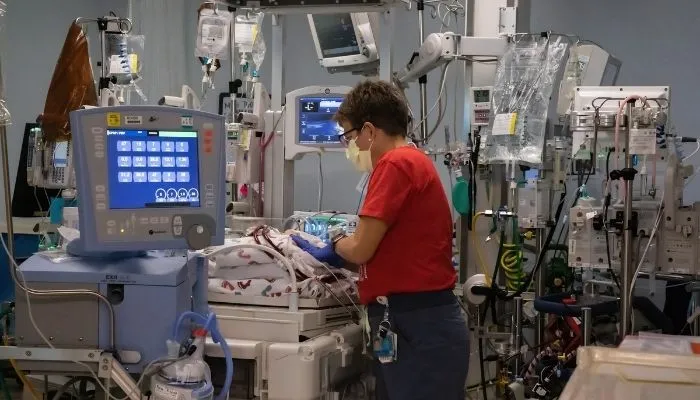
At Shree Hospitals, exchange transfusion is performed by experienced consultant neonatologists in the controlled environment of our Level III NICU. Blood is meticulously cross-matched before the procedure. Continuous monitoring of vital signs, blood glucose, electrolytes, and bilirubin levels is maintained throughout and after the procedure to ensure the baby's safety.
When Is Exchange Transfusion Needed for a Newborn?
Exchange transfusion is indicated when:
- Serum bilirubin reaches the exchange transfusion threshold despite intensive phototherapy
- Clinical signs of acute bilirubin encephalopathy are present (altered tone, poor feeding, abnormal cry)
- Bilirubin rises rapidly despite maximum phototherapy with an upward trajectory crossing the threshold
- The baby has severe haemolytic disease with both dangerous jaundice and significant anaemia
- There is evidence of immune haemolysis with positive direct Coombs test and rapid bilirubin rise
Urgent assessment is essential as bilirubin encephalopathy can develop within hours.
Is Exchange Transfusion Necessary for Your Baby?
Exchange transfusion is a last-resort but highly effective treatment when:
- Intensive phototherapy (covering maximum skin surface area with high-intensity LED lights) has failed to lower bilirubin adequately
- The baby's bilirubin level is at or above the exchange transfusion threshold on the age-specific treatment nomogram
- The baby is showing clinical signs suggesting early bilirubin toxicity
- Blood group incompatibility is causing rapid haemolysis with both anaemia and severe jaundice
- The neonatologist determines the risk of kernicterus outweighs the procedural risks of exchange transfusion
Your neonatology team will explain clearly why exchange transfusion is needed and what it involves.
Why Prompt Action Prevents Brain Damage?
Untreated or delayed treatment of severe neonatal jaundice can cause:
- Kernicterus - permanent bilirubin-induced neurological damage
- Cerebral palsy - movement disorders caused by bilirubin toxicity to motor pathways
- Sensorineural hearing loss from bilirubin damage to the auditory brainstem
- Cognitive impairment and intellectual disability in severe cases
- Exchange transfusion performed in time prevents these devastating complications in the vast majority of cases
Exchange transfusion reduces serum bilirubin by approximately 50% within a single double-volume exchange procedure.
At Shree Hospitals, our neonatology team performs exchange transfusions promptly when indicated, following strict protocols with continuous monitoring to rapidly reduce dangerous bilirubin levels and prevent kernicterus in every baby at risk.
24×7 Emergency Care
Our Approach to Exchange Transfusion
At Shree Hospitals, neonatal nutrition is treated as an active medical intervention, not just a support measure. Our neonatology team works closely with specialist neonatal dietitians and pharmacists to design, monitor, and adjust TPN formulations daily throughout each baby's NICU stay, while simultaneously advancing enteral feeding as quickly and safely as the baby's condition allows.
24×7 Emergency Care
Early Recognition and Decision to Exchange
Our neonatologists plot bilirubin levels on validated age-specific nomograms at every assessment. Exchange transfusion thresholds are based on national guidelines and account for the baby's gestation and clinical risk factors. When the exchange threshold is reached or clinical signs of bilirubin encephalopathy appear, the decision to exchange is made without delay.
Pre-Procedure Blood Preparation
Appropriate donor blood for exchange transfusion is ordered from the blood bank in a formulation matched to the baby's blood group and the cause of haemolysis. For Rh HDN, Rh-negative blood is used. For ABO HDN, group O blood of appropriate Rh type is selected. Intensive phototherapy continues at maximum strength while blood is being prepared.
Safe and Monitored Exchange Procedure
The exchange is performed via an umbilical venous catheter using a controlled aliquot technique. Small volumes of blood are alternately withdrawn and replaced in 5 to 10 ml aliquots throughout the procedure lasting 2 to 4 hours. Vital signs, heart rate, blood pressure, temperature, blood glucose, and blood gas are monitored continuously throughout the exchange.
Post-Exchange Monitoring and Phototherapy Continuation
After the exchange, bilirubin levels are checked at 2 and 6 hours to confirm adequate reduction and detect any rebound rise. Intensive phototherapy is continued after the exchange to prevent bilirubin levels from rebounding towards the exchange threshold. Blood results including haemoglobin, electrolytes, and calcium are closely monitored and corrected as needed.
Top Neonatologists in Mumbai
Every specialist at Shree Hospitals is board-certified and has an average of 15+ years of clinical experience in neonatal intensive care, preterm infant management, and neonatal resuscitation.
24×7 Emergency Care

Dr. Raghav Arora
Consultant Fetal Medicine Specialist
Step by Step Process of Exchange Transfusion
Step 1 - Bilirubin Assessment and Exchange Decision
Serum bilirubin is plotted on the exchange transfusion nomogram. If the level is at or above the exchange threshold, or if clinical signs of bilirubin encephalopathy are present, the decision to proceed with exchange transfusion is made. The decision is discussed with parents with a clear explanation of the indication, procedure, risks, and expected benefit.
Step 2 - Blood Bank Preparation and Crossmatch
The blood bank is contacted urgently to prepare cross-matched donor blood appropriate for the baby's blood group and the cause of jaundice. For babies with haemolytic disease, specific blood products are selected. While blood is being prepared, intensive phototherapy is maximised to continue reducing bilirubin as rapidly as possible.
Step 3 - Umbilical Venous Catheter Placement
A sterile umbilical venous catheter (UVC) is placed into the umbilical vein under full sterile conditions. Position is confirmed by chest X-ray. The procedure is performed in the NICU with full monitoring and resuscitation equipment available.
Step 4 - Exchange Transfusion Procedure
The double-volume exchange begins. Small aliquots of the baby's blood (typically 5 to 10 ml) are alternately withdrawn and replaced with donor blood. The total volume exchanged is approximately 160 to 200 ml/kg (twice the baby's total blood volume). The procedure takes 2 to 4 hours and is carried out slowly and carefully to maintain haemodynamic stability.
Step 5 - Intra-Procedure Monitoring
Throughout the exchange, vital signs (heart rate, blood pressure, temperature, oxygen saturation) are continuously monitored. Blood glucose is checked every 30 minutes during the procedure. Blood gas analysis and ionised calcium are performed at intervals to detect and correct any metabolic complications during the exchange.
Step 6 - Post-Exchange Care and Bilirubin Monitoring
After the exchange is complete, intensive phototherapy is continued. Bilirubin levels are checked at 2, 6, and 12 hours post-exchange to confirm adequate reduction and detect rebound. Full blood count, electrolytes, and calcium are monitored. The baby is observed closely in the NICU for 24 to 48 hours after the procedure. Parents are kept informed of progress throughout.
Parent Questions About Exchange Transfusion
Why does my baby need an exchange transfusion when phototherapy is available?
Phototherapy is always the first treatment for neonatal jaundice and works well in most cases. However, when bilirubin levels rise to the exchange transfusion threshold despite intensive phototherapy - particularly in cases of haemolytic disease where red blood cells are being destroyed rapidly - phototherapy alone cannot reduce bilirubin fast enough to prevent brain damage. Exchange transfusion physically removes the bilirubin from the bloodstream, achieving a 50% reduction in a single procedure that would take days with phototherapy alone
Is exchange transfusion dangerous for my baby?
Exchange transfusion carries procedural risks including electrolyte disturbances, low blood calcium, blood glucose instability, infection, and rarely cardiac arrhythmia. These risks are managed through continuous monitoring and preparation. The procedure is performed by experienced consultant neonatologists in a specialist NICU setting. The risk of the procedure must always be weighed against the far more serious risk of kernicterus - permanent brain damage from untreated severe jaundice.
What is kernicterus and why does my team want to prevent it?
Kernicterus is the permanent neurological damage caused by bilirubin deposits in the brain. It occurs when bilirubin reaches toxic levels and crosses into brain tissue, causing damage to the basal ganglia (movement control centres), auditory pathways (hearing), and cerebellum. The consequences include cerebral palsy, sensorineural hearing loss, intellectual disability, and abnormal eye movements. Kernicterus is entirely preventable with timely treatment. This is why our team acts quickly when bilirubin levels approach dangerous thresholds.
How will I know whe What happens after the exchange transfusion?
After the exchange, your baby remains in the NICU for close monitoring. Phototherapy continues to prevent bilirubin from rebounding. Bilirubin levels are checked frequently in the hours following the exchange. Most babies show significant and sustained improvement after a successful exchange transfusion. Once bilirubin levels are stable and well below the exchange threshold, phototherapy can be weaned and the baby progresses toward recovery and eventual NICU discharge.

Evidence-Based Case Studies by Our Specialists
Would Recommend Us
"Our baby's jaundice was worsening despite phototherapy and the doctors explained she needed an exchange transfusion urgently. The team at Shree Hospitals performed the procedure with such expertise and care. Her bilirubin dropped significantly and she recovered completely. We are so grateful for their quick action."
Parents of Baby Ananya D. (Rh Haemolytic Disease of the Newborn)
"Our son's bilirubin was rising very fast because of a condition called G6PD deficiency. The neonatologist explained we needed an exchange transfusion immediately to protect his brain. The procedure was done safely and his levels came down dramatically. He has no complications and is developing normally."
Parents of Master Vivek R. (G6PD Deficiency - Exchange Transfusion)
"Within hours of our baby being born, the doctors were concerned about her jaundice. By the next morning she needed an exchange transfusion. It was a frightening time but the team at Shree Hospitals were calm, skilled, and kept us fully informed. She came home five days later perfectly healthy."
Parents of Baby Kavya N. (ABO Incompatibility - Emergency Exchange Transfusion)
Patient
Resources

Schedule consultation

Billing & Payments

Health Packages

Hospital Facilities
24×7 Emergency Care

1800-268-4000

News & Updates
Shree Hospitals is the first to perform robotic endo surgery.
Shree Hospitals Introduces Advanced Robotic Surgery for Better Patient Care
Shree Hospitals Expands Advanced Surgical Care With Latest Medical Technology
Health Center
Exploring the Future of Telemedicine: What’s Next for Healthcare?
The Rise of Renewable Energy: Innovations in Sustainability
Follow Us

Shree
Hospitals

Shree
Hospitals
