 Ghatkopar (East), Mumbai)

Home > Neonatology > Total Parenteral Nutrition (TPN)
Total Parenteral Nutrition (TPN) for Newborns In Mumbai
Expert Intravenous Nutritional Support for Premature and Critically Ill Newborns
Total Parenteral Nutrition (TPN) provides complete intravenous nutritional support for premature and critically ill newborns who cannot yet feed orally or tolerate enteral (tube) feeding. At Shree Hospitals, our specialist neonatology and dietitian team designs personalised TPN solutions that deliver precisely the right balance of nutrients to support healthy brain development, organ maturation, and weight gain in every baby in our NICU.
Premature Baby Needing Nutritional Support? Speak to Our NICU Team
Quick facts
Route: Central venous catheter (PICC line or umbilical venous catheter)
Components: Glucose, amino acids, lipids, electrolytes, vitamins, trace elements
Monitoring: Daily blood tests for glucose, electrolytes, liver function, triglycerides
Duration: Days to weeks until full enteral feeding is established
Specialist Team: Neonatologists, respiratory therapists, NICU nurses
Weaning: Neonatologists, neonatal dietitians, pharmacists, NICU nurses
Key Benefit:Prevents malnutrition and supports optimal growth during critical early weeks
What is Total Parenteral Nutrition (TPN) for Newborns?
Total Parenteral Nutrition (TPN) is the delivery of complete nutrition directly into the bloodstream via an intravenous catheter, bypassing the gut entirely. It provides all the calories, protein (amino acids), fats (lipid emulsion), carbohydrates (glucose), electrolytes, vitamins, and trace elements that a growing newborn requires when the gastrointestinal tract is not yet functional or able to absorb adequate nutrition.
Premature babies have very limited nutritional reserves and extremely high metabolic demands for growth and brain development. Without adequate nutrition from the earliest hours of life, they are at risk of catabolism (the body breaking down its own tissues for energy), hypoglycaemia, poor weight gain, and impaired neurodevelopmental outcomes. TPN allows the baby to receive full nutritional support intravenously from day one, protecting growth and development while the gastrointestinal system matures.
At Shree Hospitals, every baby requiring TPN receives an individualised formulation calculated by our neonatal dietitian and reviewed daily by the consultant neonatologist. We start TPN within hours of birth in premature babies and transition gradually to enteral feeding (breast milk or formula via nasogastric tube) as the baby's gut matures, aiming to achieve full enteral feeding and stop TPN as early as safely possible.
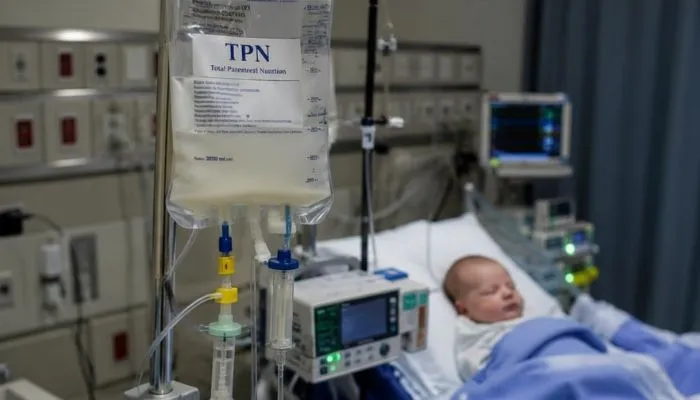
Which Newborns Need Total Parenteral Nutrition?
TPN is required for newborns who:
- Are born extremely or very premature (less than 32 weeks) and cannot yet tolerate enteral feeds
- Have gastrointestinal surgical conditions requiring bowel rest (e.g. necrotising enterocolitis, gastroschisis)
- Have severe respiratory illness making enteral feeding unsafe or impractical
- Have short bowel syndrome or other conditions causing malabsorption
- Require prolonged gut rest following gastrointestinal surgery or complications
TPN ensures these babies receive essential nutrients from the earliest possible stage of life.
What Nutrients Does TPN Provide for Newborns?
TPN is a complete nutritional package providing:
- Amino acids - protein building blocks for growth and organ development
- Glucose - the primary energy source for the brain and all body tissues
- Lipid emulsion - essential fatty acids for brain development and caloric density
- Electrolytes - sodium, potassium, calcium, phosphate, and magnesium for organ function
- Vitamins and trace elements - including zinc, selenium, and vitamins A, D, E, K for metabolism and immunity
Each formulation is calculated individually based on the baby's weight, gestation, and clinical status.
Why Optimal Early Nutrition Matters for Premature Babies?
The first weeks of life are a critical window for brain development in premature babies:
- Adequate protein and calorie intake in the NICU directly improves neurodevelopmental outcomes
- Nutritional deficits in the first weeks are difficult to reverse and affect long-term growth
- Early TPN prevents postnatal growth restriction - a common problem in very premature babies
- Optimal nutrition supports immune function and reduces the risk of infection
- Early introduction of breast milk alongside TPN provides gut-protective benefits
Adequate early protein intake in the NICU is associated with a 10-point improvement in developmental outcomes at 2 years.
Supporting Sentence: At Shree Hospitals, our neonatal dietitian and neonatology team designs individualised TPN formulations from day one, targeting optimal protein and calorie delivery to support brain development and prevent the nutritional deficits that can affect the long-term health and development of premature babies
24×7 Emergency Care
Our Approach to Neonatal Nutritional Support and TPN
At Shree Hospitals, neonatal nutrition is treated as an active medical intervention, not just a support measure. Our neonatology team works closely with specialist neonatal dietitians and pharmacists to design, monitor, and adjust TPN formulations daily throughout each baby's NICU stay, while simultaneously advancing enteral feeding as quickly and safely as the baby's condition allows.
24×7 Emergency Care
Individualised TPN Formulation
Every TPN prescription is calculated individually for each baby based on birth weight, gestational age, clinical status, and daily blood test results. Our neonatal dietitian calculates the optimal intake of protein, glucose, and lipids to achieve targeted weight gain and nutritional goals without causing metabolic complications.
Early Parenteral Nutrition Start
We start amino acid infusion within the first hours of life in all premature babies who cannot receive enteral feeds. Early protein delivery from day one prevents the protein deficit that occurs in the first days of life and is a major determinant of long-term neurodevelopment. Lipid emulsions are introduced within 24 hours to provide essential fatty acids and additional caloric support.
Enteral Feeding Advancement Alongside TPN
We introduce maternal breast milk via nasogastric tube as early as clinically safe, typically from day one as trophic or minimal enteral feeding. This protects the gut, reduces the risk of necrotising enterocolitis (NEC), and accelerates the maturation of gut function. TPN is incrementally reduced and discontinued as the baby advances to full enteral feeding.
Daily Monitoring and Complication Prevention
TPN-related complications including hyperglycaemia, hypertriglyceridaemia, electrolyte imbalances, catheter-related bloodstream infection, and cholestasis are prevented through daily blood monitoring, strict line care protocols, and regular TPN formulation adjustment.
Top Neonatologists in Mumbai
Every specialist at Shree Hospitals is board-certified and has an average of 15+ years of clinical experience in neonatal intensive care, preterm infant management, and neonatal resuscitation.
24×7 Emergency Care

Dr. Raghav Arora
Consultant Fetal Medicine Specialist
Neonatal and Newborn Care Services at Shree Hospitals
We offer a full range of specialist neonatal services including total parenteral nutrition, NICU care, mechanical ventilation, surfactant therapy, exchange transfusion, and phototherapy, all delivered by expert neonatologists and dietitians in a dedicated Level III NICU facility.
Exchange Transfusion
Specialist double-volume exchange transfusion for severe neonatal jaundice and haemolytic disease of the newborn. This procedure rapidly reduces dangerous bilirubin levels, protecting the newborn's neurological development.
Step by Step Process of Neonatal Respiratory Support
Step 1 - Nutritional Assessment and TPN
Initiation Within hours of NICU admission, the neonatologist and neonatal dietitian assess the baby's nutritional requirements based on gestation, birth weight, and clinical condition. A TPN prescription is written specifying the exact dose of amino acids, glucose, lipids, electrolytes, vitamins, and trace elements required. A PICC line or umbilical venous catheter is placed to administer the TPN.
Step 2 - First TPN Infusion
The TPN formulation is prepared by the pharmacy under sterile conditions and delivered to the NICU. The infusion is started at the prescribed rate via the central venous line. Blood glucose is checked within 1 to 2 hours of starting to ensure glucose tolerance is adequate. Initial electrolytes and blood gas are reviewed.
Step 3 - Daily Review and Formulation Adjustment
Every morning, the neonatologist and dietitian review the baby's daily blood results including glucose, electrolytes, renal function, and triglycerides. The TPN formulation is adjusted to correct any abnormalities, optimise protein and calorie delivery, and meet the baby's evolving nutritional needs as they grow.
Step 4 - Trophic Enteral Feeding Introduction
As early as the baby's clinical stability allows, small amounts of maternal breast milk are introduced via nasogastric tube as trophic feeds. These very small volumes do not contribute significantly to calorie intake but stimulate gut development, produce gut hormones, and protect the bowel from necrotising enterocolitis (NEC). TPN continues to provide full nutritional support during this phase.
Step 5 - Enteral Feed Advancement and TPN Reduction
As the baby tolerates increasing volumes of enteral feed, TPN is progressively reduced to avoid overfeeding. The transition from TPN-dominant to enteral-dominant feeding is gradual and guided by the baby's daily feeding tolerance, weight gain, blood results, and abdominal examination. The rate of advancement is reduced if the baby shows any signs of feed intolerance.
Step 6 - TPN Cessation and Full Enteral
Feeding TPN is discontinued when the baby is tolerating full enteral feeds (typically 150 to 180 ml/kg/day) and is gaining weight appropriately. The central venous line is removed when it is no longer required for TPN or medications. Parents are involved in oral feeding preparation including breastfeeding support and bottle feeding practice as the baby approaches discharge.
Parent Questions About TPN for Newborns
Why does my premature baby need TPN instead of feeding normally?
Premature babies are born before their gastrointestinal tract has fully matured. In very premature or sick babies, the gut is not yet capable of absorbing adequate nutrition from milk, and attempting to feed too early or too aggressively can cause a serious bowel complication called necrotising enterocolitis (NEC). TPN provides all the nutrition the baby needs intravenously, safely bypassing the gut until it matures enough to begin absorbing breast milk feeds. We introduce breast milk feeds as early as safely possible alongside the TPN
Can I still provide breast milk while my baby is on TPN?
Yes, absolutely. Even when your baby is receiving TPN, we actively encourage mothers to express breast milk. Small amounts of breast milk are given via tube alongside TPN as soon as clinically safe. Breast milk provides gut-protective factors, immune proteins, and beneficial bacteria that formula cannot replicate. Our lactation team will support you with expressing and establishing your milk supply from day one in the NICU.
Are there any risks with TPN?
TPN is a safe and essential treatment but does carry some potential complications that our team monitors closely. These include bloodstream infection from the central line, hyperglycaemia (high blood sugar), abnormal lipid levels, electrolyte imbalances, and cholestatic jaundice from prolonged TPN use. Our team uses strict line care protocols, performs daily blood tests to detect any abnormalities early, and works to transition the baby off TPN as quickly as safely possible to reduce these risks
How will I know when my baby is ready to come off TPN?
Your neonatologist and dietitian track the baby's daily progress including weight, feeding tolerance, and blood results. TPN is progressively reduced as the baby tolerates increasing amounts of enteral (tube) feeding. Your team will explain this transition clearly as it happens and will tell you when your baby has reached full enteral feeds and no longer needs TPN. This is an important milestone in your baby's NICU journey towards home.

Evidence-Based Case Studies by Our Specialists
Would Recommend Us
"For the first six weeks our son was fed through a line in his vein. The dietitian explained exactly what he was getting and why. When he finally started taking breast milk it was such a milestone. He is now a healthy one-year-old and you would never know how small he was."
Parents of Master Aryan S. (26-Week Premature TPN Management)
"Our baby developed NEC and had to stop all feeds. The team at Shree Hospitals gave her complete nutrition through a drip for weeks while her bowel healed. She avoided surgery and is now feeding normally. The neonatology team gave her a second chance."
Parents of Baby Ananya K. (Neonatal Hypoxic Ischaemic Encephalopathy)
: "After surgery our daughter needed TPN for nearly three months. The dietitian and neonatology team monitored every detail of her nutrition and slowly built up her feeds. She is now home and thriving. We are so grateful for the dedication of the entire team."
Parents of Baby Riya T. (Short Gut - Long-Term TPN and Enteral Transition)
Patient
Resources

Schedule consultation

Billing & Payments

Health Packages

Hospital Facilities
24×7 Emergency Care

1800-268-4000

News & Updates
Shree Hospitals is the first to perform robotic endo surgery.
Shree Hospitals Introduces Advanced Robotic Surgery for Better Patient Care
Shree Hospitals Expands Advanced Surgical Care With Latest Medical Technology
Health Center
Exploring the Future of Telemedicine: What’s Next for Healthcare?
The Rise of Renewable Energy: Innovations in Sustainability
Follow Us

Shree
Hospitals

Shree
Hospitals
