 Ghatkopar (East), Mumbai)


Home > Obstetrics Gynaecology > Uterine fibroid
Uterine Fibroids Treatment in Mumbai
At Shree Hospitals, we provide complete and personalised care for women with uterine fibroids, from small asymptomatic fibroids that simply need monitoring to large or multiple fibroids causing heavy bleeding, pelvic pressure, pain, and fertility problems.
Our gynaecology team offers the full range of fibroid treatment options including medical management, minimally invasive laparoscopic myomectomy, hysteroscopic fibroid removal, and uterine artery embolisation, so that every patient has access to the treatment that is right for her specific situation, her symptoms, and her reproductive goals.
Heavy and prolonged menstrual bleeding, pelvic pressure or fullness, frequent urination, lower back pain, and difficulty conceiving are common signs of significant uterine fibroids.
(24×7 Emergency Care)
Our Approach
(24×7 Emergency Care)
Our Approach In Managing Uterine Fibroids
Right Treatment. Right Timing. Uterus Preserved Where Possible
At Shree Hospitals, we believe that every woman with fibroids deserves a clear explanation of her condition, an honest discussion of all available treatment options, and a plan that is built around her specific symptoms, her age, and whether she wishes to preserve her fertility.
Not all fibroids need treatment and not all fibroid treatments need to involve surgery. Our team ensures that the treatment recommended is proportionate to the symptoms and designed to achieve the best possible outcome for each individual patient.
- Accurate Fibroid Assessment and Mapping
Understanding the number, size, location, and relationship of fibroids to the uterine cavity and surrounding structures is essential for planning the right treatment. Our specialists use high-resolution ultrasound and where needed MRI to create a precise fibroid map that guides treatment decisions and surgical planning.
- Transvaginal Ultrasound for Fibroid Number, Size, and Location Assessment
- MRI Pelvis for Complex or Multiple Fibroid Mapping Before Surgery
- Saline Infusion Sonohysterography for Submucosal Fibroid Assessment
- Haemoglobin and Iron Studies for Anaemia Assessment in Heavy Bleeding Cases
- Medical Management and Hormonal Therapy
For women with mild to moderate symptoms, or those who wish to avoid or delay surgery, medical management can reduce fibroid-related bleeding and symptoms effectively. Our team selects the most appropriate medical option based on your symptom profile, the fibroid location, and whether preserving fertility is important.
- Tranexamic Acid and NSAIDs for Menorrhagia Control
- Combined Oral Contraceptives and Progestins for Bleeding Reduction
- GnRH Agonist Therapy for Fibroid Shrinkage Before Surgery
- Ulipristal Acetate for Selected Pre-Surgical Fibroid Shrinkage Cases
- Laparoscopic and Hysteroscopic Myomectomy
Myomectomy means removing fibroids while preserving the uterus, making it the preferred surgical option for women who wish to conceive or who wish to keep their uterus. Our specialist laparoscopic surgeons remove fibroids through small keyhole incisions, and our hysteroscopic surgeons remove fibroids that protrude into the uterine cavity through the cervix without any external cuts, resulting in minimal recovery time and preserved uterine function.
- Laparoscopic Myomectomy for Intramural and Subserosal Fibroids
- Hysteroscopic Myomectomy for Submucosal and Cavity Fibroids
- Robotic-Assisted Myomectomy for Complex Multi-Fibroid Cases
- Open Myomectomy for Very Large or Extensively Multiple Fibroid Cases
- Uterine Artery Embolisation for Fibroid Treatment
Uterine artery embolisation is a minimally invasive, non-surgical procedure performed by our interventional radiology team that blocks the blood supply to fibroids, causing them to shrink and symptoms to resolve. It is a highly effective option for women who wish to avoid surgery and do not wish to conceive in the future, offering excellent symptom relief with a shorter recovery time than open surgery.
- Pre-Procedure MRI for Patient Selection and Fibroid Mapping
- Uterine Artery Embolisation Under Local Anaesthesia and Sedation
- Post-Procedure Symptom Monitoring and Imaging Follow-Up at 3 Months
- Patient Counselling on Expected Recovery and Outcome Timeline
- Hysterectomy for Definitive Fibroid Treatment
For women who have completed their family and whose fibroids are causing significant symptoms that have not responded to other treatments, a hysterectomy provides a permanent and definitive solution. Our team performs hysterectomy laparoscopically wherever possible, resulting in significantly shorter recovery compared to open surgery, with most patients returning to normal activity within two to three weeks.
- Total Laparoscopic Hysterectomy as the Preferred Surgical Approach
- Laparoscopic Subtotal Hysterectomy for Selected Cases Preserving the Cervix
- Pre-Surgical Anaemia Optimisation With Iron Infusion When Required
- Detailed Informed Consent Discussion Covering All Options Before Hysterectomy
How To Identify Uterine Fibroids?
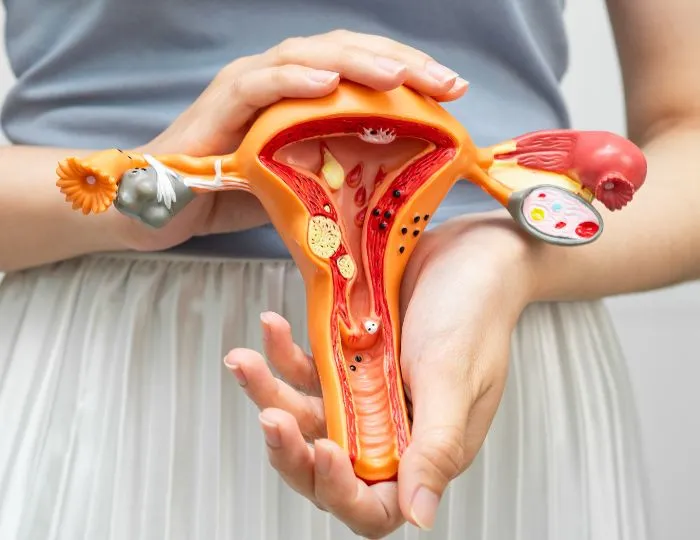
Uterine fibroids, also called uterine leiomyomas or myomas, are non-cancerous growths of muscle and fibrous tissue that develop within or on the wall of the uterus.
They are extremely common and are found in approximately 30 to 40 percent of women of reproductive age in India, though many women with fibroids have no symptoms at all and only discover them during a routine pelvic ultrasound.
When fibroids do cause symptoms, the nature and severity of those symptoms depends primarily on the size, number, and location of the fibroids. The most common and often most troublesome symptom is abnormal uterine bleeding.
This typically presents as periods that are heavier than normal with large clots, periods that last longer than seven days, and in some cases bleeding between periods. Severe menstrual blood loss from fibroids is a leading cause of iron deficiency anemia in women in India.
A feeling of pelvic pressure, heaviness, or fullness in the lower abdomen is another very common symptom, particularly with larger fibroids.
Fibroids pressing on the bladder cause frequent urination or difficulty emptying the bladder completely. Fibroids pressing on the rectum can cause constipation or a feeling of incomplete bowel emptying. Lower back pain is also frequently reported by women with posterior uterine fibroids.
Fibroids located inside the uterine cavity, called submucosal fibroids, are the type most likely to affect fertility and increase the risk of miscarriage. They distort the uterine cavity in a way that interferes with embryo implantation and early pregnancy development.
Most fibroids are discovered on a pelvic ultrasound performed either as a routine examination or when investigating symptoms like heavy periods or pelvic discomfort.
If you are experiencing any of these symptoms, a simple pelvic ultrasound is all that is needed to identify whether fibroids are present and to assess their size and location.
Contact Shree Hospitals on 1800-268-4000 to book a fibroid assessment with our specialist gynaecology team in Mumbai today.
Important FAQs: Uterine Fibroids
Do all fibroids need to be treated?
No. Many women with fibroids have no symptoms at all and their fibroids are found incidentally during a routine ultrasound. Asymptomatic fibroids that are not causing heavy bleeding, pelvic pressure, or fertility problems generally do not need treatment and can be monitored with periodic ultrasound scans to check for growth. Treatment is recommended when fibroids are causing symptoms that significantly affect quality of life, when they are large and growing rapidly, when they are causing or contributing to fertility problems, or when they are causing complications such as urinary obstruction or severe anaemia.
Can fibroids become cancerous?
The malignant transformation of a uterine fibroid into a uterine sarcoma is extremely rare, occurring in less than 1 in 1000 fibroid cases and probably even less commonly than that. The vast majority of fibroids are entirely benign and have no cancer risk. However, if a fibroid is growing unusually rapidly, particularly after menopause when fibroid growth should normally stop, this warrants further investigation to rule out the rare possibility of a uterine sarcoma. Our fibroid doctor in Mumbai will advise on the appropriate level of monitoring for your specific fibroid characteristics.
Can I get pregnant after a myomectomy?
Yes. Myomectomy is specifically designed to remove fibroids while preserving the uterus and its ability to carry a pregnancy. Many women conceive successfully after laparoscopic or hysteroscopic myomectomy. The time recommended before trying to conceive after surgery varies based on the extent of the procedure. After a laparoscopic myomectomy involving the uterine wall, most surgeons recommend waiting three to six months before attempting conception to allow adequate uterine healing. After a hysteroscopic myomectomy with no involvement of the uterine wall, the waiting period is usually much shorter. Our team will give you specific guidance based on your individual surgical findings.
Do fibroids shrink after menopause?
Yes. Uterine fibroids are oestrogen-dependent, meaning they grow in response to the higher oestrogen levels present during the reproductive years. After menopause when oestrogen levels fall significantly, most fibroids shrink naturally and symptoms associated with them, including heavy bleeding which stops at menopause, usually resolve. This is why women who are close to menopause and have manageable fibroid symptoms are sometimes advised to manage conservatively and wait for natural menopause rather than undergoing surgery. However, fibroids that do not shrink after menopause or that grow after menopause require further investigation.
What is the difference between fibroids and ovarian cysts?
Fibroids are solid muscle growths that develop within the wall of the uterus or on its surface. Ovarian cysts are fluid-filled sacs that develop within or on the surface of the ovaries. They are entirely different conditions arising from different organs and require different investigations and treatments. Both can be detected on a pelvic ultrasound and both can cause pelvic symptoms. However, they behave differently, have different causes, and their management depends on their specific characteristics. A thorough ultrasound examination and specialist gynaecology assessment will differentiate between the two accurately.
How long is recovery after fibroid surgery?
Recovery time after fibroid surgery depends on the type of procedure performed. After hysteroscopic fibroid removal, most women are able to go home the same day and return to normal activities within three to five days. After laparoscopic myomectomy, most patients are discharged within one to two days and return to light activities within two weeks, with full recovery within four to six weeks. After open abdominal myomectomy, recovery takes longer, typically six to eight weeks. After laparoscopic hysterectomy, recovery is generally four to six weeks. Our surgical team will give you a specific recovery timeline before your procedure.
When should I see a fibroid specialist in Mumbai?
Book an appointment at Shree Hospitals at our fibroid treatment centre in Mumbai India if your periods are significantly heavier or longer than they used to be, if you are using more sanitary protection than usual and passing large clots, if you are experiencing pelvic pressure, urinary frequency, or lower back pain, if a routine scan has found fibroids and you want expert guidance on whether treatment is needed, if you are having difficulty conceiving and fibroids have been identified, or if your anaemia blood tests show you are becoming iron deficient from heavy bleeding. Call 1800-268-4000 to book with our best fibroid specialist in Mumbai today.
Treatments For Uterine Fibroids at Shree Hospitals
Uterine fibroid treatment in Mumbai at Shree Hospitals covers the complete spectrum from watchful waiting and medical management for asymptomatic or mildly symptomatic fibroids to advanced minimally invasive myomectomy, hysteroscopic fibroid removal, uterine artery embolisation, and laparoscopic hysterectomy for women with significant symptoms or fertility concerns.
Laparoscopic Myomectomy for Fibroid Removal
Laparoscopic myomectomy is a minimally invasive keyhole surgery that removes fibroids from the uterus through small abdominal incisions while preserving the uterus completely. Our specialist surgeons have performed hundreds of laparoscopic myomectomies including complex cases with large or multiple fibroids, achieving excellent symptom relief and uterine preservation with minimal blood loss and a rapid recovery for most patients.
Hysteroscopic Fibroid Removal
Submucosal fibroids that protrude into the uterine cavity are removed hysteroscopically through the cervix using a thin camera and surgical instrument, requiring no external cuts and allowing patients to return home the same day in most cases. This is the most effective treatment for submucosal fibroids causing heavy bleeding or fertility problems and delivers excellent and lasting symptom relief.
Uterine Artery Embolisation (UAE)
UAE is a non-surgical treatment performed by our interventional radiology team in which tiny particles are injected into the uterine arteries through a small groin catheter to block the blood supply to fibroids. With no surgical incision, a shorter hospital stay, and a faster return to normal activity than surgery, UAE is an excellent option for women with significant fibroid symptoms who wish to avoid an operation.
Medical Therapy and Pre-Surgical Fibroid Shrinkage
GnRH agonist injections can reduce fibroid size by 30 to 50 percent over three months before surgery, making a laparoscopic approach possible in cases where fibroids are initially too large for minimally invasive surgery, and reducing intraoperative blood loss. Our team also provides medical treatment for heavy bleeding including tranexamic acid, hormonal therapy, and iron infusion for pre-operative anaemia correction.
Obstetricians & Gynaecologists in Mumbai

Dr. Manvi Verma
Cosmetic Gynecologist

Dr. Paresh Patel
Consultant Urologist, Andrologist & Endourologist

Dr. Reshma Nair
Consultant Obstetrician & Gynecologist
Dr. Jyoti Saigaonkar
Senior Obstetrician, Gynecologist & Family Physician

For Appointment/Query
1800-268-4000

Tele consultation/2nd Opinion
Schedule Consultation

News & Updates
Shree Hospitals Expands Paediatric Surgical Care With Latest Technology
Shree Hospitals Installs a Robotic-Assisted Surgical System for Better Patient Care


