 Ghatkopar (East), Mumbai)

Breast Cancer Surgery
A breast cancer diagnosis requires immediate, expert surgical decision-making, and the outcome depends on the experience of the team managing it.
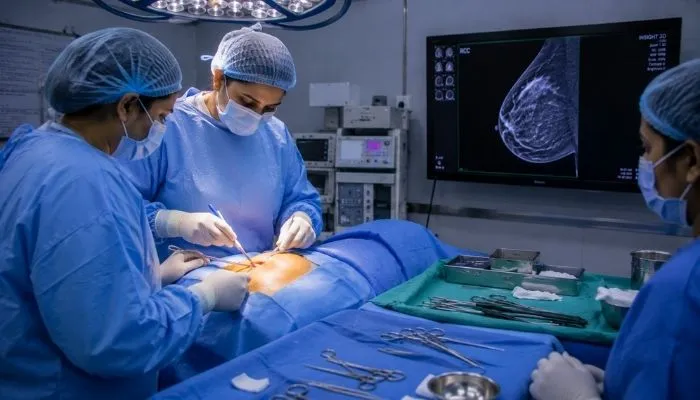
Breast cancer surgery in Mumbai at Shree Hospitals is led by dedicated breast surgical oncologists operating within a full multidisciplinary team (MDT) of oncologists, radiologists, pathologists, and reconstructive surgeons.
We prioritise breast conservation; lumpectomy with clear margins is the surgical standard for early-stage disease, while mastectomy with immediate reconstruction is offered where required.
Every patient's case is reviewed at the MDT before surgery. Sentinel node biopsy is performed in all clinically node-negative patients, and oncoplastic surgery techniques maintain cosmetic outcome without compromising oncological safety.
Book Appointment | Find Specialists
Quick facts
Type & Duration: Lumpectomy (30–60 min) or mastectomy with or without reconstruction (2–5 hours depending on type)
Hospital Stay: 1 to 2 days for lumpectomy; 3 to 5 days for mastectomy with reconstruction
Recovery Time: 2 to 3 weeks return to light activity; 4 to 6 weeks full recovery
Type of Anesthesia: General anaesthesia
Type of Surgery: Open breast surgery — lumpectomy, mastectomy, oncoplastic surgery, with sentinel node biopsy or axillary clearance
Type of Assistance: MDT pre-operative review, surgical excision with margin assessment, sentinel node biopsy, reconstructive options, post-operative oncology coordination
What is Breast Cancer Surgery?
Breast cancer surgery removes the tumour from the breast and assesses or treats the axillary (armpit) lymph nodes. The two primary operations are lumpectomy removal of the tumour with a margin of normal tissue, preserving the breast and mastectomy removal of the entire breast.
The choice between them depends on tumour size relative to breast size, tumour location, patient preference, genetic factors (BRCA1/2), and whether multiple tumours are present.
Breast conservation with lumpectomy followed by radiotherapy produces equivalent long-term survival to mastectomy for most early-stage breast cancers. Where mastectomy is required, immediate breast reconstruction using implants, tissue expanders, or the patient's own tissue (TRAM, DIEP, or latissimus dorsi flap) is offered at the same operation.
Sentinel node biopsy identifies the first lymph node(s) that drain the breast tumour. If the sentinel node is clear, full axillary node clearance is avoided, significantly reducing the risk of arm lymphoedema. Oncoplastic surgery combines cancer surgery principles with plastic surgery techniques to maintain breast shape and symmetry, particularly for larger tumours or challenging locations.
Understanding Your Diagnosis
- Tumour size, grade, and hormone receptor status (ER, PR, HER2) determine surgical and systemic treatment options
- Staging investigations: mammogram, ultrasound, MRI breast, core biopsy — all completed before surgical planning
- Multidisciplinary team (MDT) review: every case discussed by surgeons, oncologists, radiologists, and pathologists before the operation
- BRCA1/2 testing considered in young patients, strong family history, or triple-negative breast cancer
- Neoadjuvant chemotherapy (before surgery): offered to shrink large tumours and improve breast conservation eligibility
- All surgical decisions are made based on tumour biology, not just tumour size
Surgical Options at Shree Hospitals
- Lumpectomy (wide local excision): tumour removed with clear margins; breast preserved; followed by radiotherapy
- Mastectomy: entire breast removed; indicated for large tumours, multiple foci, BRCA carriers, or patient choice
- Skin-sparing or nipple-sparing mastectomy: preserves the skin envelope and nipple where oncologically safe — optimises reconstruction result
- Oncoplastic surgery: reshapes the breast tissue after lumpectomy to maintain contour and symmetry — includes therapeutic mammoplasty
- Immediate breast reconstruction: implant, tissue expander, or autologous flap reconstruction at the time of mastectomy
- Axillary surgery: sentinel node biopsy as standard for clinically node-negative disease; axillary clearance for node-positive disease
After Surgery Adjuvant Treatment
- Radiotherapy: standard after lumpectomy and in selected mastectomy cases with high-risk features
- Hormonal therapy (tamoxifen or aromatase inhibitors): for ER/PR-positive cancers — 5 to 10 years
- Chemotherapy: for high-risk or node-positive cancers — typically 4 to 6 cycles post-operatively
- HER2-targeted therapy (trastuzumab): for HER2-positive cancers — 12 months of IV infusion
- CDK4/6 inhibitors and other targeted agents: for metastatic or high-risk hormone receptor-positive disease
- Follow-up: annual mammography, physical examination at 6 months and 12 months, then annually
Breast cancer surgery outcomes depend on early detection, expert surgery, and coordinated MDT care. At Shree Hospitals, every patient is reviewed at MDT before the operation no surgical decision is made in isolation.
A breast cancer diagnosis is life-changing, but with the right surgical expertise, it is a challenge that can be effectively treated. Our breast cancer surgeons have successfully managed complex cases, delivering precise, personalized care with a focus on the best possible outcomes. The right expertise changes the outcome.
24×7 Emergency Care
Our Approach to Breast Cancer Surgery
Our breast surgical oncology team at Shree Hospitals treats every breast cancer case as unique with MDT review, breast conservation as the default goal, and reconstruction available at the time of mastectomy.
24×7 Emergency Care
MDT-Led Surgical Planning
- Every new breast cancer case presented at weekly MDT before surgical consent
- Imaging, biopsy, and receptor status reviewed collectively by surgeons, oncologists, radiologists, and pathologists
- Neoadjuvant chemotherapy considered for large or locally advanced tumours to downstage before surgery
- Surgical plan communicated to patient with full discussion of options, risks, and reconstruction choices
Margin Assessment and Oncological Safety
- Intraoperative specimen X-ray confirms tumour excision before wound closure in lumpectomy
- Cavity shavings taken routinely to reduce re-excision rates
- Re-excision rate under 10% — below published national benchmarks
- Margin status confirmed on final histopathology within 5 working days
Sentinel Node Biopsy and Axillary Management
- Sentinel node biopsy performed under dual-tracer technique (radioactive colloid + blue dye) in all clinically node-negative patients
- OSNA (one-step nucleic acid amplification) intraoperative assessment of sentinel node available for immediate decision-making
- Axillary lymph node clearance performed for clinically or biopsy-confirmed node-positive disease
- Lymphoedema physiotherapy initiated early for all patients undergoing axillary surgery
Reconstruction and Cosmetic Outcome
- Immediate implant-based reconstruction for skin-sparing or nipple-sparing mastectomy
- Autologous reconstruction (DIEP, TRAM, LD flap) for patients preferring natural tissue or post-radiation reconstruction
- Oncoplastic surgery for larger tumour-to-breast ratio lumpectomy cases — maintaining symmetry without compromising margins
- Contralateral symmetrising procedures offered at same admission where appropriate
Top Breast Cancer Surgeons in Mumbai
Our breast surgical oncology team at Shree Hospitals brings together surgeons trained at India's leading cancer centres, with expertise in breast conservation, oncoplastic surgery, and immediate reconstruction.
24×7 Emergency Care

Dr. Vivek Sukumar
Consultant Surgical Oncologist

Dr. Amit Gandhi
Consultant Surgical Oncologist
Dr. Kaustubh Burde
Consultant Interventional Cardiologist

Dr. Prasad Kasbekar
AI & Robotic Cancer Surgery
Related Treatments
Revision joint replacement sits at the complex end of a full joint care spectrum. For patients at earlier stages of joint disease or for those who require primary replacement as a precursor to eventual revision our programme covers the full pathway
Chemotherapy
Precision systemic therapy: neoadjuvant and adjuvant protocols.
Immunotherapy
Checkpoint inhibitor therapy for triple-negative breast cancer.
Step by Step Process of Breast Cancer Surgery
Step 1 — Pre-Operative Assessment and MDT Review
Staging investigations (mammogram, ultrasound, MRI breast, CT chest/abdomen/pelvis if indicated) are completed before MDT presentation. Core biopsy result with receptor profile (ER, PR, HER2, Ki67) is reviewed.
The MDT surgeons, medical oncologist, radiation oncologist, radiologist, and pathologist agrees a treatment plan. Neoadjuvant chemotherapy is recommended for eligible patients. Surgical options (lumpectomy vs mastectomy, reconstruction type) are discussed with the patient.
Step 2 — Sentinel Node Biopsy and Axillary Staging
On the morning of surgery, a radioactive tracer is injected around the tumour site. In theatre, blue dye is also injected. The gamma probe identifies the sentinel lymph node(s), which are excised and sent for intraoperative or standard histopathological assessment.
Node-negative result: axillary clearance is avoided. Node-positive result: level II axillary clearance is performed.
Step 3 — Tumour Excision and Margin Assessment
For lumpectomy: the tumour is excised with a margin of normal breast tissue; specimen X-ray confirms complete excision before closure; cavity shavings are taken; oncoplastic reshaping restores contour.
For mastectomy: the entire breast is removed with skin-sparing technique where possible; immediate reconstruction with implant or tissue flap proceeds at the same operation.
Step 4 — Post-Operative Care and Oncology Coordination
Histopathology result including margins, nodal status, and full receptor profile is reviewed at MDT within 5 working days.
Adjuvant treatment plan radiotherapy, chemotherapy, hormonal therapy, or HER2-targeted therapy is discussed with the patient and commenced. Follow-up mammography is arranged from year 1. Lymphoedema physiotherapy is initiated for axillary surgery patients.
Patient Questions About Breast Cancer Surgery
Will I Lose My Breast After Breast Cancer Surgery?
Not necessarily. Breast conservation with lumpectomy is the surgical goal for most early-stage breast cancers, and it produces equivalent long-term survival to mastectomy for tumours where clear margins can be achieved. The decision to perform mastectomy depends on tumour size relative to breast size, tumour location, multiple tumour foci, BRCA1/2 carrier status, or the patient's own preference. Where mastectomy is recommended, immediate breast reconstruction using an implant or the patient's own tissue means waking up with a reconstructed breast. The choice is made collaboratively at MDT and then discussed in detail with the patient before consent.
How Will I Know If the Cancer Has Spread to My Lymph Nodes?
Sentinel node biopsy is the standard way to assess the axillary lymph nodes without the morbidity of full axillary clearance. On the day of surgery, a radioactive tracer and blue dye are used to identify the sentinel node the first node that drains the breast tumour. This node is removed and examined. If it is free of cancer, the remaining axillary nodes are very unlikely to be involved and clearance is avoided. If the sentinel node contains cancer cells, full axillary lymph node clearance is performed. Pre-operative ultrasound of the axilla and biopsy of suspicious nodes can also identify lymph node involvement before surgery.
What Happens After Surgery Do I Need More Treatment?
Most breast cancer patients require adjuvant (post-operative) treatment. After lumpectomy, radiotherapy to the remaining breast tissue is standard it significantly reduces local recurrence. Hormonal therapy (tamoxifen or aromatase inhibitors) is prescribed for 5 to 10 years for ER/PR-positive cancers. Chemotherapy is recommended for high-risk or node-positive disease. HER2-positive cancers receive trastuzumab (Herceptin) for 12 months. The adjuvant treatment plan is determined by the final histopathology result — tumour grade, size, node status, and receptor profile — and agreed at MDT before discussion with the patient.
Can Breast Cancer Surgery Be Done If I Had Chemotherapy First?
Yes, surgery after neoadjuvant (pre-operative) chemotherapy is well-established and in many cases preferred. Neoadjuvant chemotherapy shrinks the tumour before surgery, converting some patients who would otherwise require mastectomy into candidates for breast conservation. It also allows in vivo assessment of tumour response to chemotherapy a complete pathological response (no residual cancer at surgery) is a strong favourable prognostic indicator. Post-neoadjuvant residual disease may prompt additional systemic treatment decisions. Surgery follows completion of neoadjuvant therapy, typically 3 to 4 weeks after the last chemotherapy cycle.
Is Immediate Breast Reconstruction Safe After Mastectomy?
Immediate breast reconstruction is safe and is now considered the standard of care after mastectomy for eligible patients. It avoids the psychological impact of waking without a breast and produces superior cosmetic results compared to delayed reconstruction. Implant-based reconstruction uses a tissue expander or direct-to-implant technique under the pectoralis major muscle or with an acellular dermal matrix. Autologous reconstruction using the DIEP or TRAM flap uses the patient's own abdominal tissue to create a natural breast mound. The choice of reconstruction depends on body habitus, smoking status, planned radiotherapy, and patient preference. Post-mastectomy radiotherapy can be delivered after reconstruction with acceptable complication rates in most cases.

Evidence-Based Case Studies by Our Specialists
Would Recommend Us
Early Breast Cancer Successfully Treated with Breast-Conserving Surgery
"I was diagnosed with early breast cancer and was worried about losing my breast. My team recommended a lumpectomy with sentinel node biopsy, which successfully removed the tumour with clear margins. The lymph nodes were negative, and I was discharged on day two. After completing radiotherapy and hormone therapy, I remain disease-free with my breast preserved."
Mrs. Priya, K
BRCA2-Associated Breast Cancer Successfully Treated with Bilateral Nipple-Sparing Mastectomy and Reconstruction
"After my breast cancer diagnosis, genetic testing revealed a BRCA2 mutation. I underwent bilateral nipple-sparing mastectomy with immediate implant reconstruction to treat the cancer and reduce future risk. The surgery was successful, and I achieved a natural, symmetrical reconstruction. I returned to my normal routine with renewed confidence."
Mrs. Sunita, U
Locally Advanced Breast Cancer Successfully Treated with Neoadjuvant Therapy and Breast Conservation
"I was diagnosed with HER2-positive breast cancer and underwent chemotherapy with targeted therapy before surgery. The treatment completely eliminated the tumour, allowing me to have breast-conserving surgery instead of a mastectomy. I completed my treatment and remain disease-free with preserved breast function."
Mrs. Rekha, R
Patient
Resources

Schedule consultation

Billing & Payments

Health Packages

Hospital Facilities
24×7 Emergency Care

1800-268-4000

News & Updates
Shree Hospitals is the first to perform robotic endo surgery.
Shree Hospitals Introduces Advanced Robotic Surgery for Better Patient Care
Shree Hospitals Expands Advanced Surgical Care With Latest Medical Technology
Health Center
Exploring the Future of Telemedicine: What’s Next for Healthcare?
The Rise of Renewable Energy: Innovations in Sustainability
Follow Us

Shree
Hospitals

Shree
Hospitals
