 Ghatkopar (East), Mumbai)

Chemotherapy
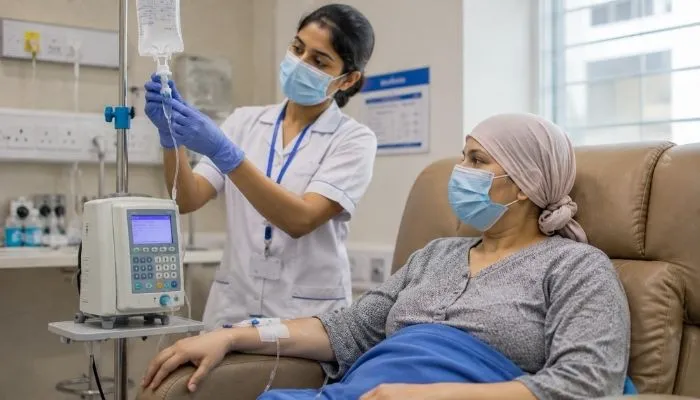
Chemotherapy is the backbone of systemic cancer treatment but its safety and effectiveness depend entirely on correct protocol selection, accurate dosing, and proactive side-effect management. Chemotherapy in Mumbai at Shree Hospitals is delivered through a dedicated oncology infusion unit with MDT-led chemotherapy protocol selection for every patient.
Our medical oncologists determine whether neoadjuvant chemotherapy (before surgery), adjuvant chemotherapy (after surgery), or palliative chemotherapy (for advanced or metastatic disease) is appropriate and calculate weight- and surface-area-based dosing for every cycle.
Antiemetic therapy, growth factor support, and haematological monitoring are integrated into every protocol.
Book Appointment | Find Specialists
Quick facts
Type & Duration: Intravenous infusion cycles every 2 to 4 weeks; cycle duration 30 minutes to 8 hours depending on chemotherapy protocol
Hospital Stay: Most cycles administered as day-care; inpatient admission for high-dose or complex regimens
Recovery Time: Varies by protocol — between cycles, 7 to 21 days for bone marrow recovery
Type of Anesthesia: Not applicable; intravenous access via peripheral cannula or implanted port
Type of Surgery: Not applicable systemic drug delivery
Type of Assistance: MDT protocol review, body surface area dosing calculation, pre-medication and antiemetic therapy, haematological monitoring, growth factor support, nutritional assessment
What is Chemotherapy?
Chemotherapy uses cytotoxic drugs to kill cancer cells or prevent them from dividing. It acts systemically reaching cancer cells throughout the body, unlike surgery or radiotherapy which are localised treatments. This makes it essential for cancers that may have spread beyond the primary site or for reducing tumour bulk before local treatment.
Neoadjuvant chemotherapy is given before surgery to shrink the primary tumour improving the chance of complete surgical removal, enabling breast conservation in breast cancer, and testing tumour response to drugs in vivo. Adjuvant chemotherapy is given after surgery to eliminate microscopic cancer cells that may remain after the visible tumour has been removed, reducing the risk of recurrence.
Palliative chemotherapy is given in advanced or metastatic disease to reduce tumour burden, control symptoms, and prolong survival not to cure.
The chemotherapy protocol the specific drugs, doses, timing, and number of cycles is determined by tumour type, stage, histology, molecular markers, performance status, and organ function.
Protocols are standardised (AC-T for breast cancer; FOLFOX for colorectal; GemCis for lung; BEP for testicular) but individualised in dose based on body surface area.
Who Needs Chemotherapy?
- Confirmed cancer diagnosis on histopathology — chemotherapy is never started empirically
- Neoadjuvant chemotherapy: for locally advanced breast, rectal, gastric, or oesophageal cancers before surgery
- Adjuvant chemotherapy: for high-risk colorectal, breast, gastric, or lung cancer after complete surgical resection
- Palliative chemotherapy: for metastatic or inoperable cancer — controls disease and improves quality of life
- Haematological malignancies (lymphoma, leukaemia): chemotherapy is the primary treatment modality
- Concurrent chemoradiotherapy: radiosensitising chemotherapy given alongside radiotherapy in head and neck, cervical, rectal, and lung cancers
Chemotherapy Administration at Shree Hospitals
- Dedicated oncology infusion unit with trained oncology nurses
- Peripheral IV cannula or implanted port (portacath) — for patients requiring multiple cycles
- Pre-medication: antiemetic therapy (ondansetron, dexamethasone, fosaprepitant) administered before every infusion
- Vital signs monitored throughout infusion — blood pressure, pulse, oxygen saturation
- Infusion reaction protocol in place — emergency treatment immediately available
- Day-care administration for most protocols; inpatient for high-dose regimens (HDAC, high-dose methotrexate)
Managing Side Effects
- Antiemetic therapy: triple-drug regimen for highly emetogenic protocols (cisplatin-based) — nausea and vomiting significantly reduced
- Haematological toxicity: FBC checked before every cycle; cycle delayed or dose reduced if counts insufficient
- G-CSF (granulocyte colony-stimulating factor): growth factor injections to prevent febrile neutropenia in high-risk protocols
- Peripheral neuropathy: dose modification for oxaliplatin or taxane-induced neuropathy
- Alopecia counselling and wig referral offered before treatment begins
- Nutritional support: dietitian review for patients with significant nausea, weight loss, or mucositis
The choice of chemotherapy protocol drug combination, dose intensity, and number of cycles directly determines treatment outcome and tolerability. At Shree Hospitals, every protocol is selected at MDT and reviewed before each cycle. No chemotherapy is started without confirmed histological diagnosis and MDT consensus.
Chemotherapy safety depends on protocol selection, accurate dosing, and proactive toxicity management. At Shree Hospitals, every chemotherapy cycle is preceded by haematological review and supervised by dedicated oncology nursing staff.
24×7 Emergency Care
Our Approach to Chemotherapy
Our medical oncology team at Shree Hospitals delivers evidence-based chemotherapy protocols from neoadjuvant chemotherapy before surgery to palliative chemotherapy in advanced disease with MDT oversight at every stage.
24×7 Emergency Care
MDT Protocol Selection
- Tumour histology, grade, molecular markers, stage, and performance status reviewed at MDT before first cycle
- National and international guideline-based chemotherapy protocol selection (NCCN, ESMO, AIIMS protocols)
- Body surface area and renal/hepatic function calculated for accurate dosing — no protocol is started with subtherapeutic or overdose
- Dose modification criteria pre-specified at treatment start — haematological, renal, hepatic, and clinical thresholds agreed
Pre-Cycle Review and Haematological Monitoring
- Full blood count (FBC), renal profile, liver function tests, and electrolytes checked before every cycle
- Cycle withheld if neutrophil count insufficient — preventing febrile neutropenia hospitalisation
- Cisplatin-containing protocols require hydration protocol to protect renal function — structured over 4 to 8 hours
- Cardiac assessment for anthracycline protocols (echocardiogram baseline and repeat every 3 cycles)
Infusion Safety and Reaction Management
- Sentinel node biopsy performed under dual-tracer technique (radioactive colloid + blue dye) in all clinically node-negative patients
- OSNA (one-step nucleic acid amplification) intraoperative assessment of sentinel node available for immediate decision-making
- Axillary lymph node clearance performed for clinically or biopsy-confirmed node-positive disease
- Lymphoedema physiotherapy initiated early for all patients undergoing axillary surgery
Response Assessment and Protocol Adaptation
- Imaging (CT scan or PET-CT) performed after 2 to 3 cycles to assess tumour response
- Non-responding tumours: protocol changed based on second-line evidence — no continuation of ineffective treatment
- Neoadjuvant chemotherapy response guides surgical timing and adjuvant treatment decision
- Treatment completion review at MDT — adjuvant, maintenance, or surveillance plan agreed
Top Breast Cancer Surgeons in Mumbai
Our breast surgical oncology team at Shree Hospitals brings together surgeons trained at India's leading cancer centres, with expertise in breast conservation, oncoplastic surgery, and immediate reconstruction.
24×7 Emergency Care

Dr. Vivek Sukumar
Consultant Surgical Oncologist

Dr. Amit Gandhi
Consultant Surgical Oncologist
Dr. Kaustubh Burde
Consultant Interventional Cardiologist

Dr. Prasad Kasbekar
AI & Robotic Cancer Surgery
Related Treatments
Revision joint replacement sits at the complex end of a full joint care spectrum. For patients at earlier stages of joint disease or for those who require primary replacement as a precursor to eventual revision our programme covers the full pathway
GI Cancer Surgery
Neoadjuvant chemotherapy and FLOT/FOLFOX protocols for GI cancers.
Step by Step Process of Chemotherapy at Shree Hospitals
Step 1 — MDT Review and Protocol Selection
Histopathology with full receptor/molecular profile is presented at MDT. Treatment intent (curative neoadjuvant or adjuvant vs palliative) is agreed. The chemotherapy protocol is selected and the number of cycles planned. Baseline investigations FBC, renal and liver function, cardiac assessment if anthracycline or trastuzumab is included are performed. Fertility preservation counselling is offered to patients of reproductive age before cytotoxic treatment.
Step 2 — Cycle 1 Administration
Pre-medications antiemetic therapy and steroid pre-medication are administered 30 minutes before the infusion. A peripheral cannula or portacath is accessed. The chemotherapy infusion begins at the protocol-specified rate under continuous observation by oncology nursing staff. Vital signs are checked every 15 to 30 minutes throughout infusion. The patient is observed for 30 minutes after completion before discharge.
Step 3 — Between-Cycle Monitoring
Blood tests (FBC, renal, liver function) are performed before each subsequent cycle typically 2 to 3 days before the next scheduled infusion. Growth factor injections (G-CSF) are administered for high-risk protocols. Patients are given emergency contact details for fever, infection, or severe nausea between cycles. Nutritional review and antiemetic adjustment are performed at each pre-cycle assessment.
Step 4 — Response Assessment and Completion
CT scan or PET-CT is arranged after 2 to 3 cycles to assess response. Results are reviewed at MDT. Responding patients continue to the planned number of cycles. Non-responding patients have their protocol changed to second-line therapy. After completion, a treatment summary and surveillance plan is provided. Surgical timing is confirmed for neoadjuvant cases.
Patient Questions About Chemotherapy
Will Chemotherapy Make Me Feel Unwell?
Side effects from chemotherapy vary significantly by protocol, dose, and individual patient factors. Nausea is the most feared side effect but is now well-controlled with modern antiemetic therapy triple-drug regimens (ondansetron, dexamethasone, and NK1 receptor antagonist) have dramatically reduced nausea and vomiting for even the most emetogenic protocols. Fatigue is common and typically peaks 5 to 7 days after each cycle. Hair loss occurs with certain protocols (anthracyclines, taxanes) but not all. Bone marrow suppression reducing blood counts is the most clinically important toxicity and is monitored with blood tests before every cycle. Most side effects are temporary and resolve after treatment ends. The oncology team at Shree Hospitals provides written guidance on what to expect and when to seek urgent review between cycles.
How Many Cycles of Chemotherapy Will I Need?
The number of cycles depends on the cancer type, stage, treatment intent, and protocol selected. Adjuvant chemotherapy for breast cancer typically involves 4 to 8 cycles over 3 to 6 months (for example, AC × 4 then paclitaxel × 12 weeks). Neoadjuvant chemotherapy for rectal cancer is usually 4 to 6 cycles before surgery. Palliative chemotherapy continues until maximum response, unacceptable toxicity, or progression — with response assessed by imaging after every 2 to 3 cycles. The treatment plan is discussed at MDT and communicated to you before the first cycle. The number of planned cycles can be revised at any point based on your response and tolerance.
Can Chemotherapy Be Given If My Blood Counts Are Low?
Not without modification. Before every cycle at Shree Hospitals, a full blood count is checked to confirm that white blood cells (particularly neutrophils), platelets, and haemoglobin are at safe levels. If the neutrophil count is below the protocol threshold, the cycle is delayed for 1 to 2 weeks and rechecked. Dose reduction may be required after severe haematological toxicity. Growth factor injections (G-CSF, such as filgrastim) are prescribed for high-risk protocols to stimulate white blood cell recovery between cycles — significantly reducing the risk of febrile neutropenia hospitalisation. Platelet transfusion is used for severe thrombocytopenia. Red blood cell transfusion or erythropoiesis-stimulating agents are used for symptomatic anaemia during treatment.
Is Chemotherapy Given Before or After Surgery?
It depends on the cancer type and stage. Neoadjuvant chemotherapy is given before surgery when the aim is to shrink the tumour, improve surgical resectability, convert an inoperable lesion to operable, test tumour chemosensitivity in vivo, or increase the chance of organ preservation (such as breast conservation in breast cancer). It is standard for locally advanced breast cancer, rectal cancer, gastric cancer, and oesophageal cancer. Adjuvant chemotherapy is given after complete surgical resection when there is a significant risk of occult micrometastatic disease — standard for high-risk colon cancer, node-positive breast cancer, and resected non-small cell lung cancer. Some cancers receive both neoadjuvant and adjuvant chemotherapy. The sequence is agreed at MDT and individualised to each patient's circumstances.
Will Chemotherapy Affect My Fertility?
Some chemotherapy drugs — particularly alkylating agents (cyclophosphamide, ifosfamide) and platinum agents at high cumulative doses — can impair fertility in both men and women. The degree of risk depends on the specific drugs, total dose, and patient age. Fertility preservation should be discussed before starting any potentially gonadotoxic chemotherapy protocol. Options include sperm banking for men, embryo freezing (if a partner is available), oocyte (egg) freezing, or ovarian tissue cryopreservation. Fertility preservation can usually be arranged within 2 to 4 weeks without significantly delaying treatment. At Shree Hospitals, all patients of reproductive age are counselled about fertility risk and referred to reproductive medicine specialists before neoadjuvant or adjuvant chemotherapy begins.

Evidence-Based Case Studies by Our Specialists
Would Recommend Us
Breast Cancer Successfully Treated with Neoadjuvant Chemotherapy
"After being diagnosed with HER2-positive breast cancer, I underwent chemotherapy before surgery to shrink the tumour. The treatment worked exceptionally well, allowing me to have breast-conserving surgery instead of a mastectomy. I completed my recommended targeted therapy, and my follow-up visits over the past two years have shown no evidence of disease."
Mrs. Seema, J
Stage III Colon Cancer Successfully Managed with Adjuvant Chemotherapy
"Following surgery for colon cancer, I completed my recommended course of chemotherapy. Although one cycle was briefly delayed because of low blood counts, my treatment was adjusted and completed successfully. My follow-up scans over the past three years continue to show no evidence of cancer recurrence, allowing me to return to my normal routine with confidence."
Mr. Rajan, L
Recurrent Ovarian Cancer Successfully Managed with Chemotherapy
"When my ovarian cancer returned, I underwent another course of chemotherapy. The treatment was well tolerated, and my scans showed a good response while my tumour marker returned to normal. Throughout treatment, I was able to maintain my daily activities and quality of life, and I continue regular follow-up with confidence."
Mrs. Kavitha, U
Patient
Resources

Schedule consultation

Billing & Payments

Health Packages

Hospital Facilities
24×7 Emergency Care

1800-268-4000

News & Updates
Shree Hospitals is the first to perform robotic endo surgery.
Shree Hospitals Introduces Advanced Robotic Surgery for Better Patient Care
Shree Hospitals Expands Advanced Surgical Care With Latest Medical Technology
Health Center
Exploring the Future of Telemedicine: What’s Next for Healthcare?
The Rise of Renewable Energy: Innovations in Sustainability
Follow Us

Shree
Hospitals

Shree
Hospitals
