 Ghatkopar (East), Mumbai)


GI Cancer Surgery
Gastrointestinal cancers of the colon, rectum, stomach, oesophagus, liver, pancreas, and gallbladder are among the most common cancers treated at Indian oncology centres, and their outcomes depend critically on the completeness of surgical resection and the coordination of systemic treatment.
GI Cancer Surgery in Mumbai at Shree Hospitals is led by specialist GI surgical oncologists with expertise in laparoscopic and robotic resection across the full GI tract. Colorectal cancer surgery, including total mesorectal excision for rectal cancer, is performed with curative intent and meticulous lymphadenectomy.
Gastrectomy with D2 lymph node dissection for gastric cancer, hepatectomy for liver cancer and colorectal liver metastases, and the Whipple procedure (pancreaticoduodenectomy) for pancreatic and periampullary cancers are performed by a dedicated high-volume team. All cases are reviewed at the GI oncology MDT before surgery.
Book Appointment | Find Specialists
Quick facts
Type & Duration: Variable by site laparoscopic colectomy 2–3 hours; total mesorectal excision 3–5 hours; gastrectomy 3–5 hours; Whipple procedure 5–8 hours; hepatectomy 3–6 hours
Hospital Stay: 3 to 5 days for laparoscopic colectomy; 5 to 7 days for major upper GI resections; 7 to 10 days for Whipple procedure
Recovery Time: 4 to 6 weeks for most GI resections; 6 to 8 weeks for Whipple procedure or major hepatic resection
Type of Anesthesia: General anaesthesia; epidural analgesia for open upper GI surgery
Type of Surgery: Laparoscopic, robotic-assisted, or open resection depending on tumour site, stage, and patient fitness
Type of Assistance: MDT pre-operative review, pre-habilitation (nutritional and fitness optimisation), ERAS post-operative protocol, adjuvant chemotherapy coordination
What is GI Cancer Surgery?
GI cancer surgery involves the resection of primary cancers of the oesophagus, stomach, colon, rectum, liver, pancreas, gallbladder, and small intestine along with regional lymph nodes and any immediately adjacent involved structures.
The fundamental oncological principle is the same regardless of site: complete resection with clear surgical margins (R0 resection) and adequate lymphadenectomy to provide accurate pathological staging and maximise the chance of cure.
Colorectal cancer surgery right or left hemicolectomy, sigmoid colectomy, or anterior resection with total mesorectal excision for rectal cancer is the most common GI cancer operation.
Total mesorectal excision (TME) for rectal cancer removes the rectum with its intact mesorectal envelope the fascial package surrounding the rectum that contains the regional lymph nodes. Complete TME significantly reduces local recurrence compared to blunt dissection, and is the international standard for rectal cancer surgery.
Gastrectomy total or subtotal, with D2 lymph node dissection is the standard surgical treatment for resectable gastric cancer. D2 dissection removes the perigastric nodes (D1) plus the nodes along the coeliac trunk, left gastric, common hepatic, and splenic arteries providing superior staging accuracy and improved survival compared to D1 dissection in Eastern surgical experience.
Hepatectomy (liver resection) for hepatocellular carcinoma or colorectal liver metastases, and the Whipple procedure (pancreaticoduodenectomy) for pancreatic head and periampullary cancers, are performed by the same specialist upper GI and hepatopancreaticobiliary (HPB) surgical oncology team.
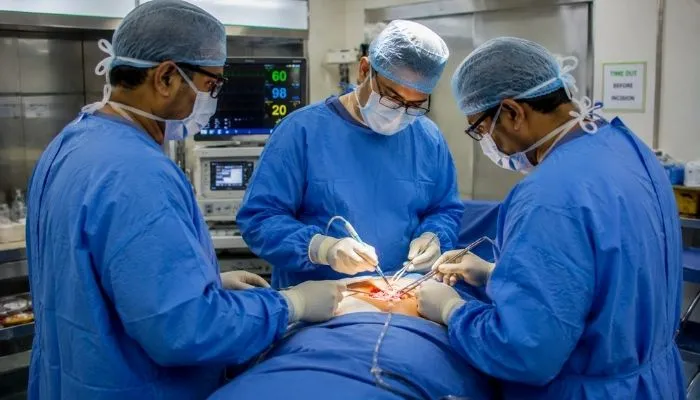
GI Cancers Treated at Shree Hospitals
- Colorectal cancer: colorectal cancer surgery — laparoscopic right/left hemicolectomy, sigmoid resection, anterior resection with total mesorectal excision, abdominoperineal resection for low rectal cancers
- Gastric cancer: gastrectomy (total or subtotal) with D2 lymphadenectomy; laparoscopic or robotic approach for selected cases
- Oesophageal cancer: minimally invasive oesophagectomy (Ivor Lewis); neoadjuvant chemoradiotherapy followed by surgery for T2–T3 resectable disease
- Liver and biliary: hepatectomy for HCC and colorectal liver metastases; cholangiocarcinoma resection; laparoscopic cholecystectomy for gallbladder cancer (selected early-stage)
- Pancreatic cancer: Whipple procedure (pancreaticoduodenectomy) for pancreatic head cancer; distal pancreatectomy + splenectomy for body/tail tumours; borderline resectable disease managed with neoadjuvant chemotherapy then surgery
- Periampullary tumours: ampullary, duodenal, and distal bile duct cancers — all treated with Whipple procedure; better prognosis than pancreatic ductal adenocarcinoma
Neoadjuvant Treatment Before GI Cancer Surgery
- Rectal cancer: neoadjuvant chemoradiotherapy (short-course 5Gy × 5 fractions or long-course 45–50.4Gy with capecitabine) before total mesorectal excision — reduces local recurrence and enables sphincter preservation
- Gastric cancer: perioperative FLOT (docetaxel, oxaliplatin, leucovorin, 5-FU) — 4 cycles before and 4 cycles after gastrectomy — improves resection rates and survival
- Oesophageal cancer: neoadjuvant CROSS regimen (carboplatin + paclitaxel with concurrent radiotherapy) before oesophagectomy — increases complete resection rate and pathological complete response
- Borderline resectable pancreatic cancer: neoadjuvant FOLFIRINOX or gemcitabine + nab-paclitaxel — to downstage tumour and convert to resectable
- All neoadjuvant decisions made at GI oncology MDT — restaging imaging after neoadjuvant treatment before surgical planning
Laparoscopic and Robotic Advantages in GI Cancer Surgery
- Laparoscopic colorectal cancer surgery: equivalent oncological outcomes to open surgery; shorter hospital stay (3 vs 5 days); less post-operative pain; earlier return to normal activity
- Robotic total mesorectal excision: 3D magnification in the narrow male pelvis; better autonomic nerve preservation; lower conversion rates to open than laparoscopic TME
- Laparoscopic gastrectomy: equivalent D2 lymph node yield to open in experienced hands; reduced blood loss; faster recovery for earlier commencement of adjuvant chemotherapy
- Laparoscopic hepatectomy for colorectal liver metastases: reduced blood loss, shorter hospital stay, better post-operative liver function
- Whipple procedure: robotic and laparoscopic approaches available at specialist centres; longer operating time but comparable outcomes in high-volume teams
- Open surgery remains preferred for T4 locally advanced tumours requiring en-bloc multi-organ resection
For rectal cancer, the quality of total mesorectal excision is the single most important surgical determinant of local recurrence more than tumour stage. At Shree Hospitals, all rectal cancer surgery is performed using complete TME technique with mesorectal integrity assessed on the specimen. The circumferential resection margin (CRM) status is reported in every case — a CRM under 1mm is a major risk factor for local recurrence and indicates inadequate surgery.
GI cancer surgery outcomes depend on surgical completeness clear margins, adequate lymphadenectomy, and intact mesorectal envelope for rectal cancer. At Shree Hospitals, every GI cancer operation is reviewed at MDT with staging imaging before the surgical plan is confirmed.
24×7 Emergency Care
Our Approach to GI Cancer Surgery
Our GI surgical oncology team at Shree Hospitals performs laparoscopic, robotic, and open resections across the full GI tract with MDT pre-operative review, neoadjuvant treatment coordination, and structured post-operative oncology follow-up.
24×7 Emergency Care
MDT Review and Staging:
- Staging CT chest/abdomen/pelvis and MRI pelvis (for rectal cancer) reviewed at dedicated GI oncology MDT
- PET-CT for selected cases (oesophageal, hepatic, suspected distant metastasis)
- Resectability assessment: tumour relationship to mesorectal fascia (MRF) for rectal cancer; portal vein, SMA, coeliac axis involvement for pancreatic and upper GI cancers
- Neoadjuvant treatment recommended for eligible patients — surgical timing agreed after restaging
Total Mesorectal Excision Technique
- Sharp mesorectal dissection in the avascular mesorectal plane — preserves hypogastric nerve plexus and pelvic autonomic nerves
- Mesorectal integrity graded (complete, nearly complete, incomplete) on specimen — incomplete TME is associated with higher local recurrence
- Circumferential resection margin (CRM) measured — CRM ≤1mm triggers discussion of adjuvant treatment
- Sphincter preservation: anterior resection preferred over abdominoperineal excision (APE) where distal margin clearance is achievable — temporary loop ileostomy for low anterior resection
Hepatopancreaticobiliary Surgery
- Hepatectomy for HCC: guided by Child-Pugh liver function, tumour size, and remnant liver volume — future liver remnant (FLR) assessment by CT volumetry before major hepatectomy
- Portal vein embolisation (PVE): used to hypertrophy the future liver remnant before major hepatectomy if FLR insufficient
- Whipple procedure: pylorus-preserving pancreaticoduodenectomy (PPPD) standard; classical Whipple for tumours involving pylorus; pancreaticojejunostomy anastomosis technique tailored to pancreatic duct size and texture
- Post-Whipple pancreatic fistula management: drain amylase on day 3 — ISGPS criteria guide management intensity
Post-Operative Recovery and Adjuvant Coordinatio
- ERAS (enhanced recovery after surgery) protocol: pre-operative carbohydrate loading, multimodal analgesia, early feeding day 1, early mobilisation day 1
- Stoma therapy: nurse specialist input pre-operatively for all patients requiring temporary or permanent stoma
- Adjuvant chemotherapy timing: FOLFOX or CAPOX commences 4 to 6 weeks after colorectal cancer surgery; FLOT post-op commences 6 to 8 weeks after gastrectomy
- Surveillance: CT chest/abdomen/pelvis and CEA every 6 months for 3 years, then annually
Top Breast Cancer Surgeons in Mumbai
Our breast surgical oncology team at Shree Hospitals brings together surgeons trained at India's leading cancer centres, with expertise in breast conservation, oncoplastic surgery, and immediate reconstruction.
24×7 Emergency Care

Dr. Vivek Sukumar
Consultant Surgical Oncologist

Dr. Amit Gandhi
Consultant Surgical Oncologist

Dr. Prasad Kasbekar
Consultant Surgical Oncologist

Dr. Preetam Jain
Consultant Medical Oncology
Related Treatments
GI Cancer Surgery is a key component of comprehensive gastrointestinal cancer care. From early-stage cancers managed with curative surgery to complex procedures requiring minimally invasive techniques, multivisceral resections, and multidisciplinary treatment, our programme delivers seamless, precision-focused care across every stage of surgical management.
HIPEC Surgery
Cytoreductive surgery + hyperthermic intraperitoneal chemotherapy for GI peritoneal metastases.
Chemotherapy
FLOT, FOLFOX, CAPOX, FOLFIRINOX — neoadjuvant and adjuvant GI cancer protocols.
Radiation Therapy
Neoadjuvant chemoradiotherapy for rectal and oesophageal cancers.
Robotic Cancer Surgery
Robotic TME, gastrectomy, and hepatectomy.
Targeted Therapy
Anti-EGFR therapy for RAS/RAF wild-type colorectal cancer; HER2-targeted therapy for gastric cancer.
Step by Step Process of GI Cancer Surgery at Shree Hospitals
Step 1 — MDT Staging Review and Resectability Assessment
CT and MRI staging imaging reviewed at GI oncology MDT. Resectability confirmed mesorectal fascia status for rectal cancer; vascular involvement for gastric, oesophageal, and pancreatic cancers; number and distribution of liver metastases. Neoadjuvant treatment recommended where appropriate. Restaging imaging arranged after neoadjuvant treatment before surgical planning is confirmed.
Step 2 — Pre-Operative Optimisation
Nutritional assessment pre-operative nutritional support for patients with significant weight loss (oesophageal and gastric cancer). Cardiorespiratory fitness assessment formal cardiopulmonary exercise testing (CPET) for major resections (Whipple, oesophagectomy, major hepatectomy). Stoma therapy marking for planned stoma cases. Anaesthetic pre-assessment for multi-organ resections.
Step 3 — Surgical Resection
Laparoscopic, robotic, or open resection performed. Oncological principles maintained: R0 resection with clear margins, adequate lymphadenectomy, intact specimen. Intraoperative frozen section for selected margin sites. Anastomosis constructed or defunctioning stoma fashioned. Drain placement as per protocol hepatectomy, Whipple, and anterior resection drains checked on day 3.
Step 4 — Post-Operative Care and Adjuvant Planning
ERAS protocol commenced from theatre. Diet resumed day 1 (colorectal); day 3–4 (upper GI). Drain amylase checked day 3 for Whipple cases. Histopathology reviewed at MDT within 5 to 7 working days stage, margins, and nodal status confirmed. Adjuvant chemotherapy plan agreed. Patient counselled on surveillance schedule.
Patient Questions About GI Cancer Surgery
Can My Bowel Cancer Be Treated Laparoscopically?
Yes — laparoscopic colorectal cancer surgery is the standard of care for most resectable colon and upper rectal cancers. Multiple large randomised controlled trials (CLASICC, COLOR, COST) have confirmed that laparoscopic colectomy produces equivalent oncological outcomes to open surgery — equivalent lymph node yields, equivalent 5-year cancer-specific survival — with shorter hospital stay, less post-operative pain, and faster return to normal activity. For mid and low rectal cancers requiring total mesorectal excision, robotic-assisted TME is increasingly preferred — 3D magnification in the narrow pelvis improves nerve preservation and reduces conversion rates. Not all colorectal cancers are suitable for laparoscopic resection — T4 tumours adherent to adjacent structures, locally advanced tumours requiring multi-organ resection, and emergency presentations with obstruction or perforation may require open surgery. Your surgeon will discuss the approach based on your specific tumour characteristics at pre-operative consultation.
What Is Total Mesorectal Excision and Why Does It Matter?
Total mesorectal excision (TME) is the technique of removing the rectum within its intact fascial envelope — the mesorectum — which contains the perirectal fat and the regional lymph nodes draining the rectum. The critical principle is that this fascial plane is dissected sharply under direct vision, keeping the mesorectal fascia intact rather than tearing through it. A torn or incomplete mesorectal dissection leaves cancer cells behind in the pelvis, resulting in local recurrence in up to 30–40% of cases. Complete TME reduces local recurrence to under 10% in most published series. The circumferential resection margin (CRM) — the distance from the tumour edge to the cut mesorectal surface — is measured by the pathologist on the specimen: a CRM of 1mm or less is an independent risk factor for local recurrence and a marker of a technically difficult or inadequate dissection. At Shree Hospitals, mesorectal integrity and CRM are reported in every rectal cancer case.
Will I Need a Stoma (Bag) After My Bowel Cancer Surgery?
Not necessarily. The decision depends on the level of the rectal tumour and the clinical circumstances. For colon cancer and upper rectal cancer, resection with primary anastomosis (re-joining the bowel) without a stoma is standard in elective cases. For mid and low rectal cancer with total mesorectal excision, a temporary defunctioning loop ileostomy is typically created to protect a low anastomosis — this is reversed after 6 to 12 weeks, once the anastomosis has healed and any adjuvant treatment is completed. A permanent stoma (end colostomy) is required after abdominoperineal excision for very low rectal cancers — where the anus cannot be preserved. Emergency surgery for obstruction or perforation may require a temporary Hartmann's procedure with colostomy, which can sometimes be reversed later. The stoma therapy team at Shree Hospitals provides pre-operative counselling and post-operative support for all stoma patients.
What Is the Whipple Procedure and When Is It Needed?
The Whipple procedure (pancreaticoduodenectomy) is the surgical removal of the head of the pancreas, the duodenum, the first 15cm of jejunum, the gallbladder, and the lower bile duct — with reconstruction of the digestive tract using three anastomoses (pancreaticojejunostomy, hepaticojejunostomy, and gastrojejunostomy). It is the only potentially curative surgical option for cancers of the pancreatic head, periampullary region, ampulla of Vater, and distal bile duct. The Whipple procedure is a major operation with significant surgical complexity — performed in 5 to 8 hours — and is reserved for patients with resectable tumours (no portal vein or superior mesenteric artery involvement) and adequate cardiorespiratory fitness. Borderline resectable tumours are treated with neoadjuvant chemotherapy first, then reassessed for surgery. At high-volume centres, the post-operative complication rate and hospital mortality are acceptable — pancreatic fistula is the most common complication, managed with drain output monitoring.
Will I Need Chemotherapy After GI Cancer Surgery?
It depends on cancer type and stage. For colorectal cancer surgery, adjuvant chemotherapy with FOLFOX (oxaliplatin + leucovorin + 5-FU) or CAPOX (capecitabine + oxaliplatin) is recommended for stage III (node-positive) colon cancer — it reduces the risk of recurrence by approximately 25–30% relative to surgery alone. High-risk stage II (T4, perforation, obstruction, insufficient lymph nodes) may also be considered for adjuvant chemotherapy depending on molecular risk markers. For gastric cancer, perioperative FLOT (4 cycles before and 4 after gastrectomy) is the standard for resectable gastric cancer — the post-operative FLOT component is commenced 6 to 8 weeks after surgery. For rectal cancer, post-operative adjuvant chemotherapy is given after neoadjuvant chemoradiotherapy and surgery — typically 4 to 8 cycles of CAPOX or FOLFOX. All adjuvant chemotherapy plans are agreed at GI oncology MDT before the patient's post-operative clinic appointment.

Evidence-Based Case Studies by Our Specialists
Would Recommend Us
Colon Cancer Successfully Treated with Laparoscopic Surgery
"After being diagnosed with colon cancer, my doctors recommended laparoscopic surgery to remove the tumour. The minimally invasive procedure went smoothly, and I was able to return home within four days. My recovery was quicker than I expected, and I started chemotherapy as planned. Three years later, my follow-up scans continue to show no evidence of disease, and I have returned to my normal routine."
Mr. Ravi, T
Rectal Cancer Successfully Managed with Robotic Surgery
"Following treatment with chemotherapy and radiotherapy, I underwent robotic surgery to remove my rectal cancer. The operation was successful, and I recovered well enough to return home within five days. My temporary ileostomy was later reversed, and I completed my chemotherapy as planned. My follow-up visits have remained reassuring, with no evidence of cancer recurrence."
Mrs. Shalini, P
Pancreatic Cancer Successfully Treated with Whipple Surgery
"After being diagnosed with pancreatic head cancer, I underwent a Whipple procedure to remove the tumour. Although I experienced a temporary postoperative complication, it was managed successfully without further surgery. I recovered steadily, was discharged within eleven days, and completed my recommended chemotherapy. My follow-up scans continue to show no evidence of disease, allowing me to move forward with confidence."
Mr. Arvind, P
Patient
Resources

Schedule
consultation

Billing &
Payments

Hospital
Facilities
24×7 Emergency Care

1800-268-4000

Follow Us

Shree
Hospitals

Shree
Hospitals
