 Ghatkopar (East), Mumbai)

Immunotherapy
Immunotherapy has fundamentally changed cancer treatment outcomes but its effectiveness depends on accurate biomarker selection, and its safety depends on expert recognition and management of immune-related side effects.
Immunotherapy in Mumbai at Shree Hospitals is delivered by a dedicated medical oncology team with expertise in checkpoint inhibitor therapy across lung, bladder, melanoma, head and neck, triple-negative breast, and colorectal cancers. PD-1 inhibitor and PD-L1 expression testing is performed before treatment to identify patients most likely to respond. CTLA-4 inhibitor therapy and combination immunotherapy protocols are available.
Immune-related adverse event (irAE) monitoring is integrated into every cycle with early identification and management protocols that prevent serious toxicity.
Book Appointment | Find Specialists
Quick facts
Type & Duration: Intravenous checkpoint inhibitor infusion every 2 to 6 weeks depending on agent (pembrolizumab, nivolumab, atezolizumab, ipilimumab)
Hospital Stay: Day-care infusion; typically 30 to 60 minutes per infusion
Recovery Time: Most patients maintain activity between infusions; fatigue variable
Type of Anesthesia: Not applicable — intravenous infusion
Type of Surgery: Not applicable — systemic immunotherapy
Type of Assistance: Biomarker testing (PD-L1, TMB, MSI/MMR), MDT protocol review, pre-infusion checks, immune-related adverse event monitoring and management, endocrine and organ function surveillance
What is IMMUNOTHERAPY?
The immune system has the capacity to recognise and destroy cancer cells but many tumours suppress this response by activating inhibitory "checkpoint" proteins that turn off T-cell activity. Checkpoint inhibitor therapy blocks these inhibitory signals, releasing the immune system to attack the tumour.
The two principal checkpoint pathways targeted in clinical oncology are PD-1/PD-L1 and CTLA-4. PD-1 inhibitors (pembrolizumab, nivolumab) and PD-L1 inhibitors (atezolizumab, durvalumab) block the interaction between cancer cells and immune T-cells that would otherwise suppress the immune response. CTLA-4 inhibitors (ipilimumab) work at an earlier stage of T-cell activation, broadly amplifying the immune response often used in combination with PD-1 inhibitors for enhanced effect.
Not all patients respond to immunotherapy. PD-L1 expression level on the tumour measured as tumour proportion score (TPS) is the primary predictive biomarker for response to PD-1 and PD-L1 inhibitors. Tumour mutational burden (TMB) and mismatch repair (MMR) / microsatellite instability (MSI) status are additional biomarkers that predict response in multiple tumour types.
Cancers Treated with Immunotherapy at Shree Hospitals
- Non-small cell lung cancer (NSCLC): pembrolizumab monotherapy for high PD-L1 TPS ≥50%; combination with chemotherapy for TPS <50%
- Urothelial (bladder) cancer: atezolizumab or pembrolizumab for platinum-ineligible or relapsed disease
- Head and neck squamous cell carcinoma: pembrolizumab with or without chemotherapy as first-line in recurrent/metastatic disease Triple-negative breast cancer: pembrolizumab + chemotherapy for PD-L1 CPS ≥10 in metastatic disease
- Colorectal cancer: pembrolizumab or nivolumab for MSI-high / dMMR colorectal cancer
- Melanoma: combination nivolumab + ipilimumab (PD-1 + CTLA-4 inhibitor) for advanced disease
Biomarker Testing at Shree Hospitals
- PD-L1 expression (tumour proportion score TPS and combined positive score CPS) on tumour biopsy — mandatory before PD-1/PD-L1 inhibitor therapy
- Tumour mutational burden (TMB): high TMB (≥10 mutations/megabase) predicts response to pembrolizumab across tumour types
- MSI/MMR testing: microsatellite instability-high (MSI-H) or deficient mismatch repair (dMMR) predicts response regardless of tumour type (pembrolizumab approved pan-tumour for MSI-H)
- EGFR, ALK, ROS1 mutations in NSCLC: must be excluded before immunotherapy — these patients respond better to targeted therapy
- BRAF V600E in melanoma: combination BRAF + MEK inhibitor may be preferred over immunotherapy depending on disease pace
- Tumour biopsy tissue reviewed by specialist oncology pathologist before treatment recommendation
Managing Immune-Related Adverse Events (irAEs)
- Immune-related adverse events occur because checkpoint inhibitors amplify the immune response non-specifically — causing inflammation in healthy organs
- Common irAEs: thyroiditis, pneumonitis, colitis, hepatitis, hypophysitis, dermatitis
- Severity graded 1 to 4: Grade 1–2 managed with dose hold and steroids; Grade 3–4 require immunosuppression and treatment discontinuation
- Pre-treatment baseline: thyroid function, liver function, renal function, blood glucose — repeated at every cycle
- Patients educated on irAE symptoms before first infusion — early reporting prevents progression to severe toxicity
- Specialist involvement (pulmonology, gastroenterology, endocrinology) for organ-specific irAEs
Immunotherapy is powerful but selecting the wrong patient or missing an immune-related adverse event can be dangerous. At Shree Hospitals, every immunotherapy decision is made at MDT with biomarker data, and every cycle includes irAE surveillance.
Immunotherapy forms part of a comprehensive cancer care pathway. From patients starting immune-based treatment for newly diagnosed or advanced cancers to those requiring maintenance or combination therapies, our programme provides seamless, multidisciplinary care across every stage of treatment.
24×7 Emergency Care
Our Approach to Immunotherapy
Our medical oncology team at Shree Hospitals delivers checkpoint inhibitor therapy with full biomarker characterisation, MDT protocol selection, and structured immune-related adverse event monitoring ensuring that immunotherapy is used precisely, not broadly.
24×7 Emergency Care
Biomarker-Guided Patient Selection:
- PD-L1 expression testing on fresh or archived tumour block before every immunotherapy referral
- MSI/MMR testing performed for all colorectal, endometrial, gastric, and small bowel cancers
- TMB testing for patients with high-grade tumours and no other predictive biomarker
- EGFR, ALK, ROS1 exclusion in NSCLC — targeted therapy supersedes immunotherapy in driver-mutated NSCLC
MDT Protocol Selection and Consent:
- All immunotherapy decisions made at MDT — no single-physician decision for first-line immunotherapy
- Consent process includes full discussion of irAEs, response rates for specific biomarker subgroup, and treatment duration
- Treatment intent documented: curative (adjuvant nivolumab for resected stage III NSCLC) vs palliative (first-line pembrolizumab for advanced NSCLC)
- Combination protocols (PD-1 + CTLA-4 inhibitor) require enhanced irAE monitoring given higher toxicity rates
Infusion and Cycle Administration
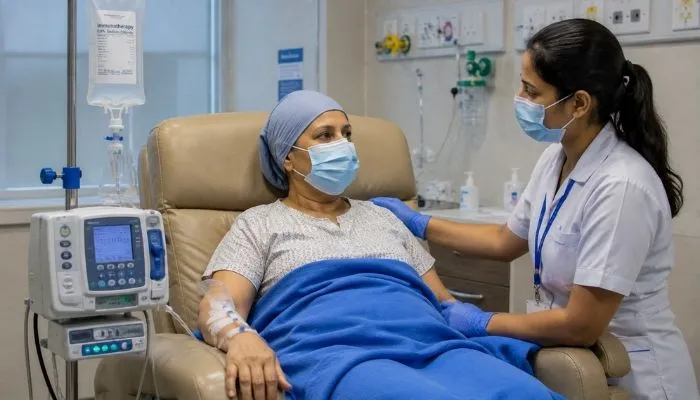
- Checkpoint inhibitor infusions administered in dedicated oncology infusion unit
- Pre-infusion: corticosteroid pre-medication for ipilimumab-containing regimens; antihistamine cover for first infusion
- First infusion: slow initial rate with close nursing observation for infusion reactions
- Cycle intervals: pembrolizumab every 3 weeks (flat 200mg dose) or every 6 weeks (400mg flat dose); nivolumab every 2 or 4 weeks; ipilimumab every 3 weeks
irAE Surveillance and Management:
- Thyroid function, liver enzymes, renal function, and blood glucose checked before every cycle
- Patient-held irAE symptom card — shortness of breath, diarrhoea, jaundice, skin rash, fatigue — report immediately
- Grade 1 irAE: treatment continues with monitoring; topical or symptomatic treatment
- Grade 2 irAE: treatment held; oral prednisolone 1mg/kg; specialist review
- Grade 3–4 irAE: treatment permanently discontinued; IV methylprednisolone; admit and specialist co-management
Top Breast Cancer Surgeons in Mumbai
Our breast surgical oncology team at Shree Hospitals brings together surgeons trained at India's leading cancer centres, with expertise in breast conservation, oncoplastic surgery, and immediate reconstruction.
24×7 Emergency Care

Dr. Vivek Sukumar
Consultant Surgical Oncologist

Dr. Amit Gandhi
Consultant Surgical Oncologist
Dr. Kaustubh Burde
Consultant Interventional Cardiologist

Dr. Prasad Kasbekar
AI & Robotic Cancer Surgery
Related Treatments
Immunotherapy forms part of a comprehensive cancer care pathway. From patients starting immune-based treatment for newly diagnosed or advanced cancers to those requiring maintenance or combination therapies, our programme provides seamless, multidisciplinary care across every stage of treatment.
Radiation Therapy
Combination immunoradiotherapy; abscopal effect in metastatic disease.
Step by Step Process of Immunotherapy
Step 1 — Biomarker Testing and MDT Referral
Tumour biopsy tissue is sent for PD-L1 expression, MSI/MMR, and TMB testing. Results are reviewed alongside histology, staging, and performance status at MDT. The appropriate checkpoint inhibitor agent and protocol are selected. Baseline organ function tests thyroid, liver, renal, blood glucose, lung function are documented. The patient is counselled on expected response rates, treatment duration, and immune-related adverse events.
Step 2 — First Infusion
Pre-medications are administered as per protocol. Checkpoint inhibitor infusion begins at reduced initial rate under nursing observation. Vital signs monitored at 15-minute intervals. Infusion reactions (chills, fever, hypotension, rash) managed per protocol. Patient observed for 30 to 60 minutes post-infusion. Symptom card issued with emergency contact number.
Step 3 — Cycle Monitoring and irAE Surveillance
Before each subsequent cycle: thyroid function, LFTs, renal function, FBC, and blood glucose reviewed. Any new symptoms reviewed against irAE checklist. Grade 1–2 irAEs managed with dose hold and steroids. Grade 3–4 irAEs trigger treatment discontinuation and specialist referral. Imaging (CT or PET-CT) performed after every 3 cycles to assess tumour response.
Step 4 — Response Review and Treatment Continuation
Radiological response assessed at MDT. Confirmed responders continue to planned treatment duration (pembrolizumab for 2 years in first-line NSCLC; indefinite in some palliative settings). Non-responders are switched to second-line chemotherapy or alternative targeted agents. Patients completing planned duration are enrolled in structured surveillance with ongoing irAE watch for up to 12 months post-treatment.
Patient Questions About Immunotherapy
How Do I Know If Immunotherapy Will Work for My Cancer?
Response to checkpoint inhibitor therapy is not uniform across all patients or tumour types. The primary tool for predicting response is biomarker testing. PD-L1 expression on the tumour — measured as tumour proportion score (TPS) or combined positive score (CPS) — is the main biomarker for PD-1 and PD-L1 inhibitor selection. A TPS of 50% or above in non-small cell lung cancer predicts a significantly higher response to pembrolizumab monotherapy. MSI-high or dMMR status predicts response across nearly all solid tumour types. High TMB (≥10 mutations/megabase) is approved as a biomarker for pembrolizumab regardless of tumour type. Your oncologist at Shree Hospitals will arrange biomarker testing on your tumour biopsy tissue before any immunotherapy recommendation is made.
What Are Immune-Related Adverse Events and How Are They Managed?
Immune-related adverse events (irAEs) occur because checkpoint inhibitors amplify the immune system broadly — not just against cancer cells — causing inflammation in healthy organs. Common irAEs include thyroiditis (underactive or overactive thyroid), pneumonitis (lung inflammation), colitis (bowel inflammation with diarrhoea), hepatitis (liver inflammation), and skin rash. Most irAEs are mild and manageable, but some can be severe and occasionally life-threatening if unrecognised. Severity is graded from 1 (mild) to 4 (severe). Grade 1 irAEs are monitored while treatment continues. Grade 2 irAEs require treatment to be held and oral corticosteroids started. Grade 3–4 irAEs require treatment to be permanently stopped, high-dose IV corticosteroids, and specialist co-management. Early recognition is critical — patients are given a symptom card at Shree Hospitals and instructed to report new symptoms immediately, not at the next scheduled appointment.
Is Immunotherapy Given Instead of Chemotherapy?
In some cancers and settings, immunotherapy has replaced chemotherapy as the first-line treatment. In non-small cell lung cancer with PD-L1 TPS ≥50% and no driver mutations, pembrolizumab monotherapy is the standard first-line treatment — chemotherapy is not used. In MSI-high colorectal cancer, pembrolizumab monotherapy is superior to chemotherapy as first-line therapy. However, in many settings immunotherapy is combined with chemotherapy rather than replacing it — concurrent chemoimmunotherapy is standard for PD-L1 CPS <10 triple-negative breast cancer and for PD-L1-positive but TPS <50% NSCLC. The decision between immunotherapy alone, in combination with chemotherapy, or chemotherapy alone is made at MDT based on tumour type, biomarker status, and patient performance.
How Long Does Immunotherapy Treatment Last?
Treatment duration depends on the cancer type, treatment intent, and protocol. For palliative first-line pembrolizumab in NSCLC, treatment continues for a maximum of 35 cycles (approximately 2 years) in responding patients — or until progression or unacceptable toxicity. For adjuvant immunotherapy (for example nivolumab after resection of stage III NSCLC, or pembrolizumab for resected stage III melanoma), treatment is typically 1 year. In bladder and head and neck cancers in the palliative setting, checkpoint inhibitor treatment continues until progression. irAEs may occasionally require early discontinuation regardless of the planned duration. Unlike chemotherapy, immunotherapy is given every 2, 3, or 6 weeks depending on the agent — infusion sessions are short (30 to 60 minutes) and most patients maintain their normal activities between cycles.
Can Immunotherapy Be Combined with Other Cancer Treatments?
Yes — combination strategies are increasingly standard. Immunotherapy combined with chemotherapy (chemoimmunotherapy) is first-line for NSCLC with TPS <50%, triple-negative breast cancer, and bladder cancer. Dual checkpoint inhibitor therapy — PD-1 inhibitor combined with CTLA-4 inhibitor (nivolumab + ipilimumab) — is standard for advanced melanoma and for NSCLC with high TMB. Immunotherapy combined with radiotherapy (immunoradiotherapy) is an area of active investigation — radiotherapy may enhance tumour antigen release and augment the anti-tumour immune response. Durvalumab as maintenance after concurrent chemoradiotherapy is standard of care for stage III unresectable NSCLC. All combination protocols at Shree Hospitals are agreed at MDT, with enhanced immune-related adverse event monitoring for regimens with higher toxicity profiles.

Evidence-Based Case Studies by Our Specialists
Would Recommend Us
Advanced Lung Cancer Successfully Treated with Immunotherapy
"After being diagnosed with advanced lung cancer, I was offered immunotherapy based on my tumour testing. Within a few months, my scans showed a significant reduction in the tumour, and I have continued treatment with minimal side effects. I'm able to enjoy my daily life while remaining on therapy."
Mr. Arun, K
MSI-High Colorectal Cancer Successfully Managed with Immunotherapy
"Molecular testing showed that my bowel cancer was suitable for immunotherapy instead of chemotherapy. My treatment produced an excellent response, and follow-up scans showed almost complete disappearance of the disease. I continue treatment with a good quality of life and have avoided many of the side effects of chemotherapy."
Mrs. Leela, K
Immunotherapy Side Effects Successfully Managed with Specialist Care
"While receiving immunotherapy for advanced melanoma, I developed inflammation in my lungs that caused breathlessness. My treatment team recognised the problem quickly, started the appropriate treatment, and closely monitored my recovery. Once the inflammation resolved, I was able to continue cancer treatment with an alternative immunotherapy regimen."
Mr. Deepak, U
Patient
Resources

Schedule consultation

Billing & Payments

Health Packages

Hospital Facilities
24×7 Emergency Care

1800-268-4000

News & Updates
Shree Hospitals is the first to perform robotic endo surgery.
Shree Hospitals Introduces Advanced Robotic Surgery for Better Patient Care
Shree Hospitals Expands Advanced Surgical Care With Latest Medical Technology
Health Center
Exploring the Future of Telemedicine: What’s Next for Healthcare?
The Rise of Renewable Energy: Innovations in Sustainability
Follow Us

Shree
Hospitals

Shree
Hospitals
