 Ghatkopar (East), Mumbai)


Robotic Cancer Surgery
Cancer surgery demands two simultaneous requirements that often compete: complete oncological resection with clear margins, and minimal disruption to adjacent anatomy.
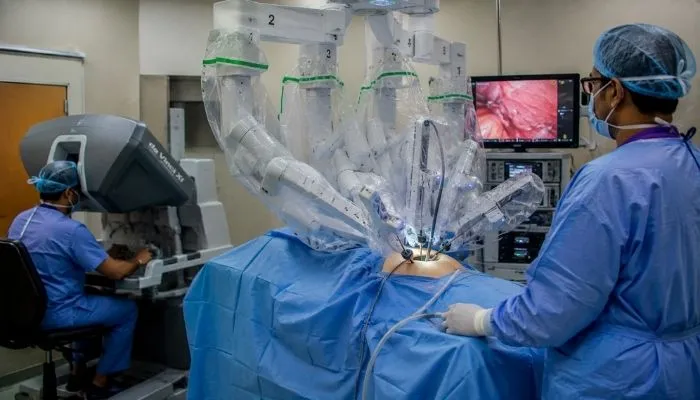
Robotic Cancer Surgery in Mumbai at Shree Hospitals uses the da Vinci surgical system to achieve both providing surgeons with 3D high-definition magnification, wristed instruments that move with seven degrees of freedom, and motion scaling that eliminates hand tremor.
Robotic-assisted surgery enables complex cancer resections prostatectomy, rectal resection, partial nephrectomy, hysterectomy for uterine cancer, gastrectomy with smaller incisions, less blood loss, and faster recovery compared to open surgery.
Nerve-sparing surgery for prostate cancer and minimally invasive oncology across gastrointestinal and gynaecological cancers are core applications. All cases are planned at MDT before robotic approach is confirmed.
Book Appointment | Find Specialists
Quick facts
Type & Duration: Robotic-assisted resection 2 to 5 hours depending on cancer type and extent; 3 to 5 small port incisions (5–8mm)
Hospital Stay: 2 to 4 days for most robotic cancer resections; versus 5 to 8 days for equivalent open surgery
Recovery Time: Return to light activity in 2 to 3 weeks; full activity in 4 to 6 weeks significantly faster than open surgery
Type of Anesthesia: General anaesthesia
Type of Surgery: Robotic-assisted laparoscopic surgery using the da Vinci surgical system surgeon operates from console with full 3D HD visualisation
Type of Assistance: MDT pre-operative review, robotic platform setup, intraoperative nerve monitoring where applicable, post-operative enhanced recovery, oncology coordination
What is Robotic Cancer Surgery
Robotic cancer surgery is a form of minimally invasive oncology in which the surgeon operates cancer resections through small port incisions using the da Vinci surgical system, a robotic platform that translates the surgeon's hand movements into precise, scaled instrument movements inside the patient.
The da Vinci surgical system provides three critical advantages over conventional laparoscopic oncology: first, a 3D high-definition 10× magnified view of the operative field compared to the 2D view of standard laparoscopy; second, wristed robotic instruments with seven degrees of freedom replicating the full range of motion of the human wrist while eliminating tremor; and third, motion scaling.
Large hand movements are translated to small, precise instrument movements, enabling microsurgery-level precision in confined anatomical spaces.
Nerve-sparing surgery for example preservation of the neurovascular bundles during radical prostatectomy benefits most from robotic precision. The 10× magnified 3D view allows surgeons to identify and preserve the bundles responsible for urinary continence and sexual function while still achieving complete cancer removal.
Similarly, total mesorectal excision for rectal cancer in the narrow male pelvis, and nerve-sparing radical hysterectomy for cervical cancer, are operations that significantly benefit from robotic assistance.
Cancers Treated with Robotic Surgery at Shree Hospitals
- Prostate cancer: robotic-assisted radical prostatectomy — nerve-sparing surgery for potency and continence preservation; standard for localised prostate cancer
- Rectal cancer: robotic total mesorectal excision (TME) — the narrow male pelvis makes open TME technically demanding; robotic approach improves circumferential resection margin rates
- Uterine (endometrial) cancer: robotic total laparoscopic hysterectomy with bilateral salpingo-oophorectomy and pelvic lymphadenectomy — minimises blood loss versus open hysterectomy
- Kidney cancer: robotic partial nephrectomy for renal cell carcinoma ≤7cm — nephron-sparing with warm ischaemia time under 25 minutes
- Gastric cancer: robotic gastrectomy with D2 lymphadenectomy — fewer conversions to open than laparoscopic; better mediastinal lymphadenectomy for proximal tumours
- Bladder cancer: robotic radical cystectomy with extended pelvic lymphadenectomy and intracorporeal urinary diversion — reduced blood loss and transfusion rates versus open
Advantages of Robotic Over Open Cancer Surgery
- Smaller incisions (3–5 ports of 5–8mm) vs one large abdominal incision — significantly reduced post-operative pain
- Less blood loss and lower transfusion rates — particularly for pelvic and retroperitoneal dissections
- Shorter hospital stay: 2 to 4 days vs 5 to 8 days for equivalent open procedures
- Faster return to normal activity and chemotherapy or radiotherapy — adjuvant treatment can commence earlier
- Reduced surgical site infection and wound complication rates — smaller incisions, lower contamination risk
- Enhanced precision in nerve-sparing surgery and tight anatomical compartments — better functional outcomes after prostatectomy and rectal resection
Oncological Safety — Margins and Lymphadenectomy
- Oncological equivalence to open surgery is the primary consideration — robotic approach is only used where it does not compromise cancer clearance
- Positive surgical margin rates for robotic prostatectomy and rectal TME are equivalent to or better than open surgery in experienced centres
- Lymph node yield: robotic D2 gastrectomy and pelvic lymphadenectomy for rectal and gynaecological cancers achieve equivalent or superior node counts compared to open
- MDT review confirms resectability and approach suitability before robotic approach is planned — not all cancers are suitable for robotic resection (T4 locally advanced tumours may require open approach)
- Conversion to open surgery rate under 5% at Shree Hospitals — triggered by oncological safety concerns, never by technical difficulty alone
- Intraoperative frozen section for margin assessment available — re-resection performed at same operation if indicated
Robotic-assisted surgery does not mean autonomous operation. The surgeon is in complete control at the console throughout the da Vinci surgical system amplifies surgical precision rather than replacing surgical judgement. Oncological principles complete resection with clear margins, adequate lymphadenectomy are identical to open surgery. The benefit is in reduced tissue trauma, smaller incisions, and faster recovery.
Robotic cancer surgery at Shree Hospitals delivers the same oncological outcome as open surgery with smaller incisions, less blood loss, and faster recovery. MDT review confirms the appropriate approach before every robotic case.
24×7 Emergency Care
Our Approach to Robotic Cancer Surgery
Our robotic surgical oncology team at Shree Hospitals applies da Vinci surgical system precision to cancer resections across prostate, rectal, gynaecological, gastric, renal, and bladder cancers with MDT planning, oncological margin assessment, and structured nerve-sparing surgery protocols.
24×7 Emergency Care
MDT Suitability Assessment:
- All potential robotic cases reviewed at MDT — imaging, staging, and tumour characteristics assessed
- Robotic approach confirmed only where oncological resection will be equivalent to or better than open surgery
- T4 tumours with adjacent organ invasion: open approach often preferred for en-bloc resection — robotic approach not selected if margin safety is compromised
- Patient factors reviewed: BMI, prior abdominal surgery, cardiorespiratory fitness for prolonged pneumoperitoneum (CO2 insufflation for robotic platform)
Nerve-Sparing and Anatomical Precision
Prostatectomy nerve-sparing surgery: neurovascular bundle dissection under 10× 3D magnification — bundles individually assessed and preserved or resected based on cancer risk
Rectal TME: autonomic nerve preservation (superior hypogastric plexus, hypogastric nerves, pelvic plexus) — critical for post-operative bladder and sexual function
Radical hysterectomy: parametrial and pelvic sidewall dissection with bladder innervation preservation
Partial nephrectomy: intraoperative ultrasound for tumour margin confirmation; selective vascular clamping to minimise warm ischaemia
Intraoperative Oncological Safety:
- Specimen orientation and margin assessment: clear anatomical marking of resected specimen — pathologist can map margins accurately
- Frozen section available for selected cases — prostate apex margin, rectal distal margin, ureteral margin in cystectomy
- Robotic intraoperative ultrasound: confirms tumour location and margin depth for renal and hepatic resections
- Lymph node dissection: template lymphadenectomy performed at same robotic operation — no separate procedure required
Post-Operative Recovery and Oncology Coordination:
- Enhanced recovery after surgery (ERAS) protocol for all robotic cancer cases — early mobilisation, early oral intake, multimodal analgesia
- Shorter hospital stay facilitates earlier commencement of adjuvant chemotherapy or radiotherapy
- Catheter duration after robotic prostatectomy: 7 to 10 days — pelvic floor physiotherapy from day 1
- Histopathology reviewed at MDT within 5 to 7 working days — adjuvant treatment plan agreed before patient follow-up appointment
Top Breast Cancer Surgeons in Mumbai
Our breast surgical oncology team at Shree Hospitals brings together surgeons trained at India's leading cancer centres, with expertise in breast conservation, oncoplastic surgery, and immediate reconstruction.
24×7 Emergency Care

Dr. Vivek Sukumar
Consultant Surgical Oncologist

Dr. Amit Gandhi
Consultant Surgical Oncologist

Dr. Prasad Kasbekar
Consultant Surgical Oncologist

Dr. Preetam Jain
Consultant Medical Oncology
Related Treatments
at Shree Hospitals
Robotic cancer surgery forms an integral part of a comprehensive cancer care pathway.
From patients undergoing minimally invasive surgery for newly diagnosed cancers to those requiring complex tumour resections or multidisciplinary treatment, our programme provides seamless, precision-driven care across every stage of surgical management.
GI Cancer Surgery
Robotic gastrectomy, colectomy, rectal TME; MDT-planned resection.
Head & Neck Cancer Surgery
Robotic-assisted transoral resection for oropharyngeal tumours.
Step by Step Process of Robotic Cancer Surgery at Shree Hospitals
Step 1 — MDT Review and Pre-Operative Planning
Staging imaging (CT, MRI, PET-CT as appropriate) is reviewed at MDT. Robotic approach suitability confirmed tumour stage, patient fitness, and anatomy reviewed.
Surgical plan agreed: extent of resection, lymph node template, nerve-sparing intent (prostatectomy, rectal TME). Pre-operative investigations completed cardiac, anaesthetic, and nutrition assessment for major cancer resection.
Step 2 — Robotic Platform Setup and Port Placement
General anaesthesia induced. Patient positioned and secured Trendelenburg or lithotomy as required. Three to five port incisions (5–8mm) placed camera port, instrument arms, assistant port.
CO2 pneumoperitoneum established. Da Vinci surgical system docked instrument arms inserted through ports. Surgeon takes console position; 3D HD view confirmed.
Step 3 — Oncological Resection
Cancer resection performed prostatectomy, TME, hysterectomy, gastrectomy, or partial nephrectomy following oncological principles identical to open surgery. Lymphadenectomy performed to standard template.
Nerve-sparing surgery executed where oncologically appropriate. Specimen removed through port-site incision extension or dedicated retrieval bag. Anastomosis or urinary reconstruction performed intracorporeally (robotic) or extracorporeally.
Step 4 — Response Review and Treatment Continuation
ERAS protocol commenced from theatre recovery. Diet resumed day 1. Mobilisation day 1. Drain output monitored. Histopathology result reviewed at MDT within 5 to 7 working days. Margin status, lymph node count, and pathological stage discussed.
Adjuvant chemotherapy or radiotherapy timing agreed. Patient counselled at follow-up appointment with full pathological report.
Patient Questions About Robotic Cancer Surgery
Is Robotic Surgery as Effective as Open Surgery for Cancer?
Yes — when applied to appropriate cases by experienced surgeons. The oncological principles of cancer surgery — complete tumour removal with clear margins and adequate lymph node dissection — are identical whether performed robotically or open. Published evidence for robotic radical prostatectomy, robotic total mesorectal excision for rectal cancer, and robotic radical hysterectomy demonstrates equivalent positive margin rates and lymph node yields to open surgery, with superior functional outcomes in nerve-sparing cases. At Shree Hospitals, robotic approach is confirmed at MDT only after review of staging imaging confirms the tumour is appropriate for minimally invasive resection. T4 locally advanced cancers requiring en-bloc multi-organ resection typically require open surgery — robotic approach is not selected at the expense of oncological margin safety.
What Is the Recovery Time After Robotic Cancer Surgery?
Recovery after robotic-assisted surgery is significantly faster than after equivalent open surgery. Hospital stay for robotic prostatectomy is typically 1 to 2 days; for robotic rectal resection 3 to 4 days; for robotic hysterectomy 2 to 3 days — compared to 5 to 8 days for open equivalents. Return to light activity is typically 2 to 3 weeks; return to full activity and driving at 4 to 6 weeks. Because post-operative pain is reduced with smaller incisions and less tissue disruption, opioid requirements are lower and mobilisation begins the day after surgery. Importantly, faster recovery means adjuvant chemotherapy or radiotherapy — where indicated — can often commence 2 to 3 weeks earlier after robotic than after open surgery, which may be clinically significant for aggressive tumours.
How Many Incisions Are Made in Robotic Cancer Surgery?
Robotic-assisted surgery requires three to five small port incisions, each 5 to 8mm in diameter — plus one slightly larger extraction incision (typically 3 to 5cm) used to remove the resected specimen. The total incision area is dramatically smaller than a single open laparotomy incision (15 to 25cm for major cancer surgery). The small port sites close with a single absorbable suture and heal with minimal scarring. The slightly larger extraction incision is placed cosmetically — typically at or below the natural bikini line — and is similarly well-hidden. Compared to the long midline or subcostal incision of open cancer surgery, the cosmetic and functional result after robotic surgery is significantly better.
Will I Feel the Robot Operating on Me?
No — the patient is under general anaesthesia throughout the procedure and is completely unconscious and pain-free. The da Vinci surgical system is a tool controlled entirely by the operating surgeon at a console in the operating theatre. There is no autonomous robotic decision-making. The surgeon sees a 3D magnified view inside the abdomen or pelvis and moves robotic instruments via hand and foot controls, with the system translating those movements into precise instrument motion. Patients are unaware of the robotic platform and experience the operation identically to any other procedure under general anaesthesia. Post-operatively, the reduced tissue trauma of the minimal-access approach means significantly less pain and faster recovery than open surgery.
Is Robotic Surgery Available for All Types of Cancer?
Not all cancers are suitable for robotic resection, and at Shree Hospitals the approach is confirmed at MDT not assumed. Robotic surgery is well-established and oncologically validated for prostate cancer (robotic radical prostatectomy), rectal cancer (robotic TME), uterine cancer (robotic hysterectomy with staging), kidney cancer (robotic partial nephrectomy), bladder cancer (robotic radical cystectomy), and gastric cancer (robotic gastrectomy). For early oropharyngeal tumours, transoral robotic surgery (TORS) avoids a mandibular split approach. Liver resections and pancreatic resections are increasingly performed robotically in specialist centres. Locally advanced tumours with adjacent organ involvement where en-bloc resection of multiple structures is required typically require open surgery. The decision is tumour-specific, stage-specific, and reviewed at MDT before any surgical consent is taken.

Evidence-Based Case Studies by Our Specialists
Would Recommend Us
Robotic Prostate Cancer Surgery Successfully Performed
"After being diagnosed with localized prostate cancer, my doctors recommended robotic surgery because it offered a precise, minimally invasive approach. The procedure went smoothly, my recovery was faster than I expected, and I regained bladder control within a few weeks. My follow-up tests have shown no evidence of cancer, and I'm back to my normal routine."
Mr. Arun, U
Endometrial Cancer Successfully Treated with Robotic Surgery
"Following my diagnosis of early-stage endometrial cancer, I underwent robotic hysterectomy. I experienced minimal discomfort, was discharged within two days, and recovered quickly at home. My pathology results showed the cancer had been completely removed, and I did not require any additional treatment. My follow-up visits have remained reassuring."
Mrs. Shobha, K
Rectal Cancer Successfully Managed with Robotic Surgery
"After chemotherapy and radiation, I underwent robotic surgery to remove my rectal tumour. The minimally invasive approach helped me recover well, and I was able to return home within a few days. My surgery achieved complete removal of the cancer, and I was able to continue the next phase of treatment as planned. My follow-up scans have shown no evidence of disease."
Mr Rajesh, M
Patient
Resources

Schedule
consultation

Billing &
Payments

Hospital
Facilities
24×7 Emergency Care

1800-268-4000

Follow Us

Shree
Hospitals

Shree
Hospitals
