 Ghatkopar (East), Mumbai)


Targeted Therapy
Targeted therapy attacks cancer cells by blocking the specific molecular driver causing their uncontrolled growth rather than harming all dividing cells as chemotherapy does. Targeted therapy in Mumbai at Shree Hospitals is built on accurate companion diagnostic testing: every patient's tumour is molecularly profiled before any targeted agent is selected.
Our oncology team manages EGFR inhibitor therapy for lung cancer, HER2-targeted therapy for breast and gastric cancers, BRAF inhibitor therapy for melanoma, CDK4/6 inhibitor therapy for hormone receptor-positive breast cancer, and ALK, ROS1, KRAS, and NTRK inhibitor protocols across tumour types.
Protocol selection and dose management are reviewed at MDT targeted therapy is only prescribed when the correct molecular target is confirmed.
Book Appointment | Find Specialists
Quick facts
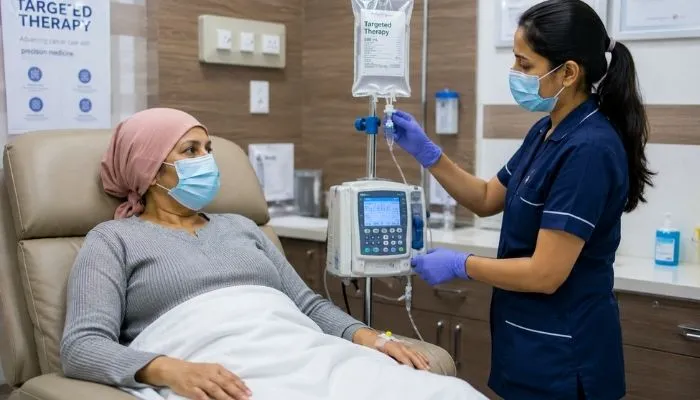
Type & Duration: Oral daily tablets (CDK4/6, EGFR, BRAF, ALK inhibitors) or IV infusions every 1 to 4 weeks (trastuzumab, pertuzumab, T-DM1)
Hospital Stay: Oral agents: outpatient; IV agents: day-care infusion
Recovery Time: Most patients maintain normal activities; side effects managed as outpatient
Type of Anesthesia: Not applicable
Type of Surgery: Not applicable — systemic molecular therapy
Type of Assistance: Companion diagnostic testing (next-generation sequencing, IHC, FISH), MDT protocol selection, toxicity monitoring, drug interaction review, response assessment imaging
WHAT IS TARGETED THERAPY?
Targeted therapy uses drugs designed to block specific molecular abnormalities proteins, enzymes, or signalling pathways that cancer cells rely on to grow, divide, and survive. Unlike chemotherapy, which broadly kills dividing cells (cancerous and healthy alike), targeted agents act selectively on cancer cells that carry the specific molecular target.
The most common examples are: EGFR inhibitors (osimertinib, erlotinib, gefitinib) for EGFR-mutant non-small cell lung cancer; HER2-targeted therapy (trastuzumab, pertuzumab, T-DM1, trastuzumab deruxtecan) for HER2-positive breast and gastric cancers; BRAF inhibitors (vemurafenib, dabrafenib) combined with MEK inhibitors (trametinib) for BRAF V600E-mutant melanoma; and CDK4/6 inhibitors (palbociclib, ribociclib, abemaciclib) for HR-positive, HER2-negative metastatic breast cancer.
ALK inhibitors (alectinib, lorlatinib), ROS1 inhibitors (crizotinib, entrectinib), and NTRK inhibitors (larotrectinib, entrectinib) target rare but actionable lung cancer driver mutations.
Companion diagnostic testing molecular profiling of the tumour is essential before targeted therapy. Giving an EGFR inhibitor to a patient without an EGFR mutation is both ineffective and exposes the patient to unnecessary toxicity.
Next-generation sequencing (NGS), immunohistochemistry (IHC), and fluorescence in situ hybridisation (FISH) are the principal testing platforms.
Cancers Treated with Targeted Therapy
- Non-small cell lung cancer: EGFR inhibitor (osimertinib) for EGFR exon 19 deletion or L858R; alectinib for ALK-rearranged NSCLC; lorlatinib for ALK-rearranged after prior ALK inhibitor
- Breast cancer: HER2-targeted therapy (trastuzumab + pertuzumab + chemotherapy for HER2-positive); CDK4/6 inhibitor + aromatase inhibitor for HR+/HER2-negative metastatic disease
- Gastric / gastro-oesophageal junction cancer: trastuzumab + chemotherapy for HER2-positive (IHC 3+ or FISH-amplified) gastric cancer
- Melanoma: BRAF inhibitor + MEK inhibitor (dabrafenib + trametinib) for BRAF V600E-mutant advanced melanoma
- Colorectal cancer: anti-EGFR antibodies (cetuximab, panitumumab) for RAS/RAF wild-type left-sided metastatic colorectal cancer
- Pan-tumour targets: NTRK inhibitors (larotrectinib) for NTRK fusion-positive solid tumours; pembrolizumab for TMB-high or MSI-H tumours (treated under immunotherapy)
Companion Diagnostic Testing at Shree Hospitals
- Next-generation sequencing (NGS): comprehensive genomic profiling of the tumour — identifies EGFR, KRAS, ALK, ROS1, NTRK, BRAF, HER2 mutations and amplifications in a single test
- IHC (immunohistochemistry): HER2 protein expression (scored 0 to 3+) and PD-L1 expression on tumour sections
- FISH (fluorescence in situ hybridisation): confirms HER2 amplification in IHC 2+ cases; confirms ALK/ROS1 rearrangement
- Liquid biopsy (ctDNA): cell-free tumour DNA in blood — useful for monitoring resistance mutations (for example EGFR T790M on first-generation EGFR inhibitor progression)
- All molecular testing coordinated through the oncology MDT — results reviewed before treatment recommendation
- Testing performed on archived biopsy tissue or fresh biopsy — not on blood alone as a substitute for tissue diagnosis
Resistance and Second-Line Targeted Therapy
- Acquired resistance to targeted agents is expected — most patients develop resistance within 1 to 3 years
- EGFR T790M mutation: the commonest resistance mechanism after first-generation EGFR inhibitors — osimertinib (third-generation) overcomes T790M resistance
- HER2-low breast cancer: trastuzumab deruxtecan (T-DXd) is effective in IHC 1+ and IHC 2+/FISH-negative HER2-low breast cancer — extending HER2-targeted therapy to a broader population
- CDK4/6 inhibitor resistance: subsequent therapies include PI3K/AKT inhibitors (alpelisib for PIK3CA-mutant) and mTOR inhibitors (everolimus)
- BRAF inhibitor resistance: rechallenge with same class after intervening chemotherapy; triplet BRAF + MEK + EGFR inhibitor protocols in CRC
- Liquid biopsy at progression identifies resistance mutations — guides second-line targeted agent selection
Targeted therapy only works when the right molecular target is present in the tumour. A companion diagnostic test confirming the target EGFR mutation, HER2 overexpression, BRAF V600E mutation is mandatory before any targeted agent is prescribed at Shree Hospitals. Prescribing targeted therapy without molecular confirmation is not evidence-based practice.
Targeted therapy without molecular confirmation is not evidence-based. At Shree Hospitals, every targeted therapy decision begins with a companion diagnostic test confirming the target before any drug is prescribed.
24×7 Emergency Care
Our Approach to Targeted Therapy
Our molecular oncology team at Shree Hospitals delivers precision targeted therapy built on comprehensive companion diagnostic testing, MDT protocol selection, and structured resistance monitoring — across lung, breast, gastric, melanoma, and colorectal cancers.
24×7 Emergency Care
Comprehensive Molecular Profiling
- NGS panel testing on all newly diagnosed advanced solid tumours where targeted therapy is potentially applicable
- HER2 IHC and FISH for breast, gastric, and biliary tract cancers
- EGFR, KRAS, NRAS, BRAF, ALK, ROS1, MET, NTRK testing for NSCLC at diagnosis — reflex testing on standard biopsy
- Liquid biopsy (ctDNA) at progression — to detect resistance mutations without requiring repeat invasive biopsy
MDT Protocol Selection and Dosing
- All targeted therapy initiation decisions made at MDT with molecular data, staging, and performance status
- Dose adjustments for renal or hepatic impairment — standard dosing of oral targeted agents assumes normal clearance
- Drug interaction review — oral EGFR inhibitors and CDK4/6 inhibitors have significant CYP3A4 interactions
- Patient education on oral drug adherence — subtherapeutic exposure from missed doses accelerates resistance
Monitoring Response and Toxicity
- CT or PET-CT imaging every 2 to 3 cycles (every 8 to 12 weeks) for response assessment
- LFT monitoring for CDK4/6 inhibitors (hepatotoxicity); FBC for haematological toxicity (neutropenia)
- QTc ECG monitoring for agents with cardiac risk (vandetanib, osimertinib at high dose)
- Skin toxicity management for anti-EGFR antibodies — acneiform rash, paronychia, hand-foot syndrome
Progression and Resistance Management:
- Progression on targeted therapy triggers repeat biopsy or liquid biopsy to identify resistance mechanism
- EGFR T790M-positive progression after first-line erlotinib/gefitinib → switch to osimertinib
- CDK4/6 inhibitor progression → PI3KCA mutation testing (alpelisib + fulvestrant for PIK3CA-mutant) or fulvestrant monotherapy
- MDT review at progression — second-line targeted agent or transition to chemotherapy or immunotherapy planned
Top Breast Cancer Surgeons in Mumbai
Our breast surgical oncology team at Shree Hospitals brings together surgeons trained at India's leading cancer centres, with expertise in breast conservation, oncoplastic surgery, and immediate reconstruction.
24×7 Emergency Care

Dr. Vivek Sukumar
Consultant Surgical Oncologist

Dr. Amit Gandhi
Consultant Surgical Oncologist

Dr. Prasad Kasbekar
Consultant Surgical Oncologist

Dr. Preetam Jain
Consultant Medical Oncology
Related Treatments
at Shree Hospitals
Targeted therapy is an integral part of a comprehensive cancer care pathway. From patients beginning precision-targeted treatment for newly diagnosed or advanced cancers to those requiring long-term maintenance or combination therapies, our programme delivers seamless, multidisciplinary care tailored to the molecular profile of each cancer across every stage of treatment.
Step by Step Process of Targeted Therapy
Step 1 — Molecular Profiling and Companion Diagnostic Testing
Fresh or archived tumour tissue is sent for NGS, IHC, and FISH as clinically indicated. Results are reviewed alongside full staging imaging, histology grade, and performance status. The MDT confirms the actionable molecular target and selects the appropriate targeted agent and protocol line. Liquid biopsy is arranged as an adjunct or where tissue re-biopsy is not feasible.
Step 2 — MDT Protocol Selection and Patient Counselling
Protocol, dose, route (oral vs IV), cycle interval, and monitoring plan are agreed at MDT. The patient is counselled on mechanism of action, expected response rate for their specific molecular subgroup, common side effects, and adherence requirements for oral agents. Drug interaction review is performed concurrent medications assessed for CYP3A4 interactions with oral targeted agents.
Step 3 — Treatment Administration and Monitoring
Oral targeted agents: taken daily at home with instructions on food interaction (gefitinib with food; osimertinib with or without food). IV targeted agents (trastuzumab, pertuzumab): administered in the oncology infusion unit at scheduled intervals. Monitoring: LFTs, FBC, ECG, and toxicity assessment before each cycle or monthly for oral agents. Response imaging every 8 to 12 weeks.
Step 4 — Progression Assessment and Second-Line Planning
Clinical or radiological progression triggers liquid biopsy (ctDNA) or repeat tissue biopsy to identify resistance mutation. Resistance mechanism guides second-line selection. EGFR T790M → osimertinib; PIK3CA mutation on CDK4/6 inhibitor → alpelisib; ALK resistance → next-generation ALK inhibitor. MDT reviews progression and agrees second-line plan before communicating with patient.
Patient Questions About Targeted Therapy
How Do I Know If I Have a Targetable Mutation?
A companion diagnostic test on your tumour biopsy tissue identifies whether a targetable molecular alteration is present. The most common tests are next-generation sequencing (NGS) which screens for dozens of mutations in a single test and IHC and FISH for protein overexpression or gene amplification (particularly HER2). These tests are performed on the tissue obtained at your original diagnostic biopsy or from a fresh biopsy if needed. Results typically take 7 to 14 working days for NGS; 3 to 5 days for IHC/FISH. At Shree Hospitals, molecular profiling is arranged by the MDT for all patients with advanced solid tumours where a targetable mutation is plausible the tests are reviewed before any targeted therapy recommendation is made.
Are Targeted Therapy Drugs Taken as Tablets or Injections?
It depends on the specific agent. Many targeted drugs are oral — daily tablets taken at home (EGFR inhibitors such as osimertinib, erlotinib; CDK4/6 inhibitors such as palbociclib, ribociclib; BRAF inhibitors such as dabrafenib; ALK inhibitors such as alectinib). The convenience of oral administration is one of the significant advantages of targeted therapy over chemotherapy. However, several important HER2-targeted agents are intravenous — trastuzumab, pertuzumab, and T-DM1 are given by IV infusion in the oncology unit every 3 weeks. Trastuzumab is also available in a subcutaneous injection formulation, reducing administration time. Your oncologist will explain the route, frequency, and practical aspects of your specific agent before treatment begins.
What Are the Side Effects of Targeted Therapy?
Side effects differ significantly between targeted agents and are generally distinct from the side effects of chemotherapy. EGFR inhibitors commonly cause acneiform (acne-like) skin rash, diarrhoea, and paronychia (nail fold inflammation) — these are managed with topical treatments and dose adjustment. CDK4/6 inhibitors most commonly cause neutropenia (low white blood cells) and fatigue — FBC is checked before every cycle. HER2-targeted therapy with trastuzumab can cause cardiac dysfunction (reduced left ventricular ejection fraction) — baseline and repeat echocardiograms are performed. BRAF inhibitors can cause pyrexia, photosensitivity, and secondary cutaneous malignancies (squamous cell carcinomas of the skin) — dermatology review is arranged. Unlike chemotherapy, hair loss is uncommon with most targeted agents.
How Long Will I Take Targeted Therapy?
Duration depends on cancer type, disease stage, and treatment intent. In metastatic disease, targeted therapy continues until disease progression or unacceptable toxicity — there is typically no fixed endpoint, and the goal is durable disease control. For example, first-line osimertinib for EGFR-mutant NSCLC produces a median progression-free survival of approximately 18 months — some patients achieve significantly longer. CDK4/6 inhibitors in combination with endocrine therapy for metastatic HR-positive breast cancer are continued indefinitely until progression, with median PFS of 24 to 29 months. In the adjuvant setting (after surgery), targeted therapy has a fixed duration: adjuvant trastuzumab for HER2-targeted breast cancer is one year; adjuvant osimertinib for stage IB–IIIA EGFR-mutant NSCLC is three years. Your oncologist will discuss the specific duration and what triggers a treatment review.
Can Targeted Therapy Be Combined with Chemotherapy or Radiotherapy?
Yes — combination strategies are evidence-based in many settings. HER2-targeted therapy (trastuzumab + pertuzumab) is almost always given with chemotherapy in the neoadjuvant or palliative setting for HER2-positive breast cancer — the combination is significantly superior to either alone. Anti-EGFR antibodies (cetuximab) are combined with FOLFOX or FOLFIRI chemotherapy for RAS/RAF wild-type metastatic colorectal cancer. In NSCLC, targeted agents are generally not combined with chemotherapy when an actionable driver mutation is present — single-agent EGFR, ALK, or ROS1 inhibitor is preferred over chemoimmunotherapy in driver-mutated NSCLC. Combination with radiotherapy — radiosensitisation using targeted agents — is an active area of investigation, particularly for anti-EGFR therapy in head and neck cancer.

Evidence-Based Case Studies by Our Specialists
Would Recommend Us
EGFR-Mutant Advanced Lung Cancer Successfully Treated with Targeted Therapy
"After my lung cancer was diagnosed, molecular testing identified an EGFR mutation, making me eligible for targeted therapy. Within a few months of starting treatment, my scans showed a significant reduction in the tumour. Apart from a mild skin rash that was easily managed, I've been able to continue my normal daily activities while remaining on treatment."
Mr. Vivek, P
HER2-Positive Metastatic Breast Cancer Successfully Managed with Targeted Therapy
"My tests confirmed that my breast cancer was HER2-positive, so my doctors recommended HER2-targeted therapy along with chemotherapy. The treatment worked remarkably well, and my scans showed an excellent response. I now continue maintenance targeted therapy with good quality of life, and my heart function has remained normal throughout treatment."
Mrs. Priya, I
HR-Positive Metastatic Breast Cancer Successfully Managed with CDK4/6 Targeted Therapy
"Following the diagnosis of metastatic breast cancer, I started targeted therapy combined with hormone treatment. Although my blood counts dropped early during treatment, my medication dose was adjusted, and I continued safely. My scans have remained stable, my tumour markers improved, and I've been able to carry on with my everyday life."
Mrs. Divya,H
Patient
Resources

Schedule
consultation

Billing &
Payments

Hospital
Facilities
24×7 Emergency Care

1800-268-4000

Follow Us

Shree
Hospitals

Shree
Hospitals
