 Ghatkopar (East), Mumbai)


Home > Orthopaedics > ACL Reconstruction
ACL Reconstruction Surgery in Mumbai
A torn ACL does not have to end your athletic career or your active life. ACL reconstruction in Mumbai at Shree Hospitals is performed by sports orthopaedic surgeons who understand what it means to get back to the sport, activity, or routine you love.
Whether the injury happened on a football pitch, a basketball court, or during a routine fall, our anterior cruciate ligament reconstruction programme is designed with one goal: restoring your knee to full strength, stability, and confidence, and keeping it there.
We combine arthroscopic precision with sports-specific rehabilitation to get you back on your feet and back in the game.
Book Appointment | Find Specialists
Quick facts
Type & Duration:Arthroscopic ACL Reconstruction; 60 to 90 minutes
Hospital Stay: Day surgery or 1-night admission
Recovery Time: Return to sport in 9 to 12 months; daily activity in 4 to 6 weeks
Type of Anesthesia: General or spinal block
Type of Surgery: Minimally invasive arthroscopic ACL repair using autograft tissue
Type of Assistance: Pre-operative ligament mapping, arthroscopic surgery, sport-specific physiotherapy and return-to-sport testing protocol
What is ACL Reconstruction Surgery?
The anterior cruciate ligament is one of four major ligaments stabilising the knee and the most commonly injured in sport. It runs diagonally through the centre of the knee, controlling rotational movement and forward sliding of the tibia on the femur.
When it tears usually during a sharp pivot, sudden deceleration, or awkward landing the knee loses its primary stabiliser. The result: giving-way episodes, swelling, instability during sport, and in active individuals, an inability to return to their previous level of activity without surgical intervention.
ACL reconstruction does not repair the torn ligament it replaces it. A new ligament is constructed using a graft reconstruction technique, where a tendon from the patient's own body (most commonly the hamstring or patellar tendon) is harvested and routed through tunnels drilled precisely in the femur and tibia.
Over the following months, the graft undergoes ligamentisation biologically integrating into the bone and transforming into functional ligament tissue.
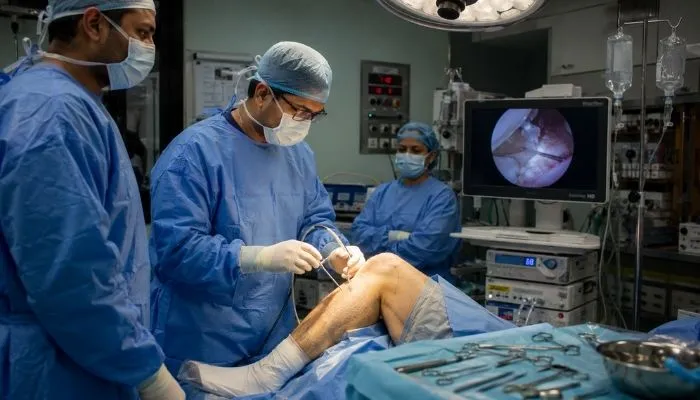
At Shree Hospitals, every knee ligament surgery is arthroscopic meaning the entire procedure is performed through two small keyhole incisions with a camera system guiding the surgeon. This minimises trauma, reduces blood loss, and dramatically shortens the recovery window compared to open surgical approaches used historically.
Signs Your ACL May Be Torn
- A loud "pop" heard or felt at the time of injury
- Immediate, severe swelling within hours of the incident
- Feeling of knee instability or "giving way"
- Inability to bear full weight immediately post-injury
- Loss of full range of motion in the knee
- Pain on the outer or inner aspect of the knee at injury site
Is ACL Reconstruction Right for You?
- Complete or high-grade partial anterior cruciate ligament tear on MRI
- Active individual — recreational or competitive athlete
- Knee instability affecting daily activity or sport
- Young patient with long sporting life ahead
- Associated meniscal or cartilage injuries requiring concurrent treatment
- Failed conservative management with ongoing instability
Why Timely Surgery Matters in ACL Injury
- Untreated instability causes progressive cartilage and meniscus damage
- Secondary meniscal tears from recurrent giving-way significantly increase surgical complexity
- Delay beyond 6 months increases cartilage degeneration risk
- Earlier surgery, followed by proper rehab, produces better graft integration
- Long-term untreated ACL deficiency accelerates sports knee injury progression to arthritis
- Psychological readiness for sport recovery is higher closer to the time of injury
With appropriate surgical technique and structured rehabilitation, return-to-sport rates following ACL reconstruction exceed 90% with a re-rupture risk of less than 5% when proper rehab protocols are followed.
An ACL tear is not a full stop. With the right surgical team and a structured return-to-sport programme, most patients return to full activity within 9 to 12 months. Your road back starts here.
24×7 Emergency Care
Our Approach to ACL Reconstruction Surgery
ACL surgery is not just about fixing a ligament it is about returning a person to their sport, their lifestyle, and their confidence. Our approach integrates surgical precision with a comprehensive return-to-performance rehabilitation model
24×7 Emergency Care
Thorough Pre-Operative MRI Assessment
Every ACL injury is assessed with MRI before any surgical decision is made. We evaluate the ACL tear pattern, concurrent meniscal or cartilage injuries, bone bruising, and the condition of the posterolateral corner and collateral ligaments because treating only the ACL when other structures are also injured leads to early graft failure.
Graft Selection Tailored to the Patient
We discuss graft options in detail hamstring tendon (gracilis and semitendinosus), bone-patellar tendon-bone, or quadriceps tendon — based on patient age, sport demands, anatomy, and any prior surgeries. Graft choice directly affects graft diameter, fixation strength, and long-term outcome. There is no single "best" graft for every patient.
Precision Arthroscopic ACL Repair Technique
All ACL procedures at Shree Hospitals are performed entirely arthroscopically. Tunnels are drilled under direct camera visualisation using anatomical landmark guidance. Graft tensioning and fixation are verified at multiple knee flexion angles to ensure stability across the full range of motion critical for return to high-demand sport.
Progressive Return-to-Sport Rehabilitation
Rehab begins the day after surgery — focused initially on swelling control, quadriceps re-activation, and full extension. The programme advances through phases: straight-line running, change-of-direction drills, sport-specific training, and finally match practice — with objective strength and movement testing at each gate before progression.
ACL Reconstruction Surgeons in Mumbai
24×7 Emergency Care
Dr. Amit Pandey
Consultant Orthopaedics
Dr. Neeraj Mishra
Consultant Orthopaedics

Dr. Tapan Shah
Consultant physiotherapist

Dr. Chirag Dalal
Consultant Orthopedic Surgeon
Related Orthopedic Treatments at Shree Hospitals
ACL injuries rarely occur in isolation. Our sports orthopaedic programme covers the full spectrum of knee injuries from single ligament tears to complex multi-structure reconstructions:
Meniscal Repair & Meniscectomy
Concurrent treatment of meniscal tears often found alongside ACL injury.
Arthroscopic Knee Surgery
Keyhole diagnosis and treatment of cartilage damage, loose bodies, and plica syndrome.
PCL & Multi-Ligament Reconstruction
Posterior cruciate and combined ligament injury management for complex knee instability.
PRP Therapy for Joint Pain
Biologic injection option for patients with sports knee injury and early cartilage changes unsuitable for surgery.
Step by Step Process of ACL Reconstruction Surgery
Step 1 — Clinical Assessment, MRI & Pre-Op Planning
Your consultation includes a thorough physical examination testing ACL integrity (Lachman, pivot shift, anterior drawer tests) alongside MRI review. Concurrent injuries are identified and included in the surgical plan.
Graft choice is discussed and agreed with the patient. Pre-habilitation exercises are prescribed to maximise quadriceps strength before the procedure.
Step 2 — Arthroscopic Setup, Graft Harvest & Knee Examination
Under general or spinal anaesthesia, the knee is first examined under anaesthesia to confirm ligamentous laxity. Arthroscopy is established through standard portals. The selected graft is harvested and prepared on the back table sized, looped, and sutured to ensure adequate diameter and tensile strength for the reconstruction.
Step 3 — Tunnel Drilling & Graft Passage
Under arthroscopic vision, femoral and tibial tunnels are drilled at anatomical ACL footprint positions using guide systems. The prepared graft is passed through the joint via a shuttle wire, seated in the femoral tunnel, and tensioned. Fixation is achieved using aperture screws or cortical buttons verified at both high and low flexion angles.
Step 4 — Closure, Brace Application & Rehab Initiation
Portal wounds are closed, and a hinged knee brace is applied for the first 2 weeks. The patient is discharged with written rehabilitation instructions. Formal physiotherapy begins within 48 to 72 hours, focusing on full extension, swelling reduction, quadriceps activation, and early proprioceptive training. Clear return-to-sport milestones are provided from day one.
Patient Questions About ACL Reconstruction
Do I Need Surgery for a Torn ACL?
Not necessarily for sedentary or older patients without instability symptoms, non-operative management with strengthening and bracing may be sufficient. However, for active individuals who wish to continue sport, cutting activities, or physical work, graft reconstruction is the recommended approach. Untreated ACL deficiency in active patients leads to progressive meniscal damage and early-onset arthritis making surgery both a functional and long-term protective choice.
When Can I Return to Sport After ACL Surgery?
Return to sport is permitted based on function, not time alone. At Shree Hospitals, we use objective criteria: the operated leg must achieve at least 90% of the strength and hop test scores of the uninjured leg before return to full contact sport is cleared. For most patients, this occurs between 9 and 12 months post-surgery. Rushing the process is the primary cause of re-rupture.
Can ACL Surgery Be Avoided With Physiotherapy Alone?
For some patients particularly older, less active individuals physiotherapy and functional bracing can manage instability adequately. However, in patients under 40 who wish to return to sport or cutting activities, arthroscopic ACL repair with reconstruction consistently outperforms non-operative management on long-term stability, meniscal protection, and quality of life. Our surgeons will guide the decision based on your specific goals and injury profile.
Patient
Resources

Schedule
consultation

Billing &
Payments

Hospital
Facilities
24×7 Emergency Care

1800-268-4000

Follow Us

Shree
Hospitals

Shree
Hospitals
