 Ghatkopar (East), Mumbai)


Home > Orthopaedics > Endoscopic Spine Surgery
Endoscopic Spine Surgery in Mumbai
Back surgery used to mean a large incision, days in hospital, weeks of recovery, and significant risk of muscle damage.
That era is over. Endoscopic spine surgery in Mumbai at Shree Hospitals delivers full spinal decompression and disc herniation treatment through an incision less than a centimetre long, guided by a high-definition endoscopic camera that gives the surgeon complete, magnified visualisation of the pathology without cutting through the back muscles.
Patients arrive for surgery in the morning and go home the next day. Many return to desk work within a week. For anyone who has been told they need open spine surgery and wants to know if there is a better option the answer, in most cases, is yes.
Book Appointment | Find Specialists
Quick facts
Type & Duration: Full-endoscopic spine surgery; 60 to 120 minutes
Hospital Stay: 1 day (most patients)
Recovery Time: Return to light work in 1 to 2 weeks; full recovery 4 to 6 weeks
Type of Anesthesia: Local with sedation (many cases) or general anaesthesia
Type of Surgery: Percutaneous endoscopy — 7mm working channel, no muscle retraction
Type of Assistance: Pre-operative MRI assessment, endoscopic procedure, physiotherapy-guided post-operative recovery and core stabilisation programme
What is Endoscopic Spine Surgery?
Conventional open back surgery requires cutting through layers of paraspinal muscle to reach the spine a necessary trade-off that leads to substantial muscle damage, blood loss, and weeks of recovery. Endoscopic spine surgery eliminates this trade-off entirely.
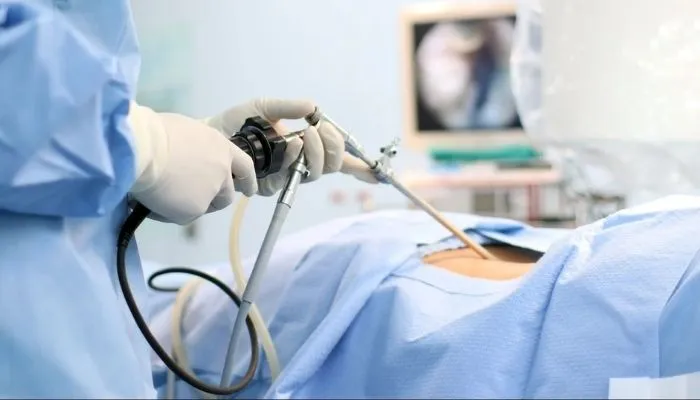
In a full-endoscopic approach, a working channel tube approximately 7 millimetres in diameter is introduced through a small skin incision and advanced to the target level in the spine using fluoroscopic guidance.
A high-definition endoscope is placed through this tube, providing the surgeon with a magnified, crystal-clear view of the disc herniation, bone spur, or area of spinal nerve compression causing the patient's symptoms.
Purpose-designed micro-instruments lasers, drills, rongeurs, and bipolar probes are introduced alongside the camera to perform the decompression.
Endoscopic discectomy for lumbar spine treatment and cervical pathologies is now the preferred surgical approach at Shree Hospitals for appropriate candidates.
The ability to perform under local anaesthesia and sedation with the patient awake and able to respond to neurological questioning represents a safety advantage over traditional general-anaesthetic spine surgery that is unique to this technique.
Conditions Treated with Endoscopic Spine Surgery
- Lumbar disc herniation (prolapsed or slipped disc)
- Cervical disc prolapse causing arm pain or numbness
- Lumbar spinal canal stenosis with leg pain
- Foraminal stenosis compressing exiting nerve roots
- Recurrent disc herniation after prior surgery
- Discogenic back pain with annular tears
Is Endoscopic Spine Surgery Right for You?
- MRI-confirmed spinal nerve compression correlating with clinical symptoms
- Failure of conservative management (physiotherapy, injections, medication) over 6 to 8 weeks
- Significant radicular pain (sciatica) or neurological weakness
- Desire for fastest possible recovery with minimal disruption
- Medically unfit patients who cannot tolerate general anaesthesia for open surgery
- No gross spinal instability requiring fusion or instrumentation
Why Choose Endoscopic Over Open Spine Surgery?
- 7mm incision vs 3 to 6 centimetre open incision
- No muscle cutting — only gentle muscle dilation
- Most patients discharged within 24 hours vs 3 to 5 days
- Return to work in days vs weeks
- Significantly lower infection risk and blood loss
- Awake procedure option provides additional neurological safety monitoring
Endoscopic spine surgery reduces post-operative blood loss by over 90% compared to open surgery and the paraspinal muscles are never cut, only gently dilated.
If open spine surgery feels like too much the incision, the hospital stay, the months of recovery endoscopic spine surgery may change your calculation entirely. One conversation with our spine team is all it takes to find out.
24×7 Emergency Care
Our Approach to Endoscopic Spine Surgery
Our endoscopic spine programme at Shree Hospitals was developed to offer patients the safest, least invasive surgical pathway available. The approach is defined by three commitments: precise patient selection, technical mastery of the endoscopic technique, and a recovery system that gets patients functional faster.
24×7 Emergency Care
Rigorous Pre-Operative MRI Correlation
Not every spine finding on MRI is the cause of the patient's pain. We correlate clinical symptoms precisely with imaging findings identifying the exact level and type of spinal nerve compression responsible for pain, weakness, or radiculopathy. Only pathology confirmed to be the clinical source is treated.
Full-Endoscopic Transforaminal or Interlaminar Approach
We offer both transforaminal and interlaminar endoscopic approaches, selected based on disc herniation morphology, level, and foraminal anatomy. The transforaminal approach accesses the disc from the side preserving the epidural space while the interlaminar approach is preferred for central and paracentral herniations. Approach selection is individualised, not standardised.
Local Anaesthesia Advantage
Many of our endoscopic discectomy procedures are performed under local anaesthesia with intravenous sedation. This allows the patient to remain responsive throughout confirming nerve decompression by sensory feedback and eliminates general anaesthetic risks. It is a significant safety advantage, particularly for older patients or those with medical comorbidities.
Rapid Return-to-Work Rehabilitation
Post-operative care begins with core stabilisation exercises prescribed from the first post-operative day. Our physiotherapists guide patients through a lumbar spine treatment recovery programme focused on deep muscle activation, postural correction, and graded return to activity preventing recurrence and protecting the surgical outcome long-term.
Spine Surgeons in Mumbai
24×7 Emergency Care
Dr. Amit Pandey
Consultant Orthopaedics
Dr. Neeraj Mishra
Consultant Orthopaedics

Dr. Tapan Shah
Consultant physiotherapist

Dr. Chirag Dalal
Consultant Orthopedic Surgeon
Related Spine Treatments at Shree Hospitals
Endoscopic spine surgery is one part of a comprehensive spinal care programme that spans from conservative management to complex surgical reconstruction. Patients with spinal conditions requiring more extensive intervention have access to the full range
Spinal Decompression Surgery
Open or minimally invasive laminectomy and foraminotomy for canal stenosis not suited to endoscopic approach.
Spinal Fusion Surgery
Instrumented fusion for segmental instability, spondylolisthesis, or post-decompression instability.
PRP Therapy for Spine Pain
Biologic injection treatment for discogenic pain and early disc degeneration in selected patients.
Revision Spine Surgery
Management of failed prior spinal procedures, including re-herniation, adjacent level disease, and hardware failure.
Step by Step Process of Endoscopic Spine Surgery
Step 1 — Consultation, MRI Review & Procedure Planning
Your MRI and any prior investigations are reviewed in detail. Clinical symptoms are mapped against imaging findings. If your condition is confirmed as suitable for endoscopic surgery, the approach, level, and technique are planned.
Pre-operative investigations are arranged. You will receive clear written information about the procedure, the local anaesthesia option, and post-operative expectations.
Step 2 — Anaesthesia & Fluoroscopic Positioning
You are positioned prone on the operating table (or lateral for some approaches). Local anaesthetic is infiltrated through the skin and along the approach tract with intravenous sedation for comfort.
A fluoroscope (intraoperative X-ray) is used to guide precise needle and cannula placement to the correct spinal level. The working sheath is advanced to position.
Step 3 — Endoscopic Decompression Under Direct Vision
The high-definition endoscope is introduced and the disc, bone spur, or compressive tissue is visualised directly. Endoscopic discectomy is performed removing the herniated disc material or bony overgrowth compressing the nerve root.
The exiting nerve is confirmed decompressed under direct vision. In awake patients, relief of radicular symptoms is confirmed by patient feedback during the procedure itself.
Step 4 — Sheath Removal, Wound Closure & Discharge
The working sheath is removed. The single skin incision is closed with a single stitch or adhesive strip. Most patients are sat up within 30 minutes and standing within 1 to 2 hours.
The following morning, a brief clinical review is completed and the vast majority of patients are discharged home with physiotherapy exercises and a follow-up appointment scheduled.
Patient Questions About Endoscopic Spine Surgery
Is Endoscopic Spine Surgery as Effective as Open Surgery?
For appropriately selected patients those with disc herniation, single-level stenosis, or foraminal narrowing multiple prospective studies show that endoscopic spine surgery achieves equivalent decompression outcomes to open microdiscectomy. The difference lies in what surrounds the surgical result: endoscopic patients experience significantly less post-operative pain, shorter hospital stays, earlier return to activity, and substantially lower blood loss. For the right candidate, it is not just equivalent it is superior.
Can I Be Awake During Endoscopic Spine Surgery?
Yes and in many cases, this is actively preferred. Percutaneous endoscopy under local anaesthesia and sedation allows the patient to remain in a comfortable conscious state throughout the procedure. When the nerve root is decompressed, the patient can confirm the disappearance of leg or arm pain in real time providing the surgeon with a level of intraoperative neurological feedback that is not possible under general anaesthesia. For patients who are medically unsuitable for general anaesthesia, this makes endoscopic surgery a viable option where open surgery would not be.
What Is the Risk of Recurrence After Endoscopic Disc Surgery?
Re-herniation rates following endoscopic discectomy are comparable to those of open microdiscectomy approximately 5 to 8% over a 5-year period. The most important factor in reducing recurrence is post-operative rehabilitation: structured core stabilisation exercises, postural correction, and graded return to loading protect the operated disc and neighbouring segments. Our physiotherapy programme addresses this directly from the first post-operative day.
Patient
Resources

Schedule
consultation

Billing &
Payments

Hospital
Facilities
24×7 Emergency Care

1800-268-4000

Follow Us

Shree
Hospitals

Shree
Hospitals
