 Ghatkopar (East), Mumbai)

Home >Paediatrics > Growth Hormone Therapy
Growth Hormone Therapy in Mumbai
Helping Children Reach Their Full Height Potential with Specialist Endocrine Care
Every parent wants to see their child grow and thrive - and when growth is falling behind, the right specialist assessment and treatment can make a life-changing difference. Growth hormone therapy in Mumbai at Shree Hospitals provides comprehensive growth hormone treatment for children with short stature and GH deficiency through an experienced paediatric endocrinology team. From the initial auxological assessment and pituitary function testing through to growth hormone injection initiation, dose adjustment, and long-term height monitoring, our paediatric growth disorder evaluation and hormone replacement programme gives every child the best possible chance of reaching their full genetic height potential safely and effectively.
Concerned About Your Child's Health? Get Expert Paediatric Care Today.
Quick facts
Condition Addressed: Growth hormone deficiency, Turner syndrome, SGA, idiopathic short stature
Diagnosis: Growth velocity assessment, IGF-1, GH stimulation tests, MRI pituitary
Treatment: Daily subcutaneous recombinant human growth hormone injection
Age of Treatment: Ideally initiated before the onset of puberty for maximum response
Monitoring: 3 to 6 monthly growth velocity, IGF-1, and bone age assessment
Duration: Treatment continues until growth plates close at skeletal maturity
Goal: Maximise final adult height and restore normal growth velocity
What is Growth Hormone Therapy?
Growth hormone (GH) is a peptide hormone produced by the anterior pituitary gland that stimulates skeletal growth, cell reproduction, and metabolism throughout childhood and adolescence. When the pituitary gland fails to produce adequate amounts of growth hormone - due to congenital pituitary abnormality, brain tumour, cranial irradiation, or idiopathic causes - children fall progressively further behind their peers in height, often crossing height centiles downward from early childhood.
Growth hormone treatment for children with short stature and GH deficiency at Shree Hospitals involves replacing the deficient hormone through daily subcutaneous injections of recombinant human growth hormone - a biosynthetic protein identical in structure to the body's own naturally produced GH. Beyond classical GH deficiency, recombinant GH treatment is also indicated for Turner syndrome, children born small for gestational age (SGA) who have not shown catch-up growth by 4 years, Prader-Willi syndrome, and children with idiopathic short stature who fall below the third centile with significantly impaired predicted adult height. Growth hormone therapy in Mumbai at Shree Hospitals is delivered through a structured paediatric growth disorder evaluation and hormone replacement programme - encompassing auxological assessment, biochemical testing, pituitary imaging, careful dose titration, and regular monitoring of growth response, IGF-1 levels, and bone age progression throughout the entire treatment course.
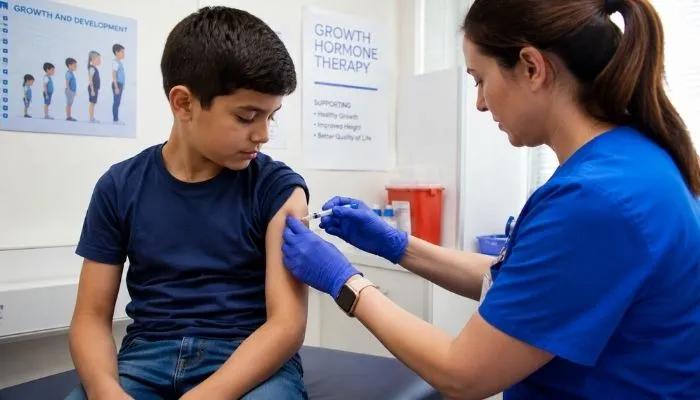
When Should a Child Be Evaluated for Growth Hormone Deficiency?
- Height below the third centile for age and sex on a standard growth chart
- Height significantly below the mid-parental height target centile
- Growth velocity below 4 to 5 cm per year during childhood
- Delayed bone age on wrist X-ray disproportionate to chronological age
- Clinical features suggesting pituitary or hypothalamic pathology including headache or visual field defects
How is GH Deficiency Diagnosed?
- Serial height measurements plotted on growth charts to assess growth velocity
- Serum IGF-1 and IGFBP-3 as screening markers of GH activity
- GH stimulation testing - insulin tolerance test or glucagon stimulation test to provoke and measure peak GH secretion
- MRI pituitary to assess pituitary gland morphology and exclude structural pathology
- Bone age X-ray to determine remaining growth potential and appropriateness of treatment timing
Why Early Diagnosis and Treatment Matters?
- Growth hormone is most effective when initiated before the growth plates begin to fuse during puberty
- Early short stature treatment maximises the number of growth years available for height gain
- Delayed diagnosis reduces final adult height gain achievable with GH deficiency diagnosis and treatment
- Untreated GH deficiency in children also impairs bone mineral density, body composition, and cardiovascular health
- Psychological wellbeing and peer social development are significantly affected by untreated severe short stature
If your child is consistently the shortest in the class and not growing at the expected rate, early specialist assessment is the most important first step.
Book a paediatric endocrinology consultation today.
24×7 Emergency Care
Our Approach to Growth Hormone Therapy
At Shree Hospitals, growth hormone therapy in Mumbai begins with a thorough auxological and clinical assessment - because not every short child has GH deficiency, and not every child who is short needs growth hormone. Our paediatric endocrinologists apply a structured diagnostic algorithm to identify the specific cause of growth failure before any treatment decision is made.
24×7 Emergency Care
Comprehensive Auxological Assessment
Height, weight, sitting height, arm span, and pubertal staging are measured and plotted at every clinic visit. Mid-parental target height is calculated and compared with the child's current centile. Growth velocity over at least 6 months is the single most important parameter - children with a normal growth velocity but short stature rarely have GH deficiency.
Targeted Biochemical and Radiological Investigation
After excluding systemic disease, hypothyroidism, and nutritional causes, GH axis assessment is performed. IGF-1 and IGFBP-3 screening is followed by formal GH stimulation testing if IGF-1 is low. MRI pituitary identifies any structural abnormality - including pituitary hypoplasia, ectopic posterior pituitary, or craniopharyngioma - before GH deficiency diagnosis is finalised.
Growth Hormone Initiation and Dose Titration
Recombinant human GH is initiated at the recommended starting dose for the specific indication and injected subcutaneously once daily - typically at bedtime to mimic the natural nocturnal GH pulse. Dose is titrated every 3 to 6 months based on growth velocity response and IGF-1 levels - targeting IGF-1 within the normal range for age without supraphysiological elevation.
Long-Term Monitoring and Transition Planning
Growth velocity, height SDS, IGF-1, HbA1c, bone age, and treatment compliance are reviewed every 3 to 6 months throughout the treatment course. Final height is estimated using bone age progression. When growth plates approach fusion, treatment discontinuation is planned and transition to adult endocrinology for adult-onset GH deficiency assessment is arranged where appropriate.
Top Specialists Paediatrics in Mumbai
Vaccination guidance at Shree Hospitals is provided by experienced consultant paediatricians and physicians who follow current IAP and national immunization programme recommendations - communicating vaccine information to patients and parents in an accessible, evidence-based, and genuinely reassuring manner at every visit.
24×7 Emergency Care

Dr. Shruti Ghatalia
Paediatricians
Paediatric and Endocrine Services at Shree Hospitals
Growth hormone therapy at Shree Hospitals is part of a comprehensive paediatric endocrinology programme - covering the full spectrum of hormonal, metabolic, and developmental disorders in children alongside dedicated growth monitoring and specialist outpatient follow-up.
Thyroid Function Assessment
Thyroid screening and treatment - hypothyroidism is the most common treatable cause of growth failure before GH deficiency is considered.
Step by Step Process of Growth Hormone Therapy
- Initial Growth Assessment and History
The child's height, weight, and growth velocity over the preceding 6 to 12 months are plotted on standard growth charts. Mid-parental height is calculated. A detailed history covering birth parameters, neonatal history, feeding, development, family height, and systemic symptoms is taken. A thorough clinical examination includes pubertal staging and assessment for syndromic features.
- Exclusion of Common Causes of Short Stature
Thyroid function, coeliac serology, full blood count, renal function, liver function, and bone age X-ray are obtained. Hypothyroidism, coeliac disease, chronic renal disease, and nutritional causes are excluded before progressing to GH axis investigation. Growth velocity is recalculated from serial measurements before biochemical testing is ordered.
- GH Axis Biochemical Testing
Serum IGF-1 and IGFBP-3 are measured. If IGF-1 is low for age and other causes are excluded, formal GH stimulation testing is arranged. The glucagon stimulation test or insulin tolerance test (under specialist supervision) measures peak GH response. A peak GH below 10 mU/L on two tests confirms GH deficiency diagnosis.
- MRI Pituitary and Final Diagnosis Confirmation
MRI pituitary with dedicated thin-slice sequences assesses the pituitary gland size, stalk, and posterior bright spot. Structural abnormalities including pituitary hypoplasia or ectopic posterior pituitary confirm organic GH deficiency. The complete diagnostic picture including growth velocity, biochemistry, bone age, and MRI is reviewed before treatment is approved and initiated.
- Growth Hormone Initiation and Family Training
Recombinant human GH is prescribed and the family receives comprehensive training in subcutaneous injection technique using the prescribed injection device. Injection site rotation, storage at 2 to 8°C, dose preparation, and what to do if a dose is missed are covered in detail. The first injection is supervised in the clinic before the family takes the treatment home.
- Monitoring, Dose Adjustment, and Long-Term Follow-Up
The child is reviewed every 3 months for the first year and every 6 months thereafter. Height velocity, IGF-1, HbA1c, and bone age are assessed at each visit. Dose is adjusted for weight gain and growth response. Treatment continues until growth plates are fused. Adult transition endocrinology review is arranged for patients with confirmed organic GH deficiency requiring adult GH replacement assessment.
Patient Questions About Growth Hormone Therapy
What are the benefits of growth hormone therapy?
- Significantly improves growth velocity - from less than 4 cm per year to 8 to 12 cm per year in the first treatment year
- Short stature treatment with GH substantially increases final adult height in GH-deficient children
- Improves body composition - reducing fat mass and increasing lean muscle mass alongside height gain
- Supports bone mineral density development - reducing fracture risk in GH-deficient children
- Improves energy levels, stamina, and wellbeing - GH has important metabolic effects beyond height alone
- Early initiation before puberty maximises the number of growing years available for height improvement
What are the risks and side effects of growth hormone therapy?
- Injection site reactions including redness, bruising, and lipohypertrophy from repeated injections at the same site
- Benign intracranial hypertension - headache and visual changes requiring prompt dose reduction if they occur
- Slipped capital femoral epiphysis - hip joint complication presenting as hip or knee pain during GH treatment
- Insulin resistance and impaired glucose tolerance - monitored with 6-monthly HbA1c during treatment
- Rare risk of growth of pre-existing pituitary lesions - excluded by baseline and follow-up MRI
- Theoretical increased risk of second malignancy in children previously treated for brain tumours - monitored throughout
What should parents ask the paediatric endocrinologist?
- Does my child definitely have GH deficiency or could another condition be causing the slow growth?
- How much additional height can my child realistically expect to gain with growth hormone therapy in Mumbai?
- At what age should treatment ideally begin and is there a point where starting would be too late?
- How is the daily injection given and will my child find it painful or distressing?
- What happens if my child misses a dose and can the injection be given at a different time?
- How will we know if the treatment is working and what happens if the response is insufficient?
Beyond Growth Hormone - Full Paediatric Endocrinology at Shree Hospitals
- Thyroid disorders - hypothyroidism treatment for the most common treatable cause of growth failure
- Type 1 and Type 2 diabetes management in children including insulin therapy and glucose monitoring
- Precocious and delayed puberty assessment and treatment including GnRH analogue therapy
- Adrenal disorders - congenital adrenal hyperplasia, adrenal insufficiency, and Cushing syndrome
- Turner syndrome multidisciplinary care including growth hormone, oestrogen therapy, and cardiac monitoring
- Transition endocrinology clinic for adolescents moving from paediatric to adult endocrine care

Evidence-Based Case Studies by Our Specialists
Would Recommend Us
A 7-year-old male with height below the 1st centile and growth velocity of 3.2 cm per year underwent formal GH deficiency diagnosis at Shree Hospitals. Peak GH on stimulation testing was 4.2 mU/L and MRI showed pituitary hypoplasia. Growth hormone therapy in Mumbai was initiated and height velocity improved to 10.8 cm in the first treatment year with excellent IGF-1 normalisation.
Rohan Deshmukh – Pituitary Hypoplasia & GH Deficiency
A 10-year-old female with Turner syndrome was referred for paediatric growth disorder evaluation and hormone replacement at Shree Hospitals. Growth hormone was initiated at the recommended Turner syndrome dose. At 3-year review, her height had gained 14 cm above the projected untreated Turner syndrome height trajectory with no significant side effects during treatment.
Kavita Joshi – Turner Syndrome & Growth Therapy
A 5-year-old male born small for gestational age with no catch-up growth by 4 years was assessed at Shree Hospitals. IGF-1 was low-normal and formal stimulation testing confirmed partial GH deficiency. Short stature treatment with GH was initiated. At 2-year review, height SDS had improved from minus 2.8 to minus 1.6 with good growth velocity and no metabolic concerns.
Rahul Patil – Short Stature & SGA Catch-Up Growth
Patient
Resources

Schedule consultation

Billing & Payments

Health Packages

Hospital Facilities
24×7 Emergency Care

1800-268-4000

News & Updates
Shree Hospitals is the first to perform robotic endo surgery.
Shree Hospitals Introduces Advanced Robotic Surgery for Better Patient Care
Shree Hospitals Expands Advanced Surgical Care With Latest Medical Technology
Health Center
Exploring the Future of Telemedicine: What’s Next for Healthcare?
The Rise of Renewable Energy: Innovations in Sustainability
Follow Us

Shree
Hospitals

Shree
Hospitals
