 Ghatkopar (East), Mumbai)


Blood in Urine Treatment
Seeing blood in your urine is alarming – and it should be taken seriously. Whether the urine is visibly pink, red, or cola-coloured (gross haematuria), or blood is found incidentally on a urine dipstick (microscopic haematuria), the cause must be identified. While many causes are benign - infections, kidney stones, or vigorous exercise - blood in the urine is also one of the earliest and most important warning signs of bladder or kidney cancer.
At Shree Hospitals, we offer prompt, thorough blood in urine treatment in Mumbai – because every episode of haematuria deserves a diagnosis.
(24×7 Emergency Care)
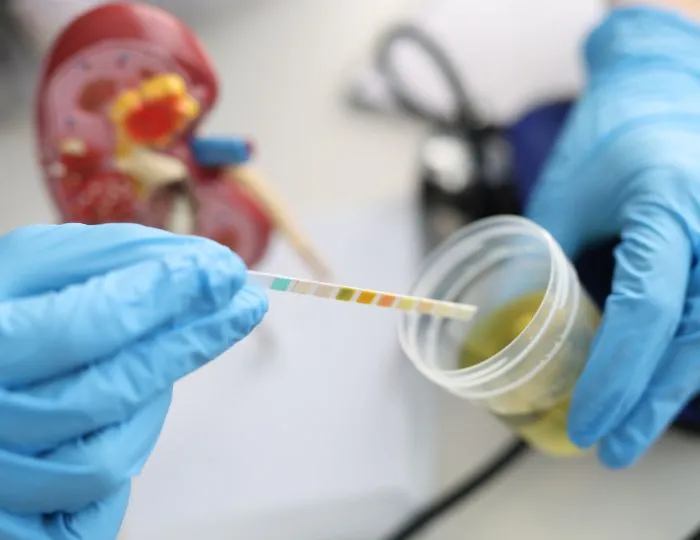
Our Approach
(24×7 Emergency Care)
Our Approach In Managing Blood in Urine - Haematuria
Every episode of blood in the urine has a cause. We find it.
Haematuria is a symptom, not a diagnosis - and the cause ranges from trivial to life-threatening. Our structured evaluation protocol ensures that no significant pathology is missed, while avoiding unnecessary investigation for patients at genuinely low risk.
- Clinical Assessment & Risk Stratification
Our evaluation begins with targeted history-taking:
- Character of haematuria - initial, terminal, or total stream; clot passage; associated pain
- Painless blood in urine - the most concerning presentation; bladder or kidney cancer must be excluded
- Pain with haematuria - suggests kidney stone or infection as the cause
- Age, sex, smoking history, occupational exposures - key risk factors for urothelial malignancy
- Anticoagulant use, recent vigorous exercise, and menstrual history (women)
- Urine Analysis & Culture
Immediate and straightforward investigation:
- Dipstick and microscopy - confirm true haematuria (vs. haemoglobinuria or myoglobinuria)
- Cystoscopy evaluation preceded by urine cytology - exfoliated bladder tumour cells detectable in urine
- Urine culture - to identify or exclude infection as the cause
- Phase contrast microscopy - dysmorphic red cells indicate a glomerular (renal) source
- Imaging - Upper Tract Assessment
The upper urinary tract (kidneys and ureters) must be imaged in all adult patients with gross haematuria:
- CT urogram (CTU) - definitive test; identifies stones, tumours, structural abnormalities and hydronephrosis in one study
- Ultrasound - appropriate initial investigation for low-risk patients, children, or those avoiding radiation
- MRI urogram - for patients with contrast allergy or renal impairment
- Bladder and kidney bleeding - CTU provides comprehensive anatomical mapping of both lower and upper tract
- Cystoscopy - Lower Tract Assessment
Flexible cystoscopy is mandatory for all adult patients with gross or significant microscopic haematuria:
- Performed under local anaesthetic gel as an outpatient procedure - takes 5–10 minutes
- Direct visualisation of the entire bladder mucosa, urethra, and ureteric orifices
- Identification of bladder tumours, stones, vascular lesions, inflammation, or prostate abnormalities
- Biopsy under general anaesthesia (TURBT) arranged if suspicious lesion identified at flexible cystoscopy
- Nephrology Assessment for Glomerular Haematuria
When phase contrast microscopy reveals dysmorphic red cells:
- Proteinuria assessment - 24-hour urine protein or protein:creatinine ratio
- Serology - ANA, ANCA, complement, anti-GBM antibodies - to identify immune-mediated nephritis
- Renal biopsy when glomerular pathology is confirmed and management would change
- Co-management with nephrology for IgA nephropathy, thin basement membrane disease, and Alport syndrome
- Management Based on Diagnosis
Treatment is determined by the identified cause:
- UTI - culture-directed antibiotics; repeat urine check at 4 weeks to confirm clearance
- Kidney stones - managed endoscopically based on size and location (see Kidney Stones page)
- Bladder tumour - TURBT for staging and treatment of non-muscle-invasive disease
- Gross haematuria diagnosis in anticoagulated patients - haematuria workup still required; anticoagulation adjustment in consultation with haematology
- Benign prostatic bleeding (haematuria from BPH) - 5ARI therapy reduces vascularity and recurrence
- Haematuria Follow-Up & Surveillance
After investigation, follow-up is structured by risk:
- Negative full workup (CTU + cystoscopy + urine cytology) - repeat urine at 6 and 12 months
- Low-grade bladder tumour - cystoscopy surveillance at 3 months, then 6-monthly, then annually
- Persistent unexplained microscopic haematuria - repeat flexible cystoscopy at 12–18 months
- High-risk patients (smokers, chemical exposure, age >60) - lower threshold for repeat investigation
How To Identify Blood in Urine - Haematuria?
Haematuria is classified by visibility and its timing within the urinary stream:
Gross (Visible) Haematuria:
- Urine appears pink, red, or cola-brown - visible to the naked eye
- May contain blood clots - particularly from bladder or upper tract sources
- May be accompanied by no pain at all - painless blood in urine is always a red flag
- Or may be associated with flank pain (kidney stone), burning (UTI), or lower urinary symptoms (BPH)
Microscopic Haematuria:
- Urine appears normal in colour
- Red blood cells detected on dipstick or formal microscopy (>3 RBC/hpf on two separate samples)
- Often found incidentally during a health screening or investigation for another complaint
- Requires the same structured evaluation as visible haematuria in adults over 40
Timing Within the Urinary Stream:
- Initial haematuria (blood at start of stream) - suggests urethral source
- Terminal haematuria (blood at end of stream) - suggests bladder neck or prostate
- Total haematuria throughout the stream - bladder or upper tract origin
Any adult with unexplained blood in the urine - visible or microscopic - requires a cystoscopy evaluation and upper tract imaging. Do not accept "it's probably a UTI" as a final answer for recurrent haematuria.
Treatments for Blood in Urine at Shree Hospitals
Flexible Cystoscopy
Outpatient direct bladder visualisation under local anaesthetic gel - mandatory for all adult haematuria. Identifies bladder tumours, stones, vascular lesions, and prostate abnormalities within a 10-minute procedure.
CT Urogram (CTU)
Comprehensive radiological evaluation of the entire urinary tract - kidneys, ureters, and bladder - in a single study. The gold standard upper tract assessment for gross haematuria.
TURBT (Transurethral Resection of Bladder Tumour)
Endoscopic resection of bladder tumours identified at cystoscopy - performed under general anaesthesia; provides both treatment and histological staging of bladder cancer.
Ureteroscopy & Laser Lithotripsy
For haematuria caused by ureteric or kidney stones - endoscopic stone fragmentation and removal simultaneously addresses the bleeding source.
Top Urologists in Mumbai

Dr. Shyam Mohan
Robotic Urological Surgery, Uro-Oncology

Dr. Alap Mehendale
Urologist, Andrologist, Kidney Transplant Surgeon

For Appointment/Query
1800-268-4000

Tele consultation/2nd Opinion
Schedule Consultation
Important FAQs: Blood in Urine - Haematuria
Is blood in the urine always serious?
Not always - but it always deserves investigation. Common benign causes include UTIs, kidney stones, and vigorous exercise. However, painless blood in urine - particularly in adults over 40, in smokers, or in those with occupational chemical exposure - is the classic presentation of bladder cancer. The only way to exclude a serious cause is through proper evaluation: urine cytology, CT urogram, and cystoscopy.
Do I need a cystoscopy for blood in the urine?
In any adult over 35 with gross haematuria, a cystoscopy evaluation is strongly recommended as part of the haematuria workup. Flexible cystoscopy is a quick, outpatient procedure performed under local anaesthetic gel - it takes under 10 minutes and directly examines the bladder lining where tumours most commonly arise. It is not optional for adults with unexplained or recurrent haematuria.
Can blood in urine be caused by medication?
Anticoagulant medications (warfarin, rivaroxaban, apixaban) can cause or exacerbate haematuria - but the underlying urinary tract must still be investigated, as these medications may unmask a pre-existing condition such as a tumour. Aspirin alone rarely causes haematuria. Blood-thinning medication is not a satisfactory explanation for haematuria without a negative haematuria workup.
What does painless blood in urine mean?
Painless blood in urine is the hallmark presentation of bladder and renal cell cancer. The absence of pain is actually what makes it more - not less - concerning, because kidney stones and infections typically do cause pain. Any episode of painless gross haematuria in an adult should be investigated urgently through our hematuria specialist in Mumbai India team - same-week evaluation is available at Shree Hospitals.
What happens if my haematuria workup comes back normal?
A negative full workup (CT urogram, flexible cystoscopy, and urine cytology) is genuinely reassuring - no significant pathology has been identified. However, microscopic haematuria that persists after a negative initial workup requires repeat urine tests at 6 and 12 months. If haematuria persists or recurs, particularly in higher-risk patients, repeat cystoscopy evaluation is recommended at 12–18 months to ensure no interval development of pathology.
(24×7 Emergency Care)

News & Updates
Shree Hospitals Expands Paediatric Surgical Care With Latest Technology
Shree Hospitals Installs a Robotic-Assisted Surgical System for Better Patient Care


