 Ghatkopar (East), Mumbai)


Ureteroscopy (URS) Surgery in Mumbai
Same-Day Stone Removal | No External Incision | 24/7 Emergency Care
A stone stuck in the ureter is one of the most urgent urological problems - causing waves of intense pain, obstructing kidney drainage, and in some cases triggering life-threatening infection. Ureteroscopy surgery in Mumbai at Shree Hospitals is the fastest, most direct solution.
Ureteroscopy passes a thin, rigid or semi-rigid telescope through the urethra and bladder directly to the ureteric stone under live camera vision - and with a laser fibre, fragments and extracts it the same day. No cuts. No overnight stays in most cases. And relief that patients frequently describe as almost immediate. For any stone in the ureter that has failed to pass or is causing obstruction, URS is the procedure of choice.
Don't Ignore Urinary Symptoms. Get Timely Urology Care Today.
Quick facts
Type & Duration: Ureteroscopy with laser or stone basketing; 30 to 60 minutes
Hospital Stay: Day surgery or 1-night admission
Recovery Time: Return to daily activity in 1 to 2 days; stent removal at 1 to 2 weeks
Type of Anaesthesia: General, spinal, or local with sedation
Type of Surgery: Endoscopic - natural urinary passage, zero external incision
Type of Assistance: Emergency or elective CT assessment, semi-rigid ureteroscope stone treatment, ureteral stent placement, post-procedure follow-up
What is Ureteroscopy (URS) Surgery?
The ureter is the tube connecting each kidney to the bladder - approximately 25 to 30cm long. When a kidney stone migrates from the kidney and lodges in the ureter, it blocks urine flow and causes the severe flank pain known as ureteric colic. Depending on where in the ureter the stone is stuck, the pain may radiate into the groin, genitals, or inner thigh - and even a small stone can cause agony disproportionate to its size.
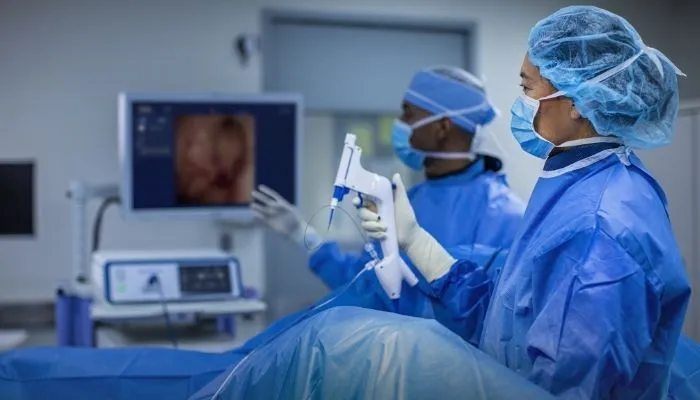
Ureteroscopy - also called URS - uses a thin endoscope introduced through the urethra and bladder to reach the stone directly in the ureter. A semi-rigid ureteroscope is used for stones in the lower and mid ureter; a flexible ureteroscope is used for upper ureteric or intrarenal stones. Once the stone is visualised, a laser fibre fragments it, and stone basketing retrieves the pieces, leaving the ureter completely clear.
The critical advantage of URS over conservative management is immediacy and certainty. Waiting for a ureteric stone to pass spontaneously is appropriate only for stones under 6 mm with no fever, infection, or single kidney involvement.
For anything larger, obstructing, infected, or simply not passing, URS delivers definitive stone removal in a single, predictable session. At Shree Hospitals, emergency URS is available around the clock for patients presenting acutely with obstructing ureteric stones.
When Should You Seek Immediate Stone Care?
- Fever alongside flank pain - infected obstructed kidney - a urological emergency
- Pain uncontrolled despite strong analgesics
- Single functioning kidney with obstruction
- Persistent obstruction beyond 4 weeks despite medical expulsion therapy
- A stone above 6 to 7mm that is unlikely to pass spontaneously
- Known urological anatomy (horseshoe kidney, transplant) requiring urgent management
Is URS Right for Your Stone?
- Ureteric stone confirmed on CT scan - any location in the ureter
- Stone above 6mm with low probability of spontaneous passage
- Failure of medical expulsion therapy after 4 to 6 weeks
- Obstruction causing hydronephrosis (kidney swelling)
- Stone associated with urinary infection - requires emergency drainage
- Patient preference for immediate, certain stone removal over conservative waiting
Why URS Is Preferred Over ESWL for Ureteric Stones?
- URS achieves stone-free rates above 95% in one session; ESWL may need 2 to 3 sessions
- ESWL is less effective for lower ureteric stones - URS has no location limitation
- Stone fragments from ESWL must still pass the ureter; URS removes them directly
- URS can be performed as an emergency; ESWL requires scheduling and waiting
- Dense stones (above 900 HU on CT) respond poorly to ESWL but fragment well with laser
- Stone basketing confirms complete removal - no residual fragment uncertainty
Ureteric stone pain is severe enough that most patients remember the date of their episode years later.
There is no reason to wait in that pain. Our emergency urology service is available 24 hours a day, 7 days a week.
24×7 Emergency Care
Our Approach to Ureteroscopy Surgery
URS is, at its core, a procedure that should be fast, thorough, and safe. Our approach to ureteroscopy is built on emergency availability, optimal imaging, and a technical standard that consistently delivers complete stone clearance.
24×7 Emergency Care
Emergency URS Available Around the Clock
Patients with an infected obstructed kidney or an acutely obstructing ureteric stone require intervention within hours, not days. Our urology team maintains 24-hour emergency access for stone surgery - ureteral stenting for drainage can be performed immediately, and definitive URS is scheduled within 24 to 48 hours of the emergency presentation once infection has been controlled.
CT-Guided Stone Localisation
Before every URS - emergency or elective - a CT KUB is reviewed to confirm stone location, size, and ureter anatomy. Knowing the exact position of the stone before the scope is introduced allows the urologist to advance to the correct level without unnecessary ureteral trauma and confirms whether a single stone or multiple fragments are present.
Semi-Rigid Scope with Holmium Laser
Our semi-rigid ureteroscope delivers clear, high-definition vision of the ureter from the ureteric orifice to the pelviureteric junction. A holmium laser fibre is deployed to fragment the stone at the optimal energy setting - dusting for small stones, fragmentation with stone basketing for larger pieces. The scope is withdrawn slowly under vision to check for any residual fragments in the ureter.
Ureteral Stent Placement & Removal Planning
A ureteral stent is placed in virtually all URS procedures - from emergency stenting to elective stone removal. The stent maintains ureteral patency while post-operative oedema resolves and prevents obstruction from any small residual fragments. Stent removal is arranged at 1 to 2 weeks in a brief clinic procedure under local anaesthesia. Patients are given clear written information on stent-related symptoms to expect.
Top Ureteroscopy Surgeons in Mumbai
Our urology team at Shree Hospitals manages ureteric stone emergencies day and night. Proficiency in ureteroscopy - from straightforward lower ureteric stones to difficult upper ureteric and angulated cases - is core to our emergency urology capability.
Every on-call urologist in our team is trained to perform emergency URS independently.
24×7 Emergency Care

Dr. Shyam Mohan
Robotic Urological Surgery, Uro-Oncology

Dr. Alap Mehendale
Urologist, Andrologist, Kidney Transplant Surgeon
Related Stone Treatments at Shree Hospitals
URS treats the ureter - but kidney stones require a broader programme. Our full stone management service ensures the right procedure for every stone location and size
RIRS
For kidney stones up to 2cm; flexible ureteroscopy navigates the intrarenal collecting system.
PCNL Surgery
For large kidney stones above 2cm requiring direct percutaneous access.
Laser Kidney Stone Surgery
Comprehensive laser stone programme across all urinary tract locations.
ESWL
External shockwave for suitable stones; non-invasive outpatient treatment.
Step by Step Process of Ureteroscopy (URS)
Step 1 - CT Confirmation, Infection Exclusion & Pre-Op Preparation
CT KUB confirms stone location and size. Urine culture is checked - a positive culture requires antibiotic treatment before definitive URS to prevent sepsis from manipulating an infected urine system. Blood tests and anaesthetic assessment are completed. Antibiotic prophylaxis is administered pre-operatively. Emergency stenting may be performed the same day for obstructed infected cases, with definitive URS at 48 to 72 hours.
Step 2 - Anaesthesia & Scope Introduction
You receive general, spinal, or local anaesthesia with sedation. The semi-rigid ureteroscope is introduced through the urethra, passed through the bladder, and advanced carefully into the ureteral orifice. The scope is advanced under continuous vision toward the ureteric stone - using saline irrigation to maintain visibility. Fluoroscopy confirms scope position in the ureter if needed.
Step 3 - Stone Fragmentation & Basketing
The stone is visualised and a holmium laser fibre is deployed. For stones under 8mm, laser dusting produces fine particles that pass spontaneously. For larger stones, fragmentation followed by stone basketing - retrieving pieces with a nitinol basket - ensures complete clearance. The ureter is inspected on scope withdrawal to confirm no residual fragments remain.
Step 4 - Ureteral Stent Placement & Discharge
A ureteral stent is placed under cystoscopic vision and confirmed on post-procedure X-ray. You are monitored in recovery for 1 to 2 hours. Most patients are discharged the same day. Stent-related symptoms are explained - urinary frequency, mild burning, and occasional minor haematuria are normal. Stent removal at 1 to 2 weeks resolves symptoms rapidly. A follow-up CT or ultrasound confirms stone-free status.
Patient Questions About Ureteroscopy Surgery
Can a ureteroscopy damage the ureter?
Ureteral injury during ureteroscopy is uncommon in experienced hands - the most significant risk is perforation of the ureter, which occurs in less than 1% of cases at high-volume centres. Minor mucosal abrasions are common and heal without consequence. The ureteral stent placed at the end of the procedure protects the ureter during the healing period. Our team uses size-appropriate scopes and avoids excessive force, particularly when accessing a non-dilated ureter.
Do I need a general gnaesthetic for URS?
Not always. While general anaesthesia is most common for ureteroscopy because it provides complete immobility and patient comfort during intraureteral work, spinal anaesthesia is an effective alternative for lower ureteric stones. In emergency situations where anaesthetic resources are limited, or for very frail patients, local anaesthesia with intravenous sedation is feasible for straightforward lower ureteric cases. Your anaesthetist and urologist will advise the safest option for your specific presentation.
What if my stone is too hard to fragment with the laser?
Hard stones - typically calcium oxalate monohydrate above 1000 HU on CT - require higher laser energy and longer operative time for fragmentation. They are not a contraindication to URS, but they may require a longer procedure or occasionally a staged approach if complete clearance is not achieved in one session. For stones that prove extremely resistant to laser in the ureter and are not clearable endoscopically, PCNL or open surgery is rarely required. Stone basketing of intact small stones is an option for very hard, small stones where laser fragmentation is slow.
Patient
Resources

Schedule
consultation

Billing &
Payments

Hospital
Facilities
24×7 Emergency Care

1800-268-4000

Follow Us

Shree
Hospitals

Shree
Hospitals
