 Ghatkopar (East), Mumbai)


Varicocele Surgery in Mumbai
Expert Varicocelectomy for Fertility & Pain Relief
A varicocele is one of the most underdiagnosed causes of male infertility - and one of the most correctable. Present in 15% of the general male population and in up to 40% of men investigated for infertility, a testicular varicocele is an abnormal dilation of the veins draining the testicle, allowing warm blood to pool around the sperm-producing tissue and gradually impairing its function.
Varicocele surgery in Mumbai at Shree Hospitals uses the most effective technique available - microsurgical varicocelectomy - to ligate the abnormal veins with an operating microscope, protecting the vital structures that preserve testicular function and fertility.
Whether you are dealing with unexplained infertility, declining sperm parameters, or testicular discomfort, this is a problem with a clear, well-established solution.
Don't Ignore Urinary Symptoms. Get Timely Urology Care Today.
Quick facts
Type & Duration: Varicocelectomy - microsurgical subinguinal or inguinal approach; 60 to 90 minutes
Hospital Stay: Day surgery or 1-night admission
Recovery Time: Return to desk work in 3 to 5 days; avoid heavy lifting for 2 to 3 weeks
Type of Anaesthesia: General, spinal, or local anaesthesia with sedation
Type of Surgery: Microsurgical open approach - small groin or scrotal incision; scrotal vein ligation under microscope
Type of Assistance: Pre-operative semen analysis and ultrasound, microsurgical varicocele repair, post-operative semen analysis at 3 and 6 months
What is Varicocele Surgery (Varicocelectomy)?
The testicle operates at a precise temperature - approximately 2 to 3 degrees lower than core body temperature - because spermatogenesis (sperm production) requires a cooler environment than the abdominal cavity.
The pampiniform plexus - the network of veins surrounding the testicular artery in the spermatic cord - acts as a heat exchanger, cooling arterial blood before it enters the testicle.
A testicular varicocele disrupts this system. When the valves inside the spermatic veins fail, blood refluxes downward and pools around the testicle - raising its temperature, reducing oxygen delivery, and creating oxidative stress that damages sperm DNA and reduces sperm count, motility, and morphology.
Grade 1 varicoceles are small and detected only by Doppler ultrasound. Grade 3 varicoceles are visible as a "bag of worms" above the testicle. All grades can affect fertility.
Varicocelectomy - surgical ligation of the abnormal veins - corrects the underlying problem. Male infertility treatment for varicocele has been studied extensively: in couples with male factor infertility, clinical varicocele, and abnormal semen analysis, surgical repair consistently improves sperm parameters and increases the chance of spontaneous conception.
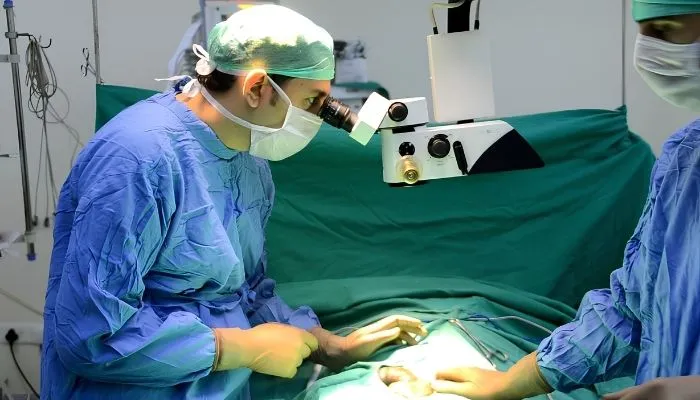
Microsurgical varicocelectomy using an operating microscope - the most refined technique - achieves higher success rates, lower recurrence rates, and fewer complications than conventional ligation or percutaneous embolisation, because magnification allows preservation of the testicular artery and lymphatics that simpler approaches damage inadvertently.
Signs a Varicocele May Be Affecting You
- Couple trying to conceive for 12+ months without success (6 months if female partner over 35)
- Semen analysis showing reduced sperm count, motility, or morphology
- A dull, persistent ache or heaviness in one or both testicles - worsening after standing
- Visible or palpable scrotal swelling above the testicle on the left (more common) or right
- Testicular asymmetry - left testicle smaller than right (may indicate testicular varicocele effect on growth)
- Discovered incidentally on ultrasound or physical examination
Is Varicocele Surgery Right for You?
- Clinical varicocele confirmed on scrotal Doppler ultrasound
- Abnormal semen analysis - at least one parameter below normal reference range
- Normal female partner fertility investigation (or concurrent ART planning)
- Unilateral or bilateral varicocele contributing to male infertility treatment plan
- Testicular discomfort affecting daily quality of life
- Adolescent with grade 2 or 3 varicocele and evidence of testicular hypotrophy (growth impairment)
Why Microsurgical Approach Is the Gold Standard?
- Operating microscope identifies and preserves the testicular artery - injury causes testicular atrophy
- Lymphatic preservation prevents post-operative hydrocele (scrotal fluid accumulation) - complication rate 5–10x lower than non-microsurgical techniques
- Internal spermatic vein ligation completed more thoroughly under magnification - lower recurrence rate
- Microsurgical varicocelectomy outperforms embolisation for fertility outcomes in head-to-head studies
- Applicable to Grade 1, 2, and 3 varicoceles - any grade affecting semen parameters
- Bilateral cases manageable in a single anaesthetic through bilateral subinguinal incisions
Infertility is a medical problem - and varicocele is a treatable one.
A 90-minute microsurgical procedure can change the trajectory of a family's journey. The consultation starts the answer.
24×7 Emergency Care
Our Approach to Varicocele Surgery
Every couple struggling with fertility deserves an evaluation that is thorough, evidence-based, and free of unnecessary waiting.
Our approach to varicocele surgery begins with a complete fertility assessment and ends with post-operative semen analysis that objectively measures the outcome.
24×7 Emergency Care
Complete Male Fertility Assessment Before Surgery
Before recommending varicocelectomy, we establish the full clinical picture - two semen analyses performed 4 weeks apart, scrotal Doppler ultrasound to grade the varicocele and assess testicular volume, hormonal profile (FSH, LH, testosterone), and a review of female partner fertility investigations. This is not just about finding a varicocele - it is about confirming that correcting it will meaningfully improve the couple's fertility potential.
Subinguinal Microsurgical Approach
Our preferred technique for microsurgical varicocelectomy is the subinguinal approach - an incision just below the inguinal ligament, accessing the spermatic cord at a point where the veins have multiplied but the artery remains identifiable. Under 16x to 25x operating microscope magnification, we ligate all internal spermatic veins while preserving the testicular artery, cremasteric artery, vas deferens, and lymphatics. Average vein ligation count per cord is 8 to 12.
Bilateral Surgery in One Session
For men with bilateral clinical varicocele - more common than generally appreciated - both sides can be repaired under a single anaesthetic through bilateral subinguinal incisions. This avoids the need for staged procedures and delivers complete scrotal vein ligation in one day of recovery. Post-operative semen analysis improvement after bilateral repair is greater than unilateral repair in appropriately selected patients.
Post-Operative Fertility Follow-Up
Sperm production cycles take approximately 72 days - so post-operative semen analysis is not performed before 3 months. Our follow-up protocol measures semen parameters at 3 and 6 months. If improvement at 6 months is adequate for natural conception, we support continued trying. If parameters remain suboptimal despite improvement, or if female factor is also present, we coordinate referral to reproductive medicine for IUI or IVF with the benefit of improved sperm quality post-repair.
Top Varicocele Surgeons in Mumbai
Microsurgical varicocelectomy is a subspecialty procedure - the quality of the result depends directly on operating microscope skill and familiarity with spermatic cord anatomy.
Our reproductive urology team at Shree Hospitals manages a dedicated volume of male infertility treatment cases, working in close coordination with reproductive medicine specialists to offer couples a complete fertility pathway rather than a single procedure in isolation.
24×7 Emergency Care

Dr. Shyam Mohan
Robotic Urological Surgery, Uro-Oncology

Dr. Alap Mehendale
Urologist, Andrologist, Kidney Transplant Surgeon
Related Urology Treatments at Shree Hospitals
Varicocele is one component of male reproductive health - our programme covers the full spectrum of conditions affecting male fertility and scrotal anatomy
Hydrocele Surgery
Surgical repair of testicular fluid accumulation; a different scrotal condition managed by the same team.
Robotic Urology Surgery
For testicular or other urological tumours requiring oncological management.
Reconstructive Urology
Includes vasectomy reversal and complex vas deferens reconstruction for fertility.
TURP Surgery
For prostate-related conditions in older men; reproductive urology managed under a separate pathway.
Step by Step Process of Varicocele Surgery
Step 1 - Assessment, Semen Analysis & Ultrasound Confirmation
Your urologist takes a detailed history - duration of infertility, prior investigations, and scrotal symptoms. Two semen analyses and a scrotal Doppler ultrasound are arranged. The varicocele is graded clinically and on Doppler; testicular volume is measured bilaterally. Hormone profile is reviewed. The decision to proceed with varicocelectomy is based on clinical varicocele, abnormal semen analysis, and couple fertility history.
Step 2 - Anaesthesia & Incision Placement
General, spinal, or local anaesthesia with sedation is administered. The subinguinal incision - 2 to 3cm, just below the external inguinal ring - is made. The spermatic cord is delivered into the wound and placed on a surgical rest under the operating microscope. Cord structures are identified under magnification.
Step 3 - Microsurgical Vein Ligation
Under 16x to 25x operating microscope magnification, the internal spermatic veins - typically 8 to 15 vessels - are individually ligated with fine suture material or vascular clips. The testicular artery is identified with a hand-held Doppler probe if needed and meticulously preserved. Lymphatics - identifiable as thin-walled transparent vessels under the microscope - are preserved. The vas deferens and its vessels are protected throughout. Scrotal vein ligation is confirmed complete before wound closure.
Step 4 - Wound Closure, Recovery & Discharge
The spermatic cord is replaced, the incision closed in layers. You are monitored in recovery for 1 to 2 hours. Most patients are discharged the same day. Scrotal support and ice packs are used for 48 hours. Desk work can typically resume in 3 to 5 days; exercise and heavy lifting are avoided for 2 to 3 weeks. Post-operative semen analysis at 3 months and 6 months confirms the fertility outcome.
Patient Questions About Varicocele Surgery
Does a varicocele always need surgery?
Not every varicocele requires intervention. Small (Grade 1) varicoceles found incidentally in men with normal semen analysis and no scrotal symptoms do not generally require treatment. The indication for surgery is a clinical varicocele (palpable Grade 2 or 3, or Grade 1 confirmed on Doppler with reflux) associated with at least one abnormal semen parameter in a couple with infertility or fertility planning - or a varicocele causing significant ongoing scrotal discomfort. Adolescents with Grade 2 or 3 varicocele and evidence of testicular hypotrophy are also candidates for early varicocelectomy to prevent long-term fertility impact.
Does varicocele surgery always work?
Microsurgical varicocelectomy improves sperm parameters in approximately 70% of treated men - but improvement does not guarantee pregnancy. Multiple factors influence pregnancy outcome: female partner fertility status, the severity of the initial semen impairment, patient age, and whether there is concurrent primary testicular failure that the varicocele has been masking. For men with very low sperm counts (below 1 million/ml) or azoospermia, the response to varicocelectomy is less predictable - though improvement sufficient to enable IVF with own sperm rather than donor sperm is still achievable in a significant proportion. Our team discusses realistic expectations at consultation, based on your specific semen parameters and female fertility investigation.
Can a varicocele recur after surgery?
Recurrence after microsurgical varicocelectomy - defined as persistent Doppler-confirmed reflux on post-operative ultrasound - occurs in approximately 1 to 2% of cases with the microsurgical technique, compared to 5 to 10% with conventional open ligation and 10 to 15% with percutaneous embolisation. The lower recurrence rate of microsurgical repair reflects the more complete identification and ligation of all veins under magnification. If a testicular varicocele does recur after surgery, repeat microsurgical repair or embolisation are both feasible options.
Patient
Resources

Schedule
consultation

Billing &
Payments

Hospital
Facilities
24×7 Emergency Care

1800-268-4000

Follow Us

Shree
Hospitals

Shree
Hospitals
