 Ghatkopar (East), Mumbai)


Table Of Content
Patient Resources
Billing, Insurances & Estimates
Admission & Discharge
Visitors’ Rules
International Patients
Hospital Facilities
Health Packges

For Appointment/Query
1800-268-4000

Search or
Find Specialist
Breast Cancer Symptoms and Diagnosis: Signs, Tests and When to See a Doctor
Breast cancer often appears as a new lump in the breast or armpit. It can also cause skin changes, nipple changes, swelling or pain. Some people have no symptoms at all. Diagnosis usually follows three steps: a breast examination, imaging such as a mammogram or ultrasound, and a biopsy to confirm the result.
Quick Answer
- Symptoms: a new lump, thickening or swelling, skin dimpling or redness, nipple pulling in, bloody nipple discharge, or a change in breast size or shape.
- Diagnosis: breast exam, imaging (mammogram, ultrasound, sometimes MRI), then a biopsy.
- Most lumps are not cancer, but any new change needs a doctor's check.
- Some people have no symptoms, which is why screening matters.
Key takeaways
- A lump is not the only sign.
- You cannot tell cancer from a benign lump by touch.
- Imaging can raise suspicion, but only a biopsy confirms cancer.
- Most people sent to a breast clinic do not have cancer, but go to the appointment.

Reviewed By
Shree Hospitals Multi-Speciality Care
Treatment:
Breast Cancer Surgery

What are the symptoms of breast cancer?
The CDC lists these warning signs:
- A new lump in the breast or underarm
- Thickening or swelling of part of the breast
- Irritation or dimpling of breast skin
- Redness or flaky skin in the nipple area or breast
- Pulling in of the nipple, or nipple pain
- Nipple discharge other than breast milk, including blood
- A change in the size or shape of the breast
- Pain in any area of the breast
The CDC adds that these signs can also happen with conditions that are not cancer. Its Bring Your Brave page also lists redness and unusual warmth in the breast.
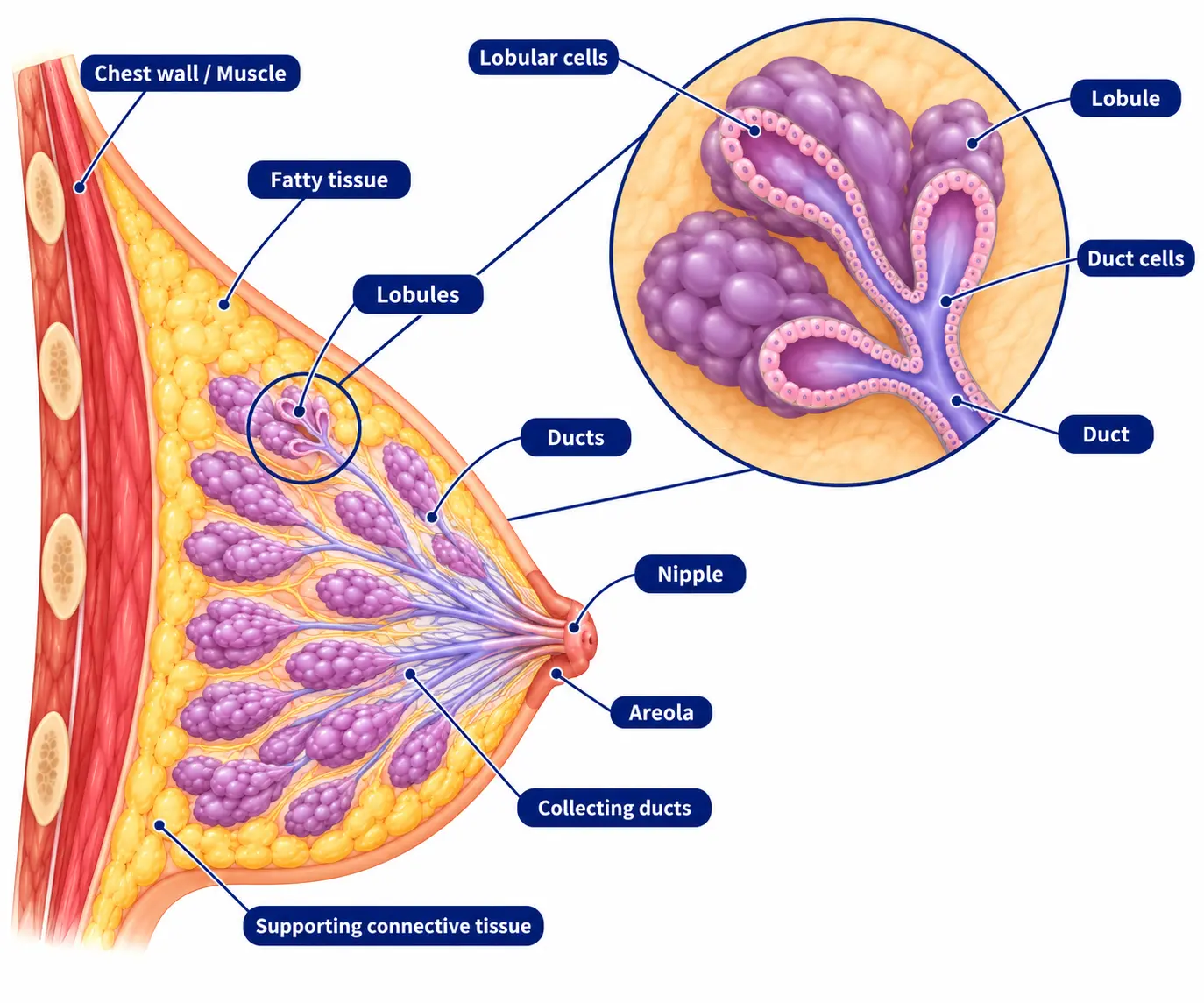
| Sign | Why it matters | Next step |
| New lump in breast or armpit | Needs examination and imaging | See a doctor soon |
| Skin dimpling, redness or thickening | Can be an infection or cancer | Get it assessed |
| Nipple turning inward, scaly or sore | Needs a closer look | Get it assessed |
| Bloody or one-sided discharge | Needs investigation | See a doctor soon |
| Change in size or shape | May be new for you | Get it assessed |
Can you have breast cancer without a lump?
Yes. The CDC notes that some people have no signs or symptoms at all and may find out after a routine mammogram. Other signs, such as skin or nipple changes, can appear without a lump.
What does a breast cancer lump feel like?
You cannot tell by touch. A lump can be hard, but it can also be soft, rounded and tender, and there may be no lump to feel at all. That is why any new lump needs examination and imaging.
Are most breast lumps cancer?
No. The CDC says most breast lumps are caused by other conditions, such as fibrocystic breast condition and cysts. A new lump still needs checking, because only tests can tell the difference. Read about breast lump evaluation at Shree Hospitals.
Is breast pain a sign of breast cancer?
Breast pain is very common and is not usually due to cancer, according to Cancer Research UK. But the CDC lists pain in any area of the breast as a possible warning sign. See a doctor if pain is persistent, in one spot, or comes with other changes.
What does nipple discharge mean?
Discharge has many causes. It deserves a check if it starts on its own, comes from one breast only, or contains blood (Medical News Today).
What are the less common signs?
- Inflammatory breast cancer can look like an infection, with a red, warm, swollen breast.
- A sore or rash on the nipple that does not settle.
- Symptoms in men are similar to those in women (Anadolu Medical Center).
When should you see a doctor?
See a doctor for any change that is not normal for you (Cancer Research UK). In particular, book an appointment promptly for:
- A new lump or thickening
- Bloody or one-sided nipple discharge
- Skin dimpling, a nipple turning in, or a rash that does not settle
- Redness and warmth with swelling
- A lump in the armpit
- A change that is getting worse
Tell the doctor about any family history of breast or ovarian cancer. Do not wait to see if a lump goes away on its own. A doctor may sometimes suggest short-term review, but that should be decided after an examination.
How is breast cancer diagnosed?
Doctors use several steps. If a screening mammogram is abnormal or you have a lump, the CDC says further tests include breast ultrasound, a diagnostic mammogram, breast MRI and biopsy. You may be referred to a breast specialist or surgeon.
Step by step
- History and breast exam: the doctor asks about symptoms, family history and past surgery, then examines both breasts and the armpits.
- Imaging: a diagnostic mammogram and/or ultrasound. MRI is used in selected cases.
- Biopsy: a small tissue sample is taken from the suspicious area.
- Pathology: a specialist examines the sample under a microscope.
- Staging tests: done only if cancer is found, to see whether it has spread.
Having an exam, imaging and a biopsy together is called a triple assessment. It may take place in a one-stop clinic.
| Test | What it does | Limits |
| Clinical breast exam | Checks lumps, skin, nipples, armpit nodes | Cannot confirm cancer |
| Mammogram | Detailed X-ray of the breast | Can miss some cancers, especially in dense breasts |
| Ultrasound | Examines a specific area, including armpit nodes | Cannot confirm cancer alone |
| MRI | Extra detail when other tests are unclear | Not routine for everyone |
| Biopsy | Confirms or rules out cancer | Needs pathology review |
Can a Mammogram or ultrasound confirm breast cancer?
No. These tests can find suspicious areas, but only a biopsy and microscopic analysis can confirm or rule out cancer. MRI complements them but does not replace them.
Why might I need extra imaging if my breasts are dense?
Dense tissue can hide abnormalities on a standard mammogram. HCG Oncology notes that an ultrasound often follows, and MRI may be suggested for some high-risk women. If you have a lump and your mammogram looks normal, ask whether an ultrasound is needed.
What are the types of breast biopsy?
The CDC lists fine-needle aspiration, core biopsy and open (surgical) biopsy. A core needle biopsy is common. Ultrasound or mammogram guidance helps the doctor reach the exact spot, and a small marker may be left in place.
How long do biopsy results take?
It varies with the tests needed. Some results come in days, and some take longer. Ask the clinic when and how you will get results, and whether to bring someone with you.
What does BI-RADS mean on my report?
BI-RADS is a standard scale radiologists use for mammogram, ultrasound and MRI results. Here are the seven categories as described by the US National Cancer Institute's SEER programme.
| Category | Meaning |
| 0 | Incomplete, more imaging needed |
| 1 | Negative |
| 2 | Benign finding |
| 3 | Probably benign, short-interval follow-up |
| 4 | Suspicious, biopsy recommended |
| 5 | Highly suggestive of cancer, biopsy recommended |
| 6 | Cancer already confirmed |
SEER gives approximate chances of cancer of about 23% to 34% for category 4 and about 95% for category 5. These are group figures, not your personal risk, and category 4 is divided into sub-groups (4A to 4C) that differ. Ask your radiologist which applies to you.
What happens after a breast cancer diagnosis?
The American Cancer Society explains that the pathology report describes:
- Grade: how abnormal the cells look.
- ER and PR status: whether the cells have hormone receptors.
- HER2 status: whether the cells make too much of the HER2 protein.
The stage is based on tumour size, spread and other features, and it usually draws on exams and imaging, not just the biopsy. Treatment depends on type and stage, so your team plans it after all results are in. Some people may also be offered genetic counselling, especially with a strong family history. Genes such as BRCA1 and BRCA2 are linked to higher risk (Institut Curie).
Screening and early detection in India
Screening finds cancer before symptoms appear, but advice differs between sources.
- India has no uniform national mammography programme for women without symptoms. The national NPCDCS programme recommends screening women aged 30 to 65 by clinical breast examination, and uptake is low.
- Many hospitals and radiology groups suggest mammography from around age 40, often yearly, because breast cancer in India tends to appear a decade earlier than in Western countries (Apollo Hospitals).
- Some international bodies no longer advise routine self-exams or clinical exams for average-risk women.
Because advice varies, ask your doctor which plan suits your age, family history and breast density. Whatever your screening plan, know how your breasts normally look and feel and report changes.
Questions to ask at the breast clinic
- Which tests do I need today, and why?
- What does my BI-RADS category mean?
- When will I get results, and who will explain them?
- If I need a biopsy, what type will it be?
- Do I need extra imaging because of dense breasts?
- Should I have genetic counselling?
- What happens next if the result is benign?
Breast cancer symptoms and diagnosis in Mumbai
A breast clinic can arrange the exam, imaging and biopsy in one place. At Shree Hospitals , Mumbai , Bring any earlier reports and a list of questions, then book a consultation or find a specialist. You can also read about our breast clinic and mammography and breast imaging .
Frequently Asked Question
How do I know if a breast lump is cancer?
You cannot tell by feel. It needs a doctor's exam, imaging and sometimes a biopsy.
Can a painless lump be cancer?
Yes. Many lumps cause no pain, so painless does not mean safe. Get any new lump checked.
Can breast cancer cause no symptoms?
Yes. Some cases are found only on a routine mammogram.
Is a cyst the same as cancer?
No. A cyst is a fluid-filled sac, commonly benign. Imaging helps tell cysts from solid lumps.
Can a normal mammogram miss cancer?
Yes, particularly in dense breasts. If a lump persists, ask for an ultrasound or specialist review.
What does BI-RADS 4 mean?
It means suspicious on imaging, and a biopsy is recommended. Many biopsies still show benign results.
Does a biopsy hurt or spread cancer?
Local anaesthetic numbs the area, and you may feel pressure or some discomfort. A biopsy is a standard safe step to confirm a diagnosis.
How long does it take to get diagnosed?
The tests can be done in one visit at some clinics. Final pathology results usually take days or longer.
Can young women get breast cancer?
Yes, though it is less common. Report any new change at any age.
Do dense breasts mean higher cancer risk?
Dense breasts can make mammograms harder to read. Ask if extra imaging is needed for you.
Which doctor should I see?
Start with a general physician or gynaecologist. A breast surgeon or oncologist manages further tests.