 Ghatkopar (East), Mumbai)

Home > Cardiac Sciences > Defibrillation & Cardioversion
Defibrillation & Cardioversion in Mumbai
Precise Electrical Therapy for Life-Threatening Heart Rhythms
When the heart beats dangerously fast, chaotically, or stops responding to normal signals, every second matters. Defibrillation and cardioversion in Mumbai at Shree Hospitals delivers controlled electrical therapy to restore the heart's natural rhythm - preventing sudden cardiac death and serious complications. Our emergency-ready cardiac team operates 24/7 with the technology and training to act when it counts most.
Concerned About Your Heart Health? Get Expert Cardiac Care Today.
Quick facts
Procedure Type: Electrical therapy - emergency (defibrillation) or planned (cardioversion)
Duration: Defibrillation takes seconds; cardioversion is typically completed within 30 minutes
Anaesthesia: Cardioversion is done under brief sedation; defibrillation requires none
Success Rate: Cardioversion restores normal rhythm in over 90% of eligible patients
Type of Care: Emergency and elective - both available at Shree Hospitals
What is Defibrillation & Cardioversion?
Not all abnormal heart rhythms are the same - and neither are the treatments. Both defibrillation and cardioversion use electrical energy to correct dangerous heart rhythm disturbances, but they serve different situations and are applied differently.
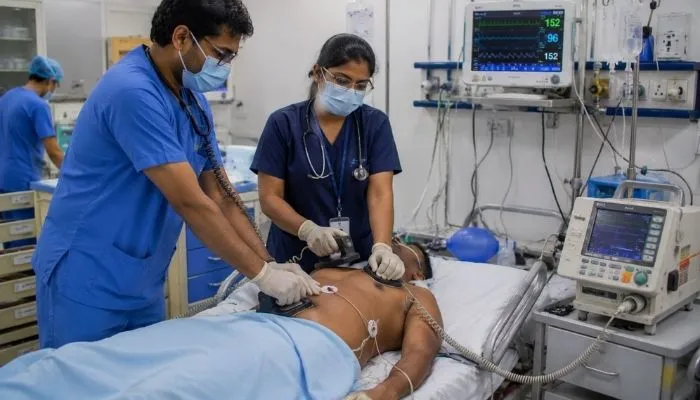
Defibrillation is an emergency procedure used when the heart is in ventricular fibrillation or pulseless ventricular tachycardia - conditions where the heart is essentially quivering instead of pumping. A high-energy shock is delivered immediately to reset the heart's electrical system.
Cardioversion is used for less immediately life-threatening but still serious arrhythmias - most commonly atrial fibrillation treatment and atrial flutter. It can be delivered as a scheduled, elective procedure under sedation, with a synchronized, lower-energy electrical shock timed precisely to the heart's activity.
At Shree Hospitals, electrical cardioversion procedure in India is performed by experienced cardiologists using advanced synchronised defibrillators with real-time ECG monitoring.
When Should You Consult a Cardiologist?
- Sudden loss of consciousness or cardiac arrest
- Diagnosed with atrial fibrillation not responding to medication
- Persistent rapid or irregular heartbeat lasting more than 48 hours
- Recurrent episodes of palpitations with dizziness
- Referral from physician for rhythm management
Is This Procedure Right for You?
- Suitable for patients with documented arrhythmias confirmed by ECG
- Cardioversion is planned after ruling out blood clots in the heart
- Not recommended in patients with digitalis toxicity or certain electrolyte imbalances
- Individual evaluation required before every procedure
Why Timely Rhythm Correction Matters?
- Uncontrolled arrhythmia weakens the heart muscle over time
- Atrial fibrillation significantly raises stroke risk if untreated
- Abnormal heart rhythm correction reduces risk of heart failure progression
- Timely intervention improves long-term quality of life and survival
Prompt defibrillation within the first 3 minutes of cardiac arrest can increase survival rates by up to 70%.
Delay costs lives - our 24/7 cardiac emergency team is always ready.
24×7 Emergency Care
Our Approach to Defibrillation & Cardioversion
At Shree Hospitals, emergency heart rhythm treatment in Mumbai follows a protocol-driven, patient-specific approach. Whether the situation is a cardiac emergency or a planned rhythm correction, our team ensures safety, accuracy, and the best possible outcome at every step.
24×7 Emergency Care
Accurate Rhythm Diagnosis
Each patient undergoes a thorough cardiac evaluation - including stress testing, ECG, and fitness baseline - before any exercise or therapy begins. This ensures the program is safe and effective from day one.
Precision-Guided Electrical Delivery
Our cardioversion procedures use synchronised technology that times the electrical shock to avoid triggering a more dangerous rhythm. This precision is critical, particularly in atrial fibrillation treatment cases, where mistimed shocks carry serious risk.
Pre-Procedure Anticoagulation Protocol
For elective cardioversion, patients are evaluated for blood clot risk using transesophageal echocardiography (TEE) or a defined anticoagulation period. This step is non-negotiable - it is what separates a safe procedure from a dangerous one.
Comprehensive Post-Procedure Cardiac Care
After cardiac shock therapy, patients are monitored for rhythm stability, blood pressure, and oxygen levels. Medications are initiated or adjusted to maintain normal rhythm and prevent recurrence.
Top Heart Specialists in Mumbai
Shree Hospitals is home to some of the most experienced cardiothoracic surgeons and cardiac anaesthetists in the region. Our surgical team maintains a consistent record of excellence across routine and high-complexity bypass procedures.
24×7 Emergency Care

Dr. Anmol Sonawane
Interventional Cardiologist, TAVI & Structural Heart
Dr. Chirag Parikh
Consultant Interventional Cardiologist
Dr. Komal Pawar
Consultant Interventional Cardiologist

Dr. Vaibhav Shah
Cardio Thoracic Surgeon
Cardiac Treatments at Shree Hospitals
Our defibrillation and cardioversion services provide comprehensive care for heart rhythm disorders, combining accurate diagnosis, advanced electrical therapies, continuous cardiac monitoring, and ongoing specialist management to restore and maintain a healthy heart rhythm.
Transesophageal Echocardiography (TEE)
Performed before elective cardioversion to rule out clots in the heart chambers - a mandatory safety step in electrical cardioversion procedure in India.
Step by Step Process of Defibrillation & Cardioversion
- Initial Assessment & Rhythm Confirmation
Every patient presenting with an abnormal rhythm undergoes a 12-lead ECG, blood tests, and echocardiogram. This confirms the type of arrhythmia and guides the choice between emergency defibrillation or planned cardioversion. For emergency heart rhythm treatment in Mumbai, this step is compressed and executed within minutes. - Pre-Procedure Preparation
For elective cardioversion, anticoagulation therapy is started at least 3 to 4 weeks prior, or a TEE is performed to confirm absence of cardiac clots. Fasting instructions are given, and a detailed consent process explains risks and expected outcomes.
- Sedation & Monitoring Setup
Cardioversion patients receive short-acting intravenous sedation administered by an anaesthesiologist. Continuous ECG, pulse oximetry, and blood pressure monitoring are established before the procedure begins. Emergency defibrillation requires no sedation - it is performed immediately. - Electrical Shock Delivery
For cardioversion, a synchronised shock is delivered through electrode pads placed on the chest. Energy levels are calibrated based on arrhythmia type - typically 100 to 200 joules. The abnormal heart rhythm correction is confirmed in real time on the cardiac monitor. Defibrillation uses higher, unsynchronised energy delivered as rapidly as possible. - Post-Procedure Monitoring
Following the procedure, patients are observed in a recovery area for 2 to 4 hours. Rhythm stability, blood pressure, and neurological status are tracked. Most elective cardioversion patients are discharged the same day with a follow-up plan. - Long-Term Rhythm Management
Rhythm-maintaining medications such as antiarrhythmics are prescribed post-procedure. Follow-up ECGs at 1 week and 1 month confirm sustained normal rhythm. Patients with recurrent arrhythmia are evaluated for atrial fibrillation treatment options including ablation or ICD implantation.
Patient Questions About Defibrillation & Cardioversion
What is the difference between defibrillation and cardioversion?
Defibrillation is an emergency procedure used when the heart is in cardiac arrest - specifically ventricular fibrillation or pulseless ventricular tachycardia. It delivers a high-energy, unsynchronised shock to abruptly reset the heart's electrical activity. Cardioversion is used for arrhythmias where the heart is still beating but abnormally - such as atrial fibrillation or atrial flutter. It uses a lower-energy, synchronised shock timed to the heart's own cycle to avoid triggering a more dangerous rhythm. Both use electrical energy, but the urgency, energy levels, and clinical contexts are very different.
Is cardioversion painful?
No. Elective cardioversion is performed under brief intravenous sedation, so you are completely unaware of the procedure during the shock delivery. You may feel mild chest soreness at the electrode pad sites for a day or two afterward, similar to a mild skin irritation. Most patients have no memory of the procedure itself and are awake and comfortable within minutes of completion.
How do I know if I need cardioversion or medication for my atrial fibrillation?
This decision depends on several factors - how long you have been in atrial fibrillation, your symptoms, your stroke risk, and whether medications have already failed to control your rhythm. Electrical cardioversion procedure in India is generally preferred when AF has lasted less than 48 hours or after adequate anticoagulation, when a rapid return to normal rhythm is the goal. Your cardiologist will review your ECG, echo, and medical history to recommend the most appropriate approach.
What are the risks of cardioversion?
Cardioversion is generally safe, but carries a small risk of stroke if pre-procedure anticoagulation protocols are not followed - which is why we take this step very seriously at Shree Hospitals. Other rare risks include skin irritation at pad sites, brief post-procedure arrhythmia, or failure to maintain normal rhythm. The procedure is not recommended in patients with digitalis toxicity or severe electrolyte abnormalities, which is why thorough pre-procedure evaluation matters.
Will I need medication after cardioversion??
In most cases, yes. Cardiac shock therapy restores normal rhythm, but it does not eliminate the underlying cause of arrhythmia. Antiarrhythmic medications are typically prescribed to maintain normal rhythm and reduce the chance of recurrence. Anticoagulants may also be continued to reduce stroke risk. Your cardiologist will determine the right combination based on your specific arrhythmia and overall cardiac health.
How soon can I return to normal activities after the procedure?
Most patients who undergo elective cardioversion are discharged on the same day and can return to light daily activities within 24 hours. Avoid driving on the day of the procedure due to sedation. Strenuous physical activity should be avoided for a few days. Your cardiologist will give you specific guidance based on your recovery and whether normal rhythm has been maintained on follow-up monitoring.

Evidence-Based Case Studies by Our Specialists
Would Recommend Us
Cardioversion
This patient presented with persistent AF of 5 days duration, causing significant breathlessness and fatigue. After TEE confirmed no cardiac clots, electrical cardioversion procedure in India was performed at Shree Hospitals. Normal sinus rhythm was restored with a single synchronised shock. He was discharged the same day and has maintained rhythm control on medication for over 14 months.
Ashok Mehta (54 yrs) – Persistent AF & Electrical Cardioversion
Recurrent AF
Rhythm Management Referred with recurrent episodes of atrial fibrillation treatment failure on two prior medications, this patient underwent cardioversion followed by a structured antiarrhythmic regimen. Her symptoms resolved completely, and she was subsequently evaluated for catheter
Sunita Deshmukh (48 yrs) – Recurrent AF & Antiarrhythmic Management
Ventricular Fibrillation
Emergency Defibrillation Brought in unresponsive following sudden cardiac collapse at home, this patient was in ventricular fibrillation on arrival. Emergency heart rhythm treatment in Mumbai at Shree Hospitals - including immediate CPR and defibrillation within 4 minutes - restored circulation. He recovered fully and was later assessed for ICD implantation to prevent recurrence.
Ramesh Kulkarni (62 yrs) – Ventricular Fibrillation & Emergency Defibrillation
Patient
Resources

Schedule consultation

Billing & Payments

Health Packages

Hospital Facilities
24×7 Emergency Care

1800-268-4000

News & Updates
Shree Hospitals is the first to perform robotic endo surgery.
Shree Hospitals Introduces Advanced Robotic Surgery for Better Patient Care
Shree Hospitals Expands Advanced Surgical Care With Latest Medical Technology
Health Center
Exploring the Future of Telemedicine: What’s Next for Healthcare?
The Rise of Renewable Energy: Innovations in Sustainability
Follow Us

Shree
Hospitals

Shree
Hospitals
