 Ghatkopar (East), Mumbai)


Prostate Cancer Treatment in Mumbai
Prostate cancer is the most common cancer in men – yet when detected early, it is also one of the most curable. The challenge is that early prostate cancer causes no symptoms. By the time symptoms appear, the disease may have progressed.
At Shree Hospitals, our uro-oncology team provides expert prostate cancer treatment in Mumbai, from PSA screening and diagnostic biopsy through to radical surgery, radiotherapy, and hormone therapy - with a multidisciplinary team dedicated to every stage of the cancer journey.
(24×7 Emergency Care)
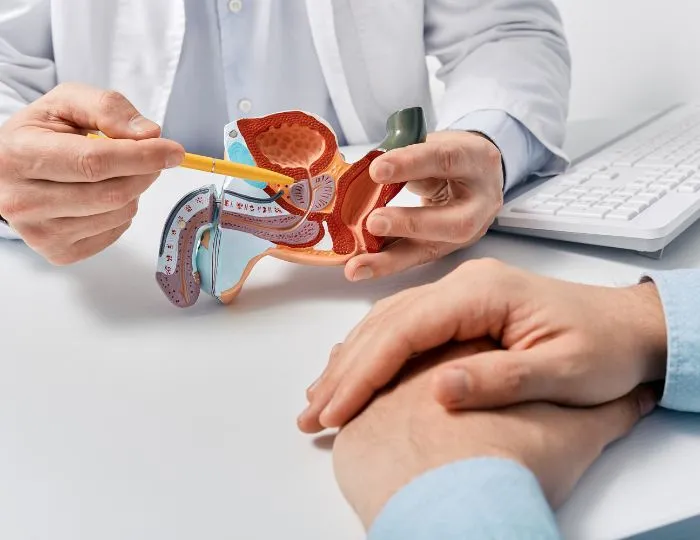
Our Approach
(24×7 Emergency Care)
Our Approach In Managing Prostate Cancer
Screen early. Stage accurately. Treat decisively.
Prostate cancer treatment is not one-size-fits-all. Low-risk disease may be best managed by active surveillance. High-risk or metastatic disease requires aggressive multimodal therapy.
Our multidisciplinary uro-oncology team individualisess every decision based on cancer characteristics, patient age, health status, and personal priorities.
- PSA Screening & Early Detection
PSA screening and diagnosis is the gateway to early, curable prostate cancer detection:
- PSA (Prostate Specific Antigen) blood test - recommended annually for men over 50; from 40 for high-risk men (positive family history, BRCA2 mutation, Afro-Caribbean origin)
- PSA velocity and PSA density - additional metrics to improve specificity of PSA testing
- Digital rectal examination (DRE) - clinical assessment of prostate consistency and symmetry
- MRI prostate (mpMRI) before biopsy - PI-RADS scoring to identify suspicious lesions and guide biopsy
- MRI-Targeted Prostate Biopsy
Multiparametric MRI has transformed prostate cancer diagnosis:
- mpMRI performed before biopsy - identifies the highest-risk lesion for targeted sampling
- MRI-targeted (fusion) biopsy - GPS-like overlay of MRI images onto real-time ultrasound for precise needle placement
- Systematic 12-core biopsy combined with targeted cores - maximises clinically significant cancer detection
- Transperineal approach preferred - lower infection risk than transrectal; performed under local or general anaesthesia
- Cancer Staging & Risk Classification
Once confirmed, accurate staging determines the treatment pathway:
- ISUP grade group (Gleason score) - from grade group 1 (low-risk) to 5 (very high-risk)
- Clinical stage - T1 (incidental), T2 (palpable), T3 (locally advanced), T4 (fixed or invading structures)
- CT abdomen-pelvis and bone scan for intermediate-to-high-risk disease - lymph node and bone metastasis assessment
- PSMA PET-CT - superior sensitivity for nodal and distant staging in high-risk prostate cancer
- Active Surveillance for Low-Risk Disease
Not all prostate cancer needs immediate treatment:
- Active surveillance (AS) is the recommended approach for ISUP grade group 1 (Gleason 3+3) and selected group 2 cancers
- Protocol - PSA every 3–6 months; mpMRI annually; repeat biopsy at 12 months and 3–5 yearly
- AS avoids or defers treatment-related side effects (incontinence, erectile dysfunction) without compromising cancer outcomes
- Escalation to treatment triggered by PSA rise, MRI progression, or grade group upgrade on repeat biopsy
- Radical Prostatectomy - Surgical Treatment
For localised and locally advanced prostate cancer:
- Robotic prostatectomy Mumbai - robot-assisted laparoscopic radical prostatectomy (RARP) is the preferred approach
- Magnified 3D visualisation and wristed instruments enable precise nerve-sparing and urethral anastomosis
- Nerve-sparing technique preserves the neurovascular bundles for erectile function recovery
- Pelvic lymph node dissection performed simultaneously for intermediate-to-high-risk disease
6.Hormone Therapy, Systemic Therapy & Follow-Up
For locally advanced, recurrent, or metastatic disease:
- Androgen deprivation therapy (ADT) - LHRH agonist or antagonist injections every 1–3 months
- Abiraterone, enzalutamide, or apalutamide for castration-resistant prostate cancer (CRPC)
- Docetaxel chemotherapy for metastatic disease - in combination with ADT for high-volume metastatic prostate cancer
- PSMA-targeted radiotherapy (Lu-177 PSMA) for metastatic CRPC - available through our oncology referral network
How To Identify Prostate Cancer?
Early prostate cancer causes no symptoms - which is why screening is essential. Symptoms typically appear in more advanced disease:
Urinary Symptoms (often overlap with BPH):
- Weak or slow urine stream
- Hesitancy, frequency, nocturia, or incomplete emptying
- Blood in urine or semen (haemospermia)
- Burning on urination - less common in prostate cancer than infection
Symptoms of Advanced or Metastatic Disease:
- Bone pain - particularly in the back, pelvis, hips, or thighs (bone is the most common metastatic site)
- Weight loss and fatigue - signs of systemic disease
- Leg swelling - from pelvic lymph node involvement obstructing lymphatic drainage
- Neurological symptoms - leg weakness, incontinence from spinal cord compression (oncological emergency)
Incidentally Detected:
- Raised PSA on routine screening - by far the most common mode of detection for early, curable disease
- Suspicious finding on DRE - firm, nodular, or asymmetric prostate
Regular PSA screening and diagnosis for men over 50 is the single most effective strategy for detecting prostate cancer at a stage when it is definitively curable.
Treatments For Prostate Cancer At Shree Hospitals
Robotic Radical Prostatectomy (RARP)
Robot-assisted removal of the prostate - offers superior visualisation, nerve-sparing capability, and faster recovery than open surgery. The preferred surgical approach for localised prostate cancer.
External Beam Radiotherapy (EBRT / SBRT)
High-dose radiation precisely targeted to the prostate - delivered over 5–7 weeks (EBRT) or 5 sessions (SBRT). Equivalent cancer control to surgery for localised disease with a different side effect profile.
Brachytherapy (Prostate Seed Implant)
Permanent implantation of radioactive seeds into the prostate - day-care procedure for low-risk localised disease. High cancer control rates with excellent urinary and sexual function preservation.
Androgen Deprivation Therapy (ADT)
LHRH agonist or antagonist injections that suppress testosterone to castrate levels - reduces tumour growth in locally advanced, high-risk, and metastatic prostate cancer. Used alone or combined with radiotherapy or chemotherapy.
Urology Doctors in Mumbai
Dr. Nikhil Ailani
Consultant General Surgery
Dr. Priyanka Mehta
Consultant Neurology
Dr. Amey Adate
Consultant Orthopaedics
Dr. Chirag Desai
Consultant Dermatology

For Appointment/Query
1800-268-4000

Tele consultation/2nd Opinion
Schedule Consultation
Important FAQs: Prostate Cancer
At what age should men start PSA screening?
Men at average risk should begin discussing PSA screening and diagnosis with their doctor at age 50. Men at higher risk - those with a first-degree relative (father or brother) with prostate cancer, those of Afro-Caribbean origin, or BRCA2 mutation carriers - should begin at age 40–45. Annual PSA testing with DRE, combined with mpMRI if the PSA is raised, is the most effective early detection strategy currently available.
Is robotic prostatectomy better than open surgery?
Robotic prostatectomy Mumbai offers several advantages over open surgery - smaller incisions, less blood loss, magnified 3D visualisation that improves nerve-sparing precision, and faster recovery. Studies show equivalent long-term cancer control outcomes between robotic and open approaches, but robotic surgery is associated with earlier return of urinary continence and comparable erectile function recovery in experienced hands. It is the preferred approach at Shree Hospitals for eligible patients.
What is active surveillance and is it safe?
Active surveillance is the recommended management strategy for low-risk prostate cancer (Gleason 3+3, ISUP grade group 1) - monitoring the cancer closely rather than treating it immediately. It is not "watchful waiting" or inaction - it is a structured protocol with regular PSA tests, annual MRI, and scheduled biopsies. Studies confirm that active surveillance does not compromise survival for appropriately selected patients, while avoiding the side effects of unnecessary treatment. Our prostate cancer specialist in Mumbai India will determine if you are a suitable candidate.
What are the main side effects of prostate cancer treatment?
Surgery (radical prostatectomy) carries risk of stress urinary incontinence and erectile dysfunction - both of which are manageable and improve over time in most patients. Radiation therapy for prostate cancer can cause bowel and urinary irritation during treatment, and has lower immediate incontinence risk but may cause late-onset urinary or bowel effects. ADT causes hot flushes, reduced libido, fatigue, and bone density loss. Our team provides dedicated post-treatment rehabilitation including pelvic floor physiotherapy and erectile function support.
Can prostate cancer be cured?
Localised prostate cancer - confined within the prostate - is highly curable with either radical prostatectomy or radiotherapy. Five-year survival rates for localised prostate cancer exceed 98%. Locally advanced disease is treated with combination therapy - surgery or radiotherapy plus ADT - with good long-term control. Metastatic prostate cancer is not currently curable but is highly controllable for many years with modern systemic therapies including novel hormonal agents and targeted treatments.
(24×7 Emergency Care)

News & Updates
Shree Hospitals Opens Its Doors to Comprehensive Multispeciality Healthcare in Mumbai
Shree Hospitals Strengthens Emergency and Critical Care Services With 24/7 Support


