 Ghatkopar (East), Mumbai)


Table Of Content
Patient Resources
Billing, Insurances & Estimates
Admission & Discharge
Visitors’ Rules
International Patients
Hospital Facilities
Health Packges

For Appointment/Query
1800-268-4000

Search or
Find Specialist
Robotic vs Laparoscopic Colorectal Surgery: Differences and Suitability
Robotic colorectal surgery is an advanced form of keyhole surgery. The surgeon controls wristed robotic instruments with a magnified 3D view. It usually takes longer and costs more than standard laparoscopy. Safety is broadly similar for colon surgery. For middle and low rectal cancer, a large 2025 trial reported fewer local recurrences with robotics. The right choice depends on where the tumour is, your health, and the surgeon's experience.
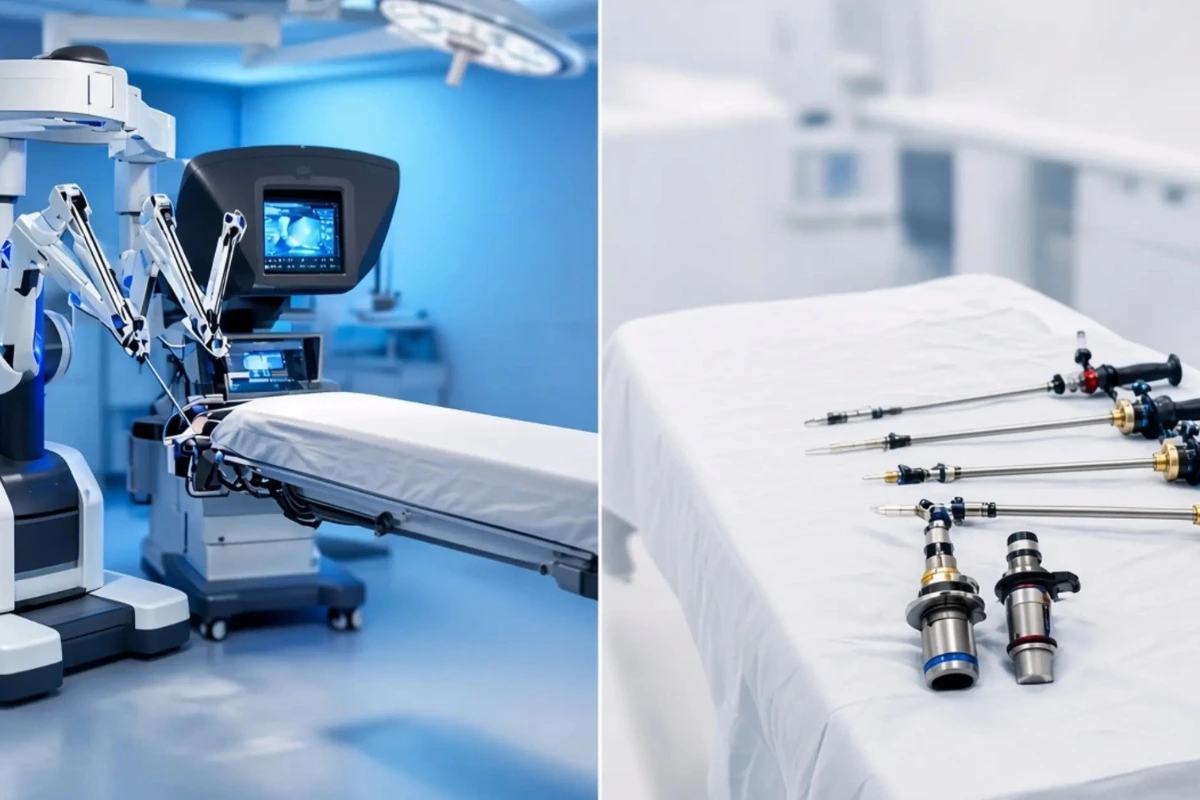
Robotic and laparoscopic surgery are both keyhole ways of operating on the colon and rectum. Both use small cuts, a camera and thin instruments. The main difference is control. In laparoscopy, the surgeon holds the instruments by hand. In robotic surgery, the surgeon moves robotic arms from a console beside the patient.
For most colon operations, the two approaches give broadly similar results. For some low rectal cancers, newer research suggests robotics may help when experienced teams use it. In many cases, the surgeon's skill and experience matter more than the machine.
Key Takeaways
- Both are minimally invasive. Neither is "scarless".
- The robot never operates on its own. A surgeon controls every movement.
- For colon surgery, outcomes are broadly similar. Robotic surgery takes longer and costs more.
- For low rectal cancer, robotics may offer an advantage in experienced, high-volume centres.
- Any keyhole operation may need to switch to open surgery for safety.
- Ask how many of these operations your surgeon performs each year.

Reviewed By
Shree Hospitals Multi-Speciality Care
Treatment:
Breast Cancer Surgery
What Is Colorectal Surgery and When Is It Needed?
Colorectal surgery treats diseases of the large bowel (colon), rectum and anus. Doctors usually recommend it for:
- Colon or rectal cancer
- Large polyps that cannot be removed during colonoscopy
- Diverticulitis that keeps coming back or causes complications such as abscess or fistula
- Crohn's disease or ulcerative colitis not controlled by medicines
- Rectal prolapse
|
Operation |
What is removed |
Common reason |
|---|---|---|
|
Right hemicolectomy |
Right side of the colon |
Cancer of the caecum or ascending colon |
|
Left hemicolectomy |
Left side of the colon |
Cancer of the descending colon |
|
Sigmoid colectomy |
S-shaped lower colon |
Cancer, recurrent diverticulitis |
|
Low anterior resection |
Part or most of the rectum, with the bowel rejoined |
Middle and low rectal cancer |
|
Abdominoperineal resection |
Rectum and anus, with a permanent stoma |
Very low rectal cancer close to the sphincter |
|
Total colectomy |
Whole colon |
Ulcerative colitis, some inherited cancer syndromes |
Robotic and laparoscopic methods can both be used for most of these operations.
What Is Laparoscopic Colorectal Surgery?
Laparoscopic (keyhole) surgery uses 3 to 5 small cuts in the abdomen. The surgeon inserts a camera and long, straight instruments, then operates while watching a screen. The diseased bowel comes out through one slightly larger cut.
Laparoscopy has been the standard minimally invasive approach to bowel surgery for many years. UK guidance from NICE has supported laparoscopic resection as an alternative to open surgery for bowel cancer when both are suitable (NIHR summary).
Laparoscopic (keyhole) surgery uses 3 to 5 small cuts. The surgeon inserts a camera and straight, long instruments, and watches a screen while operating by hand. The bowel section is removed through one slightly larger cut.
It has been the standard minimally invasive approach for bowel cancer for many years. The UK's NICE guidance recommended laparoscopic resection as an alternative to open surgery for bowel cancer when both are suitable.
What Is Robotic Colorectal Surgery?
Robotic colorectal surgery is also keyhole surgery. The scars are about the same size as with laparoscopy. The difference is in how the instruments move.
- The instruments bend like a human wrist.
- The surgeon sees a steady, magnified 3D image.
- The system filters out small hand tremors.
These features help most in tight spaces. The rectum sits deep in the narrow bony pelvis, so this is where robotic surgery is most often used.
Does the robot do the surgery by itself?
No. The surgeon sits at a console in the same operating room and controls every movement. A second surgeon and the theatre team stay at the patient's side throughout.
Robotic vs Laparoscopic: Side-by-Side Comparison
| Factor | Laparoscopic | Robotic |
|---|---|---|
| Who controls instruments | Surgeon, by hand | Surgeon, through a console |
| Instrument movement | Straight, limited angles | Wristed, wider range |
| View | Usually 2D | Magnified 3D, stable |
| Scar size | Small cuts | Similar small cuts |
| Operating time | Usually shorter | Usually longer (setup and docking) |
| Sense of touch | Some feedback through the instruments | Little or none on most systems |
| Cost | Lower | Higher |
| Strongest evidence for | Most colon surgery | Middle and low rectal surgery |
| Availability | Widely available | Limited to equipped centres |
Is Robotic Surgery Better Than Laparoscopic? What the Research Shows
The honest answer is "it depends on the part of the bowel".
For colon cancer and colectomy
A 2015 systematic review in PLOS ONE pooled 12 studies covering 4,148 patients. It found that robotic colectomy:
- Took longer and cost more
- Was linked to slightly quicker return of bowel function and a slightly shorter hospital stay
- Showed no difference in anastomotic leak, conversion to open surgery, or lymph nodes removed
Most of those studies were observational, not randomised, so the small benefits are uncertain. Later reviews of right and transverse colectomy report a similar pattern: longer operations and broadly comparable results.
For rectal cancer: the ROLARR trial (JAMA, 2017)
This international trial randomised 471 patients treated by 40 surgeons at 29 sites in 10 countries.
- Conversion to open surgery was 8.1% with robotic surgery and 12.2% with laparoscopy. The difference was not statistically significant.
- Complications, 30-day deaths, bladder function and sexual function showed no significant difference.
- A further analysis hinted at benefit when surgeons had more robotic experience.
For rectal cancer: the REAL trial (JAMA, 2025)
This trial enrolled 1,240 patients with middle and low rectal cancer at 11 high-volume centres in China.
- Cancer returning in the pelvis within 3 years occurred in 1.6% after robotic surgery and 4.0% after laparoscopy.
- Overall survival at 3 years did not differ significantly between the groups.
- The disease-free survival advantage appeared in low rectal cancer, not in middle rectal cancer.
Experts still debate REAL. Critics noted far fewer recurrence events than the trial was designed to detect. US editorial writers also questioned how far the results apply outside high-volume centres.
What this means for you
- Colon surgery: a skilled laparoscopic surgeon usually gives comparable results at lower cost.
- Low rectal cancer: robotics may offer an advantage, especially with an experienced team.
- Either way: neither approach has been shown to improve overall survival.
Which Approach for Which Operation?
|
Operation or condition |
What evidence and practice suggest |
|---|---|
|
Right hemicolectomy |
Both work well. Robotic takes longer. No clear outcome advantage. |
|
Sigmoid colectomy for diverticulitis |
Both are used. Evidence is mostly observational and shows similar results. Robotics may help with inflamed or scarred tissue. |
|
Low anterior resection |
Robotics may help in a narrow pelvis and with nerve-sparing dissection. |
|
Abdominoperineal resection |
Either, depending on surgeon expertise. |
|
Emergency surgery (blockage, perforation) |
Usually open or laparoscopic. Robots are rarely used in emergencies. |
Who Is Suitable for Each Approach?
Can obese patients have robotic colorectal surgery?
Often, yes. Extra body weight makes working deep in the pelvis harder. The wristed instruments and steady camera can help. Your anaesthetist will still check whether your heart and lungs can cope with a long keyhole operation.
Can I have robotic surgery after chemoradiation for rectal cancer?
Yes. Many rectal cancer patients receive chemotherapy and radiotherapy before surgery. Both the ROLARR and REAL trials included such patients. Radiation can make tissues stiffer, so the surgeon's experience matters even more.
Who is not a candidate for robotic surgery?
Robotic surgery may not suit you if you have:
- A large tumour growing into nearby organs, which may need open or extended surgery
- Dense scar tissue from previous abdominal operations
- Severe heart or lung disease that rules out a long operation with gas in the abdomen and a head-down position
- An emergency needing surgery within hours
You can also choose not to have robotic surgery. NHS hospital guidance makes clear that patients can decline it and be offered standard keyhole or open surgery instead (UCLH).
Disadvantages of Robotic Colorectal Surgery
- Longer time under anaesthesia, partly because the robot has to be set up and docked
- Higher hospital cost
- Little or no sense of touch for the surgeon on most systems
- A learning curve for the surgical team
- Limited availability outside large centres
None of these makes robotic surgery unsafe. They are trade-offs to weigh against its possible benefits.
Which Is Safer? Risks of Both Approaches
Overall complication rates are broadly similar. NHS patient information describes the risks of robotic colorectal surgery as similar to those of keyhole surgery.
Risks of either approach include:
- Anastomotic leak (the bowel join leaks)
- Bleeding or wound infection
- Blood clots in the legs or lungs
- Slow return of bowel function (ileus)
- Injury to nearby organs, such as the bladder or ureter
- Changes in bladder or sexual function after rectal surgery
What does "conversion to open surgery" mean?
Sometimes the surgeon has to switch from keyhole to open surgery during the operation. This can happen because of bleeding, scar tissue or a difficult tumour position. It is a safety decision, not a failure.
Will I Need a Stoma?
A stoma is an opening on the abdomen where stool leaves the body into a bag. Whether you need one depends on where the tumour is and how safe the bowel join is. It does not depend on which surgical approach is used.
- Temporary stoma (often an ileostomy): commonly made after low rectal surgery to protect the healing join. It is usually reversed after a few months.
- Permanent stoma: needed when the tumour is too close to the anal sphincter to save it.
What is LARS?
Low anterior resection syndrome (LARS) means bowel changes after rectal surgery. Symptoms include urgency, frequent small stools, clustering and occasional leakage. It often improves over months. Diet changes, medicines and pelvic floor therapy can help. Ask your surgeon about your personal risk.
How the Treatment Pathway Works
- Diagnosis. Colonoscopy and biopsy confirm the problem.
- Staging. A CT scan checks for spread. MRI of the pelvis is used for rectal cancer. Blood tests include CEA, a tumour marker.
- Tumour board. A team of specialists decides whether you need chemotherapy or radiotherapy before surgery.
- Pre-surgery assessment. Fitness tests, plus stoma counselling if a stoma is possible.
- Preparation. Some operations need bowel preparation. Enhanced recovery (ERAS) programmes guide what you eat and drink before surgery.
- Surgery. The diseased segment and nearby lymph nodes are removed. The bowel is rejoined, or a stoma is made.
- Recovery. Early walking, early eating and pain control.
- Follow-up. The pathology report decides further treatment. Regular scans and colonoscopy follow.
Recovery After Robotic or Laparoscopic Colectomy
Recovery is broadly similar for both keyhole approaches, and usually faster than after open surgery. Your own timeline depends on the operation, your health and any complications.
|
Stage |
What usually happens |
|---|---|
|
Day of surgery |
Sips of fluid, sitting out of bed |
|
First 1 to 3 days |
Walking, light diet, catheter and drains removed |
|
Before discharge |
Eating, passing gas or stool, pain controlled with tablets |
|
Weeks 1 to 2 |
Short walks, rest, wound care |
|
Weeks 4 to 6 |
Gradual return to light work; avoid heavy lifting |
|
Following months |
Bowel habit settles; chemotherapy if advised |
Is gas pain after laparoscopic bowel surgery normal?
Yes. The gas used to inflate the abdomen can cause bloating and shoulder-tip pain. It usually settles within a few days. Walking helps. Pain that gets worse instead of better needs a doctor's review.
Robotic Colorectal Surgery Cost in Mumbai and Insurance
Robotic surgery generally costs more than laparoscopy. The extra cost comes from single-use robotic instruments, longer theatre time and equipment charges. Your final bill depends on:
- The type of operation, and whether a stoma is made
- Room category and length of stay
- Tests, chemotherapy or radiotherapy
- Complications or ICU care
Does insurance cover robotic surgery in India?
Many health policies now cover robotic surgery. Some apply sub-limits that cap how much they pay for it. Before admission:
- Ask your insurer in writing whether robotic surgery is covered and up to what limit.
- Ask the hospital for an itemised estimate for both robotic and laparoscopic surgery.
- Check pre-authorisation requirements with the hospital's TPA desk.
Is robotic surgery worth the extra cost?
For most colon operations, the evidence does not show a clear outcome advantage that justifies a large extra cost. For low rectal cancer in experienced hands, the case is stronger. Discuss your case with your surgeon instead of deciding on price or technology alone.
How to Check Your Surgeon's Experience
Experience matters with either approach. Ask:
- How many robotic or laparoscopic colorectal operations do you perform each year?
- Why do you recommend this approach for me in particular?
- Is my tumour in the colon or the rectum, and how low is it?
- What is my chance of needing a stoma, and will it be temporary?
- What happens if the operation needs to switch to open surgery?
- Who will look after me if a complication happens after discharge?
When to See a Doctor
See a doctor if you notice:
- Blood in your stool
- A change in bowel habit lasting more than a few weeks
- Unexplained weight loss
- Tiredness or breathlessness from anaemia
- Ongoing abdominal pain or bloating
After surgery, seek urgent care if you have:
- Fever or chills
- Abdominal pain or swelling that is getting worse
- Repeated vomiting
- Heavy bleeding from the wound or rectum
- Calf pain, leg swelling, chest pain or breathlessness
- Redness, pus or a foul smell from a wound
- No gas or stool, with increasing bloating
- A stoma that turns dark or stops working
Frequently Asked Question
Is robotic surgery better than laparoscopic surgery for colon cancer?
Not clearly. Studies show broadly similar safety and cancer outcomes for colon surgery. Robotic surgery usually takes longer and costs more.
Is robotic surgery better for rectal cancer?
Possibly, for low rectal cancer. The 2025 REAL trial found fewer local recurrences with robotics. The earlier ROLARR trial found no significant difference.
Which is safer, robotic or laparoscopic bowel surgery?
Complication rates are broadly similar. The experience of the surgeon and hospital affects safety more than the platform does.
How long is the hospital stay after robotic colorectal surgery?
Usually a few days with an enhanced recovery programme. Stays are similar to laparoscopy and longer if complications occur.
How long does recovery take?
Most people return to light activity within 4 to 6 weeks. Full recovery can take longer, especially if chemotherapy follows.
Is robotic surgery less painful?
Both keyhole approaches cause less pain than open surgery. Differences between robotic and laparoscopic surgery are small.
Can robotic surgery be used for diverticulitis?
Yes, for planned sigmoid colectomy. Evidence so far is mostly observational and shows outcomes similar to laparoscopy.
Will robotic surgery avoid a stoma?
Not by itself. The need for a stoma depends on tumour position and how safe the bowel join is.
Does robotic surgery protect sexual and bladder function?
It may help nerve-sparing surgery in the pelvis, but trial results are mixed. ROLARR found no significant difference.
Does robotic surgery improve survival?
Current trials have not shown a significant difference in overall survival.