 Ghatkopar (East), Mumbai)


Table Of Content
Patient Resources
Billing, Insurances & Estimates
Admission & Discharge
Visitors’ Rules
International Patients
Hospital Facilities
Health Packges

For Appointment/Query
1800-268-4000

Search or
Find Specialist
Thyroid and Parotid Tumours: Symptoms, Tests, Treatment and Recovery
Quick Answer
Thyroid and parotid tumours are growths in the thyroid gland (front of the neck) or the parotid gland (in front of the ear). Most are benign. Doctors diagnose them with an ultrasound and a needle test called FNAC.
- Thyroid nodules: many can simply be monitored. Surgery is advised for cancer, suspicious results, or large nodules causing symptoms.
- Parotid tumours: usually removed surgically, even when benign, while the surgeon protects the facial nerve.
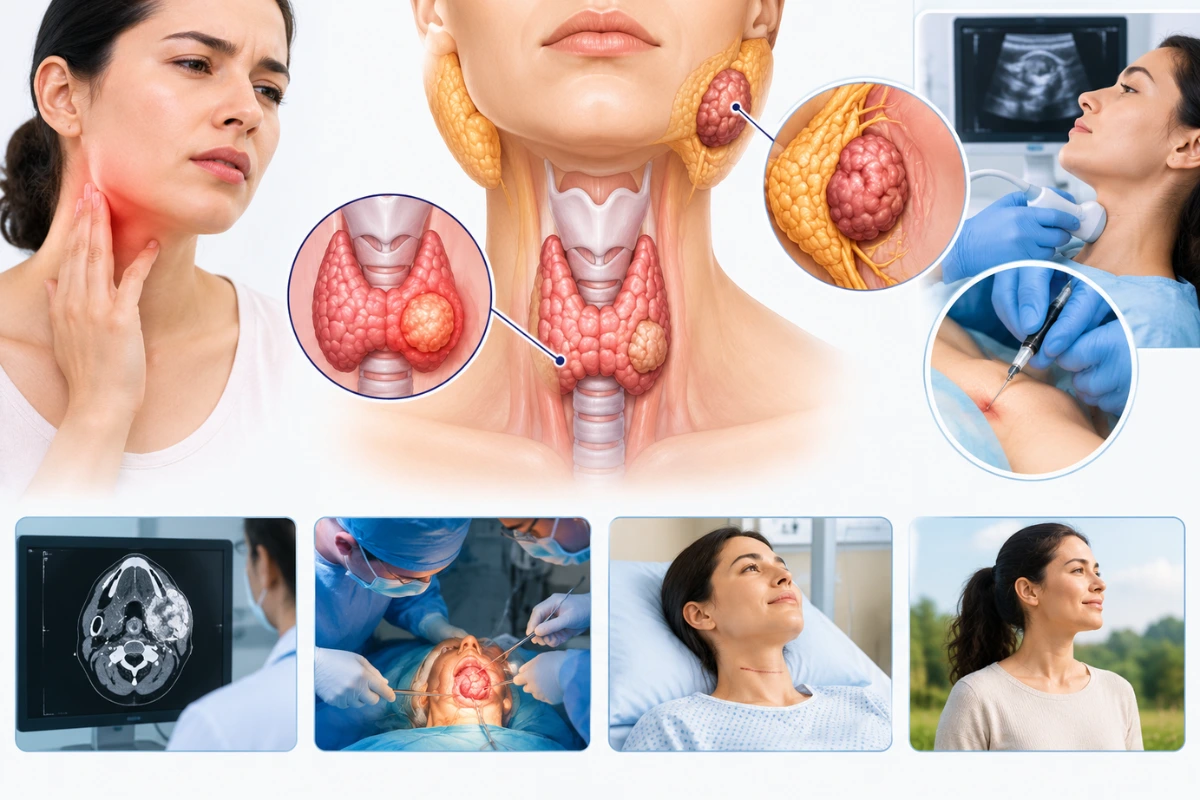
Thyroid and parotid tumours are lumps that grow in two different glands in the head and neck. The thyroid sits at the front of the lower neck. The parotid sits in front of and just below each ear.
The good news is that most lumps in both glands are not cancer. Ultrasound finds thyroid nodules in up to two-thirds of adults, and only a small share are cancerous. About three in four parotid tumours are benign (non-cancerous).
Even so, any new or growing lump needs a proper check. Early diagnosis keeps treatment simpler and helps protect important structures, such as your voice and facial movement.

Reviewed By
Shree Hospitals Multi-Speciality Care
Treatment:
Head & Neck Cancer Surgery
Key Takeaways
- Most thyroid nodules and most parotid lumps are not cancer.
- A new, growing or hard neck or face lump needs an examination.
- Ultrasound and FNAC (fine needle aspiration cytology) are the main first tests.
- Many benign thyroid nodules need monitoring only, not surgery.
- Benign parotid tumours are often removed because some keep growing, and a few can change over time.
- Voice changes, difficulty breathing or swallowing, and facial weakness are warning signs.
What Are Thyroid and Parotid Tumours?
What is a thyroid nodule?
A thyroid nodule is a lump inside the thyroid gland. It can be solid, fluid-filled (a cyst), or mixed. Some people have one nodule. Others have many, which is called a multinodular goitre.
Thyroid nodules are very common. Teaching material based on the 2015 American Thyroid Association guidelines reports that:
- Ultrasound finds incidental nodules in 19 to 68% of adults.
- Between 1.6% and 15% of nodules show cancer.
The wide ranges reflect differences between the groups studied, not one person's risk.
What is a parotid tumour?
The parotid is the largest salivary gland. A parotid tumour is a lump that grows inside it. The facial nerve, which controls facial movement, runs right through this gland. That is why parotid tumours need careful assessment and planning.
Cancer Research UK reports that about 75% of parotid tumours are benign.
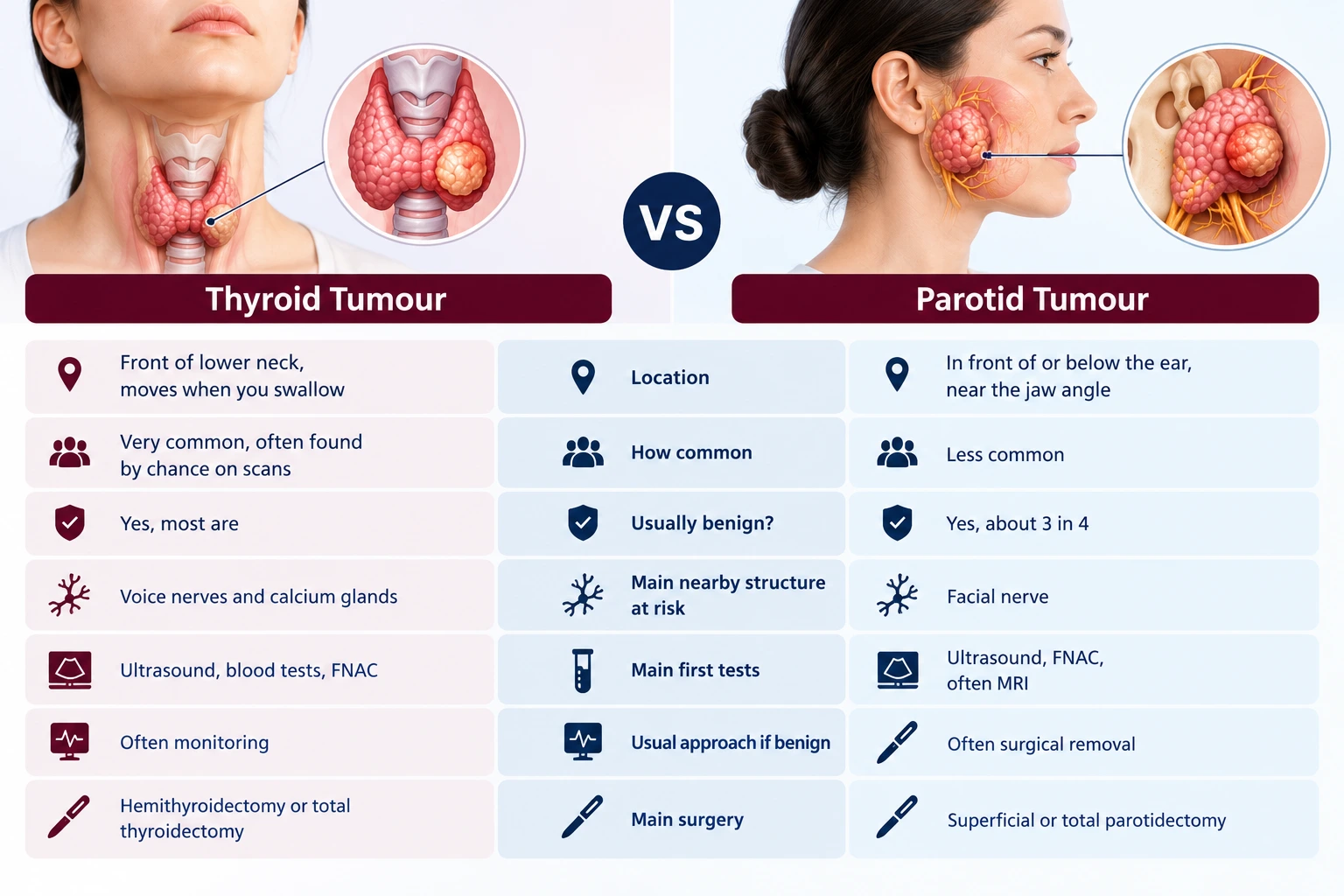
Thyroid vs Parotid Tumours: Key Differences
| Feature | Thyroid tumour | Parotid tumour |
| Location | Front of lower neck, moves when you swallow | In front of or below the ear, near the jaw angle |
| How common | Very common, often found by chance on scans | Less common |
| Usually benign? | Yes, most are | Yes, about 3 in 4 |
| Main nearby structure at risk | Voice nerves and calcium glands | Facial nerve |
| Main first tests | Ultrasound, blood tests, FNAC | Ultrasound, FNAC, often MRI |
| Usual approach if benign | Often monitoring | Often surgical removal |
| Main surgery | Hemithyroidectomy or total thyroidectomy | Superficial or total parotidectomy |
What Are the Types of Thyroid and Parotid Tumours?
Benign thyroid nodules
- Colloid nodule
- Thyroid cyst
- Follicular adenoma
- Multinodular goitre
- Papillary: the most common type
- Follicular
- Medullary
- Anaplastic: rare and more aggressive
Benign parotid tumours
- Pleomorphic adenoma: the most common type. It grows slowly but can recur if not fully removed.
- Warthin tumour: more common in smokers, and sometimes found on both sides.
Parotid cancers (Cancer Research UK)
- Mucoepidermoid carcinoma: the most common salivary gland cancer
- Acinic cell carcinoma
- Adenoid cystic carcinoma
- Carcinoma ex-pleomorphic adenoma: a cancer that develops in a long-standing benign pleomorphic adenoma in a small number of people
What Are the Symptoms?
Thyroid tumour symptoms
Most thyroid nodules cause no symptoms and are found by chance. When symptoms occur, NHS guidance lists:
- A painless lump in the front of the neck that slowly grows
- A hoarse voice or sore throat that does not go away
- Difficulty swallowing or breathing
- Pain or pressure in the front of the neck
Some nodules make too much thyroid hormone. This can cause weight loss, a fast heartbeat, sweating or anxiety.
Parotid tumour symptoms
- A painless lump in front of the ear, below the ear, or near the jaw angle
- Slow growth over months or years
- Rarely, numbness of the face or ear
Signs that need faster review:
- Weakness or drooping on one side of the face
- Rapid growth
- Pain
- A lump fixed to the skin
- Lumps in the neck
What Causes Thyroid and Parotid Tumours?
The exact cause is often unknown. Known risk factors include:
| Risk factor | Thyroid | Parotid |
| Radiation to the head or neck, especially in childhood | Yes | Yes |
| Family history | Yes, for some thyroid cancers | Rarely |
| Iodine deficiency | Linked to goitre and nodules | No |
| Smoking | No clear link | Linked to Warthin tumour |
| Being female | Nodules are more common in women | Varies by type |
| Age | Nodules increase with age | Most occur in adults |
Is It a Tumour or Something Else?
Not every lump in the neck or near the ear is a tumour. Common look-alikes include:
- Swollen lymph nodes from a throat, ear or tooth infection
- A dental abscess causing swelling near the jaw
- Salivary gland infection or stones, often painful when eating
- Mumps, with swelling on both sides and fever
- Fatty lumps (lipomas) or skin cysts
- An overactive or underactive thyroid causing a general swelling (goitre)
- A doctor can usually tell these apart with an examination and an ultrasound.
How Are Thyroid and Parotid Tumours Diagnosed?
Step-by-step diagnosis
- History and examination. The doctor feels the lump and checks your neck, face and facial movement.
- Blood tests. Thyroid function tests (TSH) check whether the gland is overactive or underactive. These are needed for thyroid lumps only.
- Ultrasound. This shows the size, shape and features of the lump. For thyroid nodules, many centres use a scoring system called TIRADS.
- FNAC. A thin needle takes cells from the lump, usually guided by ultrasound. Most people feel only brief discomfort.
- Cytology report. Thyroid results are often reported using the Bethesda system, from Category 1 to 6.
- Further imaging. MRI or CT may be needed for parotid tumours, large goitres, or suspected cancer.
- Voice box check. A camera check of the vocal cords may be done before thyroid surgery.
What do TIRADS and Bethesda results mean?
| Report | What it tells you |
| TIRADS 1 to 2 | Ultrasound features suggest a benign nodule |
| TIRADS 3 to 5 | Rising level of suspicion; FNAC is guided by size and score |
| Bethesda 2 | Benign cells |
| Bethesda 3 or 4 | Indeterminate result; may need a repeat FNAC, molecular testing or surgery |
| Bethesda 5 or 6 | Suspicious for, or confirms, cancer |
Your doctor reads these results together with your symptoms and history. One number alone does not decide treatment.
How Are Thyroid Tumours Treated?
Treatment depends on the FNAC result, the size of the nodule, symptoms and your preferences.
| Situation | Common approach |
| Small benign nodule, no symptoms | Monitoring with periodic ultrasound |
| Benign nodule causing pressure or cosmetic concern | Surgery, or non-surgical options like radiofrequency ablation in selected cases |
| Indeterminate FNAC | Repeat test, molecular testing, or diagnostic hemithyroidectomy |
| Thyroid cancer | Surgery, sometimes followed by radioactive iodine |
| Very small low-risk papillary cancer | Some specialists offer active surveillance |
| Overactive "hot" nodule | Medicines, radioactive iodine or surgery |
Hemithyroidectomy vs total thyroidectomy
|
Feature |
Hemithyroidectomy |
Total thyroidectomy |
|
What is removed |
One half (lobe) of the thyroid |
The whole thyroid |
|
Used for |
One-sided benign nodule, indeterminate FNAC, some small cancers |
Larger cancers, nodules on both sides, large goitre |
|
Lifelong thyroid tablets |
Not always; some people need them |
Yes, always |
|
Risk to calcium glands |
Low |
Higher, because both sides are operated on |
Is thyroid cancer curable?
The National Cancer Institute states that thyroid cancer found at an early stage can often be treated successfully. Papillary cancer, the most common type, usually responds well to treatment. Your specialist can explain the outlook for your own type and stage.
How Are Parotid Tumours Treated?
Most parotid tumours are removed surgically, even when benign. Reasons include:
- Benign tumours usually keep growing slowly.
- A larger tumour is harder to remove safely.
- A small number of pleomorphic adenomas can turn cancerous over many years.
| Procedure | What it involves |
| Superficial parotidectomy | Removes the outer part of the gland, above the facial nerve |
| Total parotidectomy | Removes the whole gland while protecting the nerve where possible |
| Neck dissection | Removes neck lymph nodes in some cancers |
| Radiation therapy | After surgery for some cancers |
| Systemic treatment | Chemotherapy or targeted therapy for selected advanced cancers |
Some Warthin tumours in older or less fit patients may be watched instead of removed, after a specialist assessment.
What Are the Risks of Thyroid and Parotid Surgery?
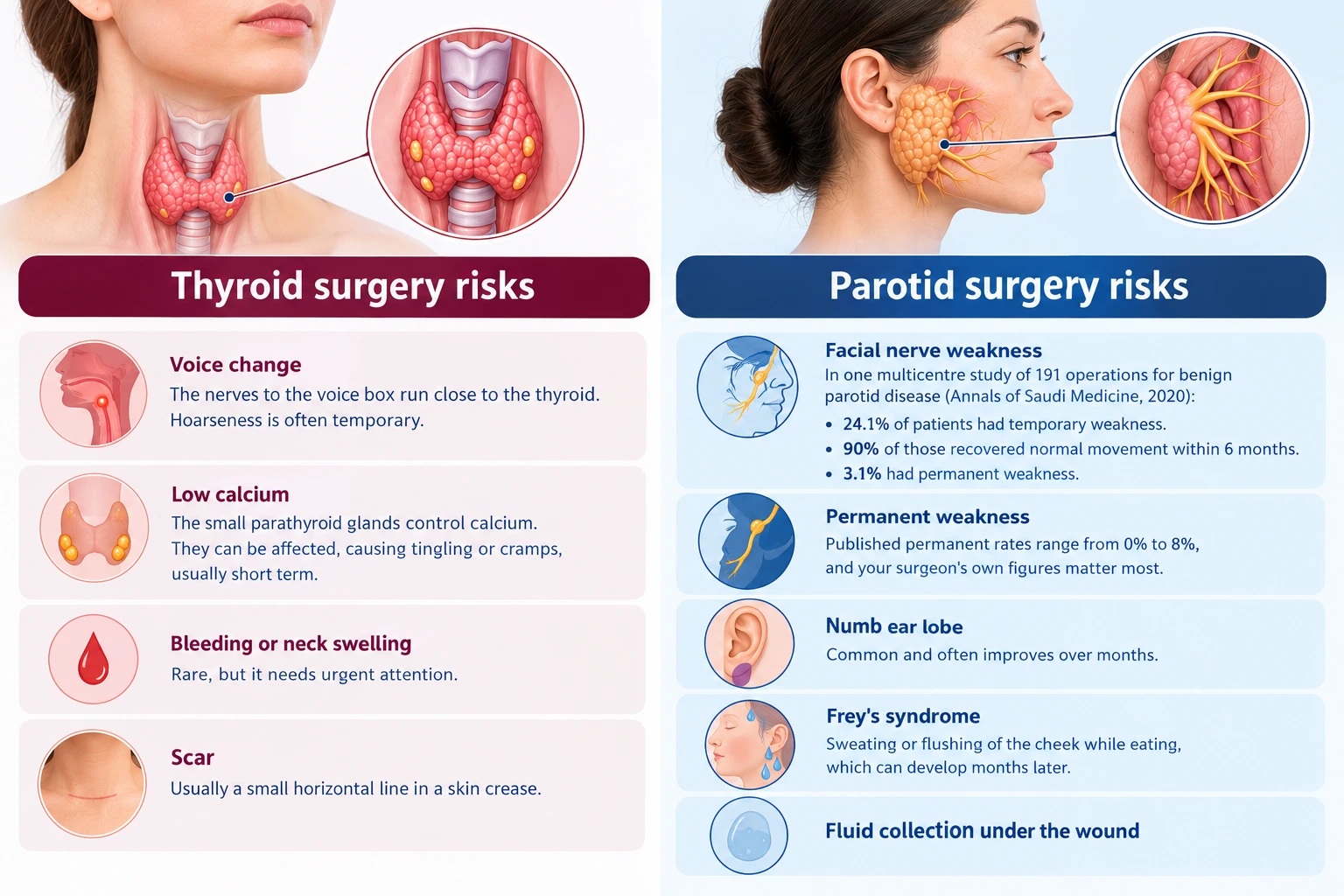
Thyroid surgery risks
- Voice change. The nerves to the voice box run close to the thyroid. Hoarseness is often temporary.
- Low calcium. The small parathyroid glands control calcium. They can be affected, causing tingling or cramps, usually short term.
- Bleeding or neck swelling. Rare, but it needs urgent attention.
- Scar. Usually a small horizontal line in a skin crease.
Parotid surgery risks
- Facial nerve weakness. In one multicentre study of 191 operations for benign parotid disease (Annals of Saudi Medicine, 2020):
- 24.1% of patients had temporary weakness.
- 90% of those recovered normal movement within 6 months.
- 3.1% had permanent weakness.
- Published permanent rates range from 0% to 8%, and your surgeon's own figures matter most.
- Numb ear lobe. Common and often improves over months.
- Frey's syndrome. Sweating or flushing of the cheek while eating, which can develop months later.
- Fluid collection under the wound.
Many surgeons use facial nerve monitoring during parotid surgery to help locate and protect the nerve.
What Is Recovery Like?
|
Stage |
Thyroid surgery |
Parotid surgery |
|
Hospital stay |
Often 1 to 2 days |
Often 1 to 2 days, sometimes with a drain |
|
First week |
Mild throat discomfort, soft diet if needed |
Facial swelling, wound care |
|
2 weeks |
Most return to desk work |
Most return to light activity |
|
Weeks to months |
Voice and calcium settle; thyroid tablets adjusted |
Facial movement and ear numbness gradually improve |
|
Long term |
Regular blood tests if on thyroxine |
Follow-up for recurrence |
These are general patterns. Your surgeon will give you a personal plan.
When Should You See a Doctor?
Book a check-up if you notice:
- A new lump in your neck or in front of or below your ear
- A lump that is growing
- A hoarse voice lasting more than 3 weeks
- Pain or pressure in the front of the neck
Seek urgent care if you have:
- Difficulty breathing or noisy breathing
- Difficulty swallowing
- Sudden facial weakness or drooping
- Rapid swelling of the neck after surgery
Get Your Lump Checked in Mumbai
A neck or face lump can feel worrying, but most turn out to be benign. A clear diagnosis is the best next step. At Shree Hospitals, Ghatkopar, our ENT and head and neck team can examine your lump, arrange an ultrasound and FNAC, and explain every option before any decision is made. Book a consultation
Frequently Asked Question
Are most thyroid nodules cancerous?
No. Most are benign. Only a small share show cancer on testing.
Is a lump in front of the ear always a parotid tumour?
No. It can be a swollen lymph node, cyst or infection. An ultrasound helps tell them apart.
Can a thyroid nodule go away on its own?
Fluid-filled cysts can shrink. Solid nodules usually stay or grow slowly, so they are monitored.
Is FNAC painful?
Most people feel brief discomfort similar to a blood test. It takes a few minutes.
What does Bethesda 3 mean?
It means the result is unclear. Your doctor may repeat the FNAC, order molecular testing, or advise surgery.
Will I need thyroid tablets after surgery?
Always after total thyroidectomy. Some people need them after half thyroidectomy too.
Can I live normally without a thyroid?
Yes. Daily thyroid hormone tablets replace what the gland made, with regular blood tests.
Why remove a benign parotid tumour?
Most keep growing, larger tumours are harder to remove safely, and a few can change over time.
Will parotid surgery affect my face?
Temporary weakness can happen and usually recovers. Permanent weakness is uncommon in experienced hands.
Which doctor treats thyroid and parotid tumours?
An ENT or head and neck surgeon. Endocrinologists help manage thyroid hormone levels.
How long does recovery from thyroid surgery take?
Most people return to desk work in about 2 weeks. Voice and energy can take longer to settle.
Can a pleomorphic adenoma come back?
Yes, especially if not fully removed, which is why complete surgical removal matters.